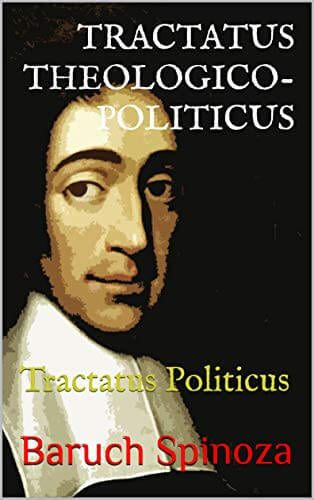
Tractatus Theologico-Politicus
Series: John Taylor Gatto Recommends
Genre: Education
ASIN: B00CF0K6GG
ISBN: 9798713523442
Tractatus Theologico-Politicus by Benedict de Spinoza investigates the interplay of religious authority, political freedom, and the critical study of the Hebrew Scriptures, establishing a comprehensive model for intellectual liberty in society.
Foundations of Religious Critique
Benedict de Spinoza asserts that superstition arises wherever uncertainty and fear dominate human experience. As people confront adversity and lack inner counsel, they oscillate between hope and dread, which cultivates a susceptibility to magical thinking. Leaders who understand the structure of superstition exploit it, shaping collective beliefs and behaviors to serve political ends. Spinoza locates the origins of superstition in psychological volatility, linking human credulity to external pressures and internal anxieties. Through this analysis, he frames religious authority as historically contingent and responsive to the needs and vulnerabilities of populations in flux.
Authority and the State
Spinoza identifies the civil state as the only structure capable of ensuring public peace amid diverse religious beliefs. The foundations of a stable commonwealth rest on the capacity of sovereign power to adjudicate what counts as just, pious, and lawful. When rulers legislate speculative matters or criminalize opinions, they open the door to sectarian conflict and sedition. The maintenance of state security requires a legal architecture focused on actions, not inner convictions. This doctrine of civil authority clarifies the boundaries between the temporal power of the state and the inward sphere of conscience. The convergence of law, order, and liberty occurs when citizens retain the right to think and speak freely within the limits set by public safety and justice.
Revelation and the Nature of Prophecy
Spinoza defines prophecy as certain knowledge communicated by God to humans, whose role as prophets depends on their capacity to interpret revelations for those without direct access to certainty. He distinguishes prophetic knowledge from natural knowledge, stating that the latter flows from the human capacity to perceive the eternal order of nature—a capacity accessible through reason. Prophets transmit divine truths in forms attuned to the understanding of ordinary people, using language and imagery that foster obedience and devotion. The status of a prophet derives from the function of mediating divine will, rather than from possession of extraordinary metaphysical insight.
Scripture: History, Purpose, and Interpretation
Spinoza treats the Hebrew Scriptures as the product of historical processes and collective memory. He analyzes the authorship and compilation of the Pentateuch and other books, highlighting the role of figures such as Ezra as editors and compilers rather than sole authors. Scriptural authority, in his framework, does not derive from a single unbroken line of transmission but from a social process of canonization and interpretation. The true purpose of Scripture lies in its ethical teaching, directing people toward justice, charity, and obedience to God, rather than in revealing speculative truths about the cosmos. For Spinoza, the sacred character of the text depends on its capacity to inspire virtue and social harmony.
Faith and Reason
In Spinoza’s model, faith commands obedience, and its essence is simple: love God and neighbor, uphold justice, and live according to ethical precepts. He insists on a sharp boundary between faith and philosophy. Theology articulates a set of moral imperatives, seeking to move the will; philosophy seeks knowledge through rational inquiry, explaining the natural world by its first causes. This division of labor between faith and reason structures Spinoza’s entire approach to religious controversy. He claims that faith, when defined by obedience to God’s commandments, does not conflict with philosophical reason. Both serve essential roles—faith grounds communal morality, while reason expands understanding.
Miracles and Natural Law
Spinoza approaches miracles through a rigorous commitment to natural law. He contends that the events recorded as miracles in Scripture do not constitute violations of the order of nature. Instead, they reflect either natural phenomena misunderstood by observers or extraordinary but lawful occurrences. Miracles function rhetorically in the narrative to underscore God’s power and inspire reverence, but Spinoza holds that understanding nature’s fixed order yields greater knowledge of divine providence. The divine will operates through immutable laws, and piety consists in recognizing this structure and aligning human life with it.
Origins and Evolution of Religious Law
The Mosaic law emerged as a code tailored to the particular needs and circumstances of ancient Israel. Spinoza argues that God’s election of the Jews as a chosen people rests on providential allocation of territory and social cohesion, rather than on inherent spiritual superiority. The ceremonial and judicial laws served to maintain national unity and identity, not to establish metaphysical truths binding across societies and eras. As the historical context changes, the binding force of these laws shifts, making them contingent rather than universal. The ethical teachings of the prophets, however, retain enduring relevance as expressions of the true essence of religion.
Rights and the Social Contract
Natural rights, in Spinoza’s philosophy, flow directly from the capacities and desires of individuals. The social contract arises when individuals transfer part of their power to a sovereign authority for the sake of mutual security. Even in the most comprehensive political arrangement, people retain certain inalienable rights rooted in their capacity for thought and judgment. The state possesses legitimate authority over actions but cannot compel belief. The best-ordered republic ensures maximum freedom of thought and expression consistent with public order, recognizing that attempts to police opinion generate instability and resistance.
Universal Religion and Ethical Life
The core of religion, as Spinoza defines it, centers on love, justice, and intellectual clarity. He identifies the universal elements of religion as love of God, expressed through understanding and obedience to divine laws, and love of neighbor, realized in acts of charity and justice. The particulars of ritual, ceremony, and historical narrative serve as vehicles for the transmission of these principles. True piety manifests not in slavish adherence to custom but in the exercise of reason, humility, and goodwill toward others. By focusing on these universal values, Spinoza constructs a model of religion accessible to reason and compatible with diverse cultural forms.
Freedom of Thought and Speech
Spinoza champions the liberty of philosophizing as the lifeblood of a healthy society. He states that no authority can rightfully constrain inquiry or suppress dissenting opinions without endangering the foundations of the state. The convergence of liberty and security requires a political culture that distinguishes between speech and action. Where rulers seek to punish individuals for ideas rather than conduct, they foster resentment, hypocrisy, and unrest. Spinoza frames the free state as one where citizens speak and think openly, contributing to collective progress and the refinement of laws and customs. He presents this principle as essential for piety, science, and social peace.
Influence and Legacy
Spinoza’s Tractatus Theologico-Politicus established critical precedents for Enlightenment thought, biblical criticism, and the philosophy of toleration. His arguments for the separation of theology and philosophy laid the groundwork for subsequent models of secular governance and religious pluralism. He anticipated later developments in the sociology of religion, the study of myth and ritual, and the critique of clerical authority. The analytical rigor and clarity of his prose attracted thinkers such as Lessing, Goethe, and Schleiermacher, who regarded Spinoza as a touchstone for rational inquiry and moral seriousness. The structure of Spinoza’s arguments continues to inform debates about church-state relations, religious freedom, and the foundations of ethical community.
Structural Convergence: Religion, Reason, and the State
By tracing the historical emergence and development of religious institutions, Spinoza links the evolution of belief systems to the broader currents of human civilization. He observes that as societies progress, they demand clearer distinctions between the spheres of faith, governance, and science. The state achieves stability and legitimacy when it guarantees the right to inquiry, encourages debate, and focuses its coercive power on public welfare rather than the enforcement of dogma. Religion achieves its highest form when it motivates people to justice, charity, and the pursuit of knowledge. Spinoza’s synthesis of critical method, ethical teaching, and political philosophy models a framework for pluralism, toleration, and the advancement of the common good.
Prophetic Vision and the Ethical Future
Spinoza envisions a future in which religious and philosophical inquiry support, rather than undermine, the flourishing of society. Where people investigate sacred texts with care, apply reason to the mysteries of existence, and act with justice toward one another, society develops resilience against fanaticism and tyranny. The civil state, in turn, supports these conditions by fostering education, ensuring security, and protecting freedom of conscience. Spinoza’s prophetic call—rooted in rigorous analysis and an ethic of charity—guides the search for truth and piety in an interconnected world. The Tractatus Theologico-Politicus articulates a vision of human society where liberty, reason, and faith intersect to promote peace, wisdom, and justice.