Weapons of Mass Instruction: A Schoolteacher’s Journey Through the Dark World of Compulsory Schooling
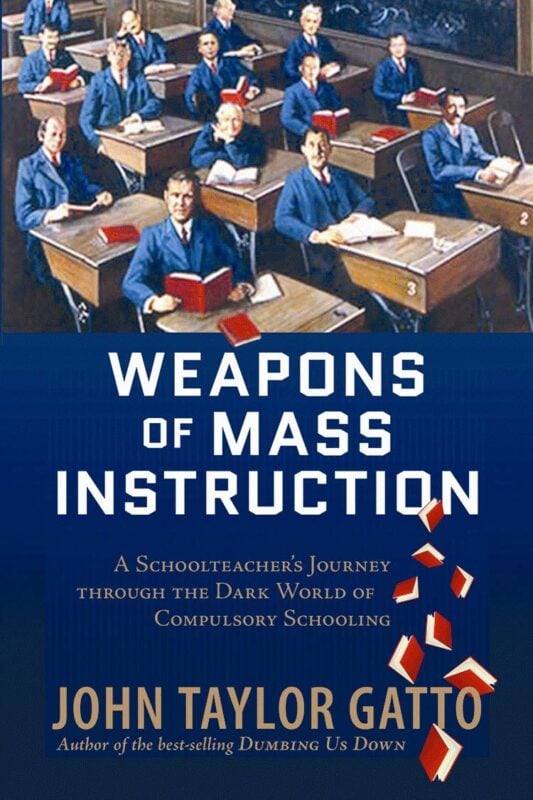
Weapons of Mass Instruction by John Taylor Gatto exposes the structural forces shaping American schooling and traces their origins to industrial and political interests that view mass education as a mechanism for social management. Gatto, a former New York State Teacher of the Year, synthesizes historical records, policy documents, and his decades in the classroom to reveal how compulsory schooling evolved from a means of community learning to a tightly controlled system engineered for conformity, obedience, and docility.
The Prussian Template and the Logic of Compulsion
Nineteenth-century Prussia developed a school system designed to manufacture uniformity and predictability among citizens. American policymakers imported these designs, seeking a population trained to obey authority and conform to expectations set by economic elites. Industrialists and philanthropists, including the Rockefeller and Carnegie interests, invested heavily in the American education project, advancing the view that large populations require centralized management and efficient production of social roles.
Schooling as a Technology of Standardization
School administrators established age-grading, standardized testing, and a rigid curriculum to control what students experience and learn. Policy documents reveal six functional imperatives: training reflexive obedience, integrating students into a managed norm, sorting children by predicted adult function, differentiating instruction according to predetermined social outcomes, reinforcing perceived inferiority or superiority, and cultivating an elite managerial class. Every element of the institution—schedules, subjects, teacher authority—serves these imperatives, which together shape children into predictable, manageable adults.
The Corporate Roots of Modern Education
Industrial philanthropies shaped the trajectory of American public education. The Rockefeller General Education Board, through its stated mission, envisioned a nation where children submit “with perfect docility” to the “molding hands” of educational authorities. Andrew Carnegie’s initiatives framed practical schooling as the antidote to “bad attitudes” in the workforce, promoting an educational system that discourages critical engagement and channels ambition toward routine labor and consumerism. These foundations operated as powerful agents of change, exerting influence over teacher colleges, textbook publishers, and the formulation of national policy.
Literacy and the Decline of Autonomy
Historical data on literacy before and after the implementation of mass compulsory schooling indicates a dramatic decline in reading proficiency, especially among marginalized groups. Military draft statistics and government surveys chart a steady drop in the percentage of inductees able to meet minimal reading standards, despite unprecedented increases in school spending. The abandonment of phonetic instruction, the proliferation of “whole word” methods, and the narrowing of curricula reduced children’s capacity for independent reading and writing. Gatto asserts that educational practices engineered by experts favored obedience over mastery, resulting in the systematic erosion of student autonomy.
Testing, Sorting, and the Logic of the Permanent Record
Standardized tests anchor the architecture of schooling, providing a means to classify, sort, and direct students toward prescribed social roles. Policy makers treat these tests as instruments of truth, linking performance to future opportunity, social standing, and personal worth. Gatto documents the historical expansion of cumulative records—“your permanent record”—which follow students through their educational careers and into the labor market. These records operate as both surveillance and selection, legitimizing decisions about advancement and exclusion.
Childhood Prolonged: The Extension of Dependency
Gatto identifies the deliberate extension of childhood as a central consequence of institutional schooling. By segmenting learning into narrow, age-based tracks, schools delay the onset of adult responsibility and independence. Regulatory practices—compulsory attendance, restriction of free movement, and emphasis on group activity—suppress the growth of individual initiative. The system produces young adults who lack experience in real-world problem solving and risk management, reinforcing a culture of passive consumption and dependence on external authority.
Family and Community: The Disintegration of Local Control
Early American schools operated under local, democratic oversight, with independent school boards composed of community members. Centralization initiatives—district mergers, state control, federal mandates—dismantled this structure. The locus of power shifted to distant bureaucracies and philanthropic boards, marginalizing the voices of parents and local educators. Gatto recounts the erosion of community authority, describing how political and commercial interests harnessed education as a tool for economic and social engineering.
The Behavioral Revolution in Teacher Training
Mid-twentieth-century reforms, shaped by projects such as Benjamin Bloom’s Taxonomy of Educational Objectives and the Behavioral Science Teacher Education Project, recast the teacher’s role from content expert to social engineer. Curricula redefined education as the shaping of attitudes, beliefs, and feelings compatible with desired social outcomes. Teachers received training to identify, remediate, and redirect student behaviors, aligning instruction with state and corporate goals. Gatto describes how these changes transformed classrooms into laboratories for behavioral control.
The Triumph of Consumption and the Economy of Attention
The mass production economy that flourished in the twentieth century demanded a corresponding mass market for goods and services. Educational institutions supplied this need by promoting habits of compliance and distraction. Gatto asserts that modern schooling trains children to value external validation, immediate gratification, and superficial entertainment, all essential to sustaining high levels of consumption. Marketing strategies exploit these traits, linking identity and satisfaction to products rather than personal achievement or community participation.
Resistance, Genius, and the Case for Autonomy
Gatto insists that the suppression of individuality and the management of genius constitute deliberate outcomes of the school system’s design. Historical figures who shaped American life—Washington, Franklin, Lincoln, Edison—did not attend or graduate from institutions resembling modern public schools. Their development depended on self-directed study, apprenticeship, and community engagement. Gatto challenges readers to recognize the potential for extraordinary achievement that flourishes outside standardized education.
The Invitation to an Open Conspiracy
The book closes with a call to action: Gatto proposes an “open conspiracy” to reclaim the practice of education from institutional schooling. He urges students and families to opt out of standardized testing, stating that a critical mass of non-compliance would destabilize the system. He advocates for self-education, apprenticeships, family and community-based learning, and the cultivation of real-world skills. Gatto frames the transformation of education as essential to the preservation of personal liberty and a thriving democracy.
What structures support or undermine genuine learning? Where do the origins of policy intersect with daily classroom experience? Who benefits when students become consumers rather than citizens? These questions animate Gatto’s analysis, sustaining the book’s narrative momentum and inviting readers to examine the costs and consequences of accepting mass schooling as inevitable.
Weapons of Mass Instruction commands attention as a work of educational critique grounded in historical evidence, policy analysis, and lived experience. John Taylor Gatto positions the book as both diagnosis and blueprint, offering a precise account of the forces shaping American schooling and mapping pathways toward autonomy, creativity, and civic agency. The book’s arguments draw on specific legislative records, foundation archives, statistical data, and firsthand testimony, synthesizing a century of educational reform into a cohesive, actionable narrative.
By foregrounding the agency of families, communities, and self-motivated learners, Gatto affirms the capacity for renewal outside institutional frameworks. He identifies education as an act rooted in curiosity, resilience, and the willingness to confront uncertainty. The clarity of his assertions and the progression of his evidence establish a logical architecture for readers seeking to understand both the origins and the future of American education.