Fleshing Out Skull & Bones: Investigations into America’s Most Powerful Secret Society

Fleshing Out Skull & Bones: Investigations into America’s Most Powerful Secret Society by Kris Millegan assembles a detailed exposé of one of the most enigmatic and influential secret societies linked to American political and economic power. It unveils how the Yale-based Order of Skull and Bones functions as a crucible for elite grooming, using secrecy, ritual, and networked influence to shape national and international policy outcomes across generations.
The Yale Genesis and Opium Capital
The society’s roots run through the corridors of Yale University, where American secret society culture fused with mercantile power from the opium trade. Samuel Russell founded Russell and Company in 1823, launching American opium smuggling into China. His cousin, William H. Russell, returned from Germany in 1832 steeped in Hegelian philosophy and formed the Order with Alphonso Taft. Their shared vision drew from Prussian models of authoritarian education and systemic discipline. The society adopted Germanic ritualistic structures and aesthetic markers, embedding a philosophical commitment to state supremacy and dialectical manipulation.
Russell and Company’s business facilitated elite intermarriages and philanthropic projects that seeded Ivy League endowments, quietly yoking narcotics finance to American academia. Families such as the Coolidges, Delanos, and Lowes emerged as dynastic players in both global commerce and domestic cultural foundations. The opium trade forged international alliances while masking capital accumulation behind prestigious institutional facades.
Architects of the American Intelligence Apparatus
Graduates of Skull and Bones catalyzed the formation of America’s modern intelligence infrastructure. Daniel Coit Gilman, a founding Bonesman, helped institutionalize scientific education and served as the first president of Johns Hopkins and the Carnegie Institution. His cohort, including Timothy Dwight and Andrew D. White, established patterns of federal-academic partnerships that proliferated throughout the 20th century. Their legacy fortified the ideological and bureaucratic core of institutions like the CIA, shaping a surveillance-driven national security state.
Robert Lovett, Prescott Bush, and the Bundy brothers operated as connective tissue between Bones and the highest levels of U.S. foreign policy. Through investment banks like Brown Brothers Harriman and policy forums such as the Council on Foreign Relations, these figures fused elite financial strategy with geopolitical engineering. The CIA, OSS, and Department of War reflect a lineage of institutional command crafted within the Tomb at Yale. Intelligence operations abroad—from Lend-Lease to regime change in Latin America—trace back to Bonesmen and their peers.
Controlled Conflict as a Governing Principle
The Order applies Hegelian dialectics as a method of historical control, generating and managing oppositional forces to engineer predetermined syntheses. This logic animates its participation in wars, coups, and social engineering. From financing both Bolshevik and Nazi regimes to orchestrating controlled economic rivalries, the society implements dual-track engagement to exhaust alternatives and consolidate influence.
Prescott Bush’s directorship at Union Banking Corporation, which the U.S. government seized under the Trading with the Enemy Act for Nazi financing, exemplifies this tactic. The same corporate networks invested in post-war reconstruction, deriving profit and position from both collapse and recovery. This synthesis creation extends to cultural spheres, with media conglomerates and think tanks run by Bones affiliates channeling public discourse into managed dissent.
The Ritual Machine of Power
The Tomb, the society’s windowless headquarters, houses ceremonial spaces designed to imprint allegiance and secrecy. Initiates undergo esoteric rites that simulate death and rebirth, constructing loyalty through psychological imprinting and symbolic inversion. The Tomb’s artifacts—skulls, occult symbols, cryptic inscriptions—mark a convergence of Masonic, Rosicrucian, and Bavarian Illuminati traditions.
Each year, 15 juniors are “tapped” in secret to join, their future trajectories shaped by internal patronage and external deployment. These initiates receive immediate entry into elite economic, legal, and governmental circuits, positioned to reinforce the Order’s global objectives. The annual selection ritual transmits generational continuity and sustains a closed loop of ideological, familial, and financial alignment.
Bonesmen in the Shadow of Empire
George H.W. Bush and George W. Bush exemplify the society’s long-term strategic insertion into executive power. George H.W. Bush’s early connections to CIA operations, including ties to the Bay of Pigs invasion and Iran-Contra drug trafficking, reflect the Order’s capacity for covert continuity. His appointment as CIA Director capped decades of clandestine integration.
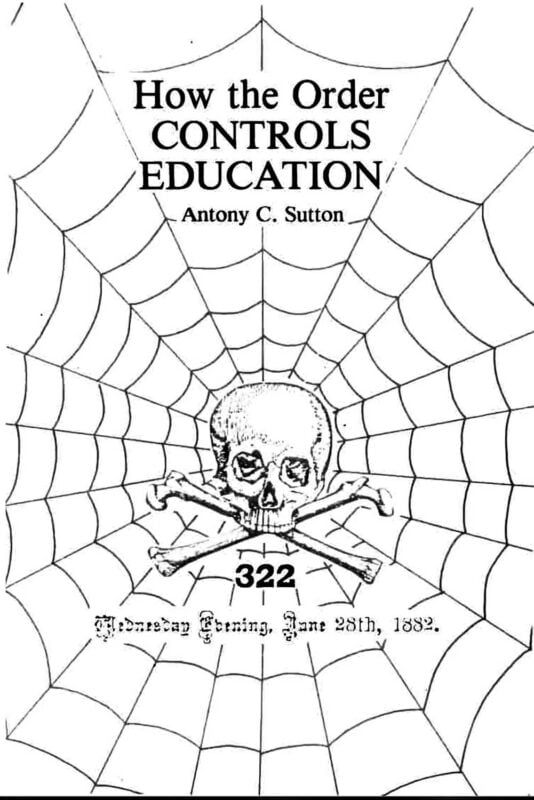
George W. Bush’s presidency resurrected many of the society’s Cold War networks. From the Patriot Act to covert operations in the Middle East, the mechanisms of mass surveillance, regime destabilization, and controlled narrative framing found new currency. Antony Sutton, a key contributor to the book, maps these patterns in detail, revealing how Hegelian conflict orchestration persisted into the War on Terror.
The Kennedy Assassination and Ritual Statecraft
The book asserts that the assassination of President John F. Kennedy served a ritualistic function within a broader strategy of psychological warfare. Reports linking George H.W. Bush to CIA planning and Cuban exile coordination suggest a direct operational role. Researchers cited in the book describe the event as a “Killing of the King” rite, designed to traumatize the public and recalibrate political allegiance through symbolic sacrifice.
This interpretation situates political violence within the framework of ceremonial control. By encoding national tragedy into a ritual matrix, the Order reinforces its metaphysical claim over historical direction. These assertions connect the occult dimensions of Skull and Bones with its operational strategies in governance and media.
From Yale to Global Governance
The society’s model of control extends into global policy through partnerships with supranational entities and foundations. Figures such as Henry Luce, McGeorge Bundy, and Averell Harriman function as diplomatic nodes, embedding Bones networks into the architecture of the United Nations, NATO, and international development banking. Educational institutions aligned with the Order disseminate technocratic ideology under the guise of progressive internationalism.
The H. Smith Richardson Foundation, tied to Bones member Eugene Stetson, sponsored psychological warfare research and CIA-backed social science programs. These initiatives explored behavior modification, group dynamics, and propaganda diffusion. The intellectual tools developed in these projects support contemporary narratives of democracy promotion, color revolutions, and media steering.
Secrecy as a Constitutional Weapon
Fleshing Out Skull & Bones argues that secrecy has mutated into an active mechanism of governance. Through classified programs, sealed archives, and undisclosed operations, Bones-affiliated agencies suppress civic oversight. The creation of the National Security State transforms public institutions into instruments of private strategy, shielded by legal and informational barriers.
Legislation such as the National Security Act of 1947 codified these dynamics, facilitating the centralization of intelligence and the circumvention of congressional scrutiny. Bonesmen have operated at key junctures to entrench these structures, leveraging secrecy as both shield and sword. This consolidation diminishes public sovereignty and concentrates decision-making within initiatic hierarchies.
Continuity of Influence
Bonesmen exert sustained influence across presidential administrations, regardless of party. Whether as policymakers, donors, or media arbiters, they shape the conditions within which political discourse unfolds. The society’s strategic ambiguity permits adaptation to changing cultural moods while maintaining structural imperatives. Initiates ascend through law firms, investment banks, intelligence posts, and diplomatic appointments, building a lattice of mutual reinforcement.
The book traces generational alignments and explores how familial legacies transmit authority. From the Tafts to the Bushes, the continuity of purpose suggests a design oriented toward long-term societal engineering. This design incorporates education policy, foreign affairs, and economic regulation, calibrated to preserve a specific model of elite control.
Conclusion: The Dialectics of Disclosure
Fleshing Out Skull & Bones contends that the Order’s concealment strategy operates dialectically, alternating between revelation and obfuscation to manage exposure. Publications, academic works, and media leaks function within this dialectic to normalize secrecy, sanitize reputation, or misdirect inquiry. The society does not merely hide—it curates its own mythology, exploiting the tension between curiosity and taboo.
Kris Millegan and contributing researchers dissect this phenomenon through historical documents, insider testimony, and geopolitical analysis. They challenge the reader to confront the structures behind political spectacle and to recognize the architecture of initiation, manipulation, and enforcement that governs beneath the surface of public institutions. The stakes lie in the capacity of civil society to reclaim narrative sovereignty and disrupt the rituals of elite succession.