The Underground History of American Education, Volume I: An Intimate Investigation Into the Prison of Modern Schooling
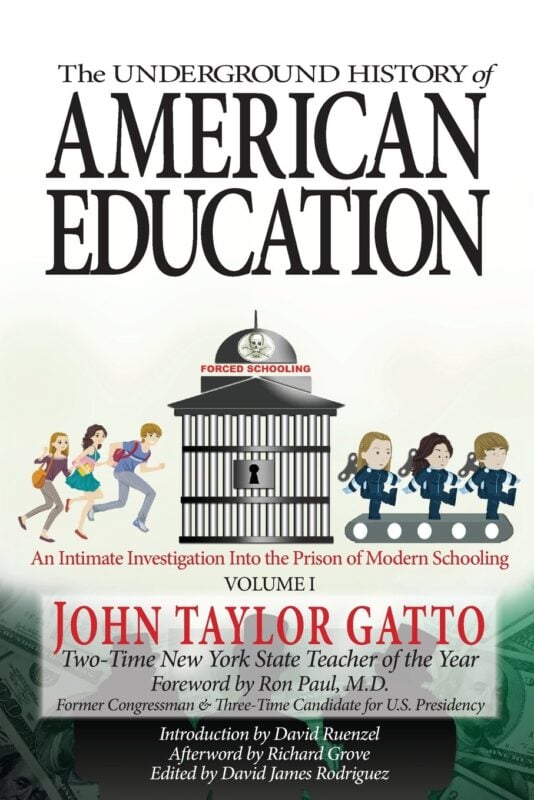
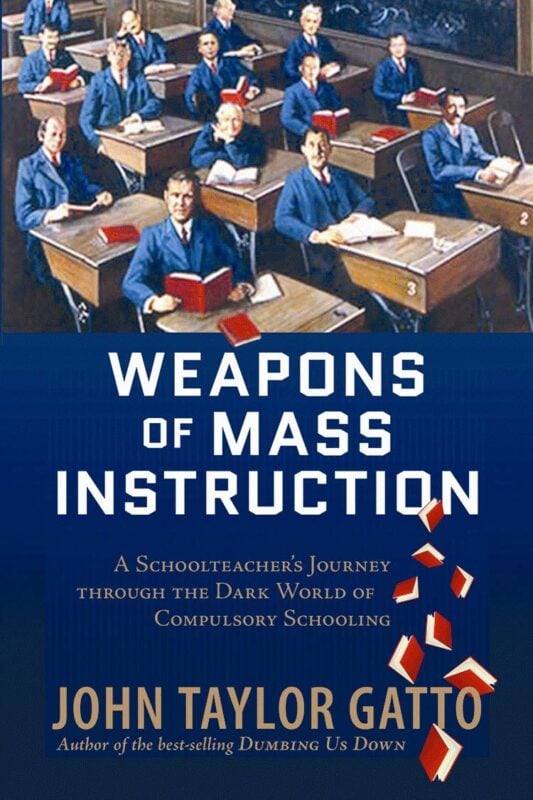
The Underground History of American Education by John Taylor Gatto opens with a provocative claim: mass public schooling in America was never designed to educate. It was engineered to produce manageable citizens in a managed economy. Gatto, a former New York State Teacher of the Year, draws upon his experience and years of archival research to argue that the American school system evolved not from democratic impulses but from a desire to impose order, compliance, and a fixed social hierarchy. He reveals how the schooling model, imported from Prussia, serves corporate and political elites by conditioning young minds to a life of obedience.
School as a Tool of Governance
Public schooling in the United States began as a decentralized and often informal community endeavor. Over time, as industrialization demanded a compliant and standardized workforce, education was transformed into a vehicle for social control. Gatto outlines how corporate foundations, particularly those connected to Rockefeller and Carnegie, heavily influenced the structure and objectives of modern education. These entities shifted educational goals from cultivating independent thinkers to manufacturing dependable workers.
Who were the architects of this transformation? Men like Ellwood P. Cubberley and Edward Thorndike, who openly promoted a mechanized, behaviorist approach to instruction, inspired by factory models of productivity and efficiency. Their writings reveal a philosophy that sought to design human beings as predictably as machines. School, in this framework, became a behavioral conditioning program—standardized, impersonal, and hierarchical.
The Prussian Blueprint
In tracing the roots of American education, Gatto illuminates the foundational influence of Prussian schooling. In 19th-century Prussia, the state constructed a comprehensive education system to mold loyal, obedient subjects. The purpose was explicit: to instill uniformity, suppress individuality, and ensure that children would grow into citizens who followed orders. America adopted this model eagerly, not because it worked educationally, but because it aligned with elite interests.
This importation was neither organic nor public-driven. It was orchestrated by a coalition of industrialists, politicians, and academic theorists who viewed schooling as a tool to engineer society. They believed in planned progress and social stability, achieved not through democratic participation but through controlled upbringing.
Compulsory Education and the New Religion
The imposition of compulsory schooling laws in the late 19th and early 20th centuries marked a turning point. For Gatto, these laws represent a fundamental betrayal of American ideals of liberty and self-governance. Compulsory schooling transformed children into passive recipients of state-sanctioned knowledge and moral values. Education ceased to be a quest for truth; it became a method of mass conditioning.
By elevating the school to a quasi-sacred institution, society replaced traditional religious authority with secular institutionalism. Gatto characterizes modern schooling as a new kind of church—a place where obedience, uniformity, and dependence are inculcated under the guise of academic instruction.
Literacy, Numeracy, and the Myth of the Unteachable Child
One of Gatto’s most powerful arguments concerns literacy rates. He provides compelling evidence that, prior to the rise of compulsory education, literacy in America was widespread and robust. In 1840, complex literacy rates among white Americans approached 100 percent in some regions. This was accomplished through family effort, community schools, and self-directed learning. The advent of state schooling coincided with a decline in genuine intellectual capacity.
Why does modern schooling fail to teach what it claims to value? Gatto argues that failure is the system’s purpose, not its shortcoming. A truly literate, numerate, and critically thinking population would challenge the social order. Thus, schools teach compliance and superficial knowledge, not autonomy or depth.
The Hidden Curriculum
Beyond formal lessons, schools impart a "hidden curriculum" that shapes students’ beliefs, behaviors, and expectations. Gatto identifies seven key lessons: confusion, class position, indifference, emotional dependency, intellectual dependency, conditional self-esteem, and surveillance. These lessons are not part of the official curriculum, but they are taught consistently through structure, policy, and pedagogy.
In this schema, students learn that knowledge is fragmented, that authority must not be questioned, and that self-worth is conditional upon institutional approval. The aim is to produce citizens who can be managed, not thinkers who challenge.
Corporatism and the Control of Human Behavior
Gatto details the role of large foundations in directing educational policy, citing figures like Max Mason of the Rockefeller Foundation, who in 1933 declared the goal of controlling human behavior through education. The shift to centralized, national schooling systems was driven not by educational research or pedagogical necessity but by a desire for social engineering.
These foundations funded teacher colleges, research centers, and administrative bureaucracies that propagated uniform standards and centralized governance. Schools became data-collection centers, psychological laboratories, and training grounds for consumerism and conformity.
Resistance, Reform, and the Need for Renewal
Despite his scathing critique, Gatto does not end in despair. He points to moments of educational vitality—where teachers, parents, and students reclaimed the meaning of learning. He calls for a rebirth of local, decentralized, community-based education rooted in real-world experience and human relationship.
What might this look like? Schools organized around apprenticeships, family enterprises, independent study, and civic participation. Education as an extension of community life, not an artificial separation from it.
The Trap of Bureaucracy
The endurance of the existing system lies in its diffusion of responsibility. No single entity controls education; authority is dispersed across layers of bureaucracy. Change becomes difficult not due to opposition but due to structural inertia. Reform efforts fail because they address symptoms, not causes. Gatto proposes that genuine change must come from outside the system—through families, communities, and independent learners taking back educational authority.
The Stakes of Sovereignty
Ultimately, Gatto argues that education is a battlefield for human sovereignty. The choice is not between traditional and progressive methods, but between freedom and control. Schools can either serve as training grounds for democratic citizenship or factories of docile labor. The stakes are high: a free society depends on free minds.
His final appeal is for readers to awaken—to question not only what schools teach, but why they exist in their current form. Education, he insists, must serve humanity, not systems. Only then can individuals fulfill their potential and reclaim their role as agents in history.
Reclaiming the Legacy of Liberty
Gatto concludes by evoking the spirit of the American Revolution. The colonists rejected kings and state churches to build a society from the bottom up. That same courage is needed now to confront the educational Leviathan. The future of democracy depends on it. Let the conversation begin. Let the reclaiming of education commence.