Wall Street, the Nazis, and the Crimes of the Deep State
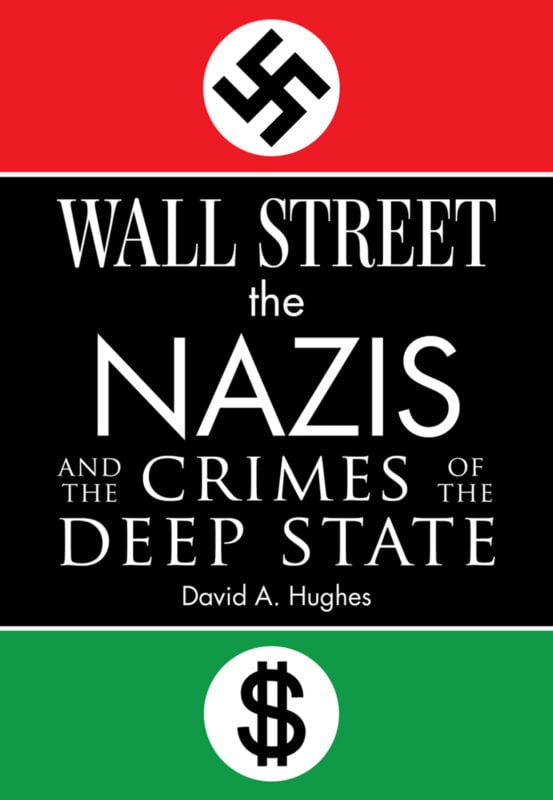
Wall Street, the Nazis, and the Crimes of the Deep State by David A. Hughes unearths a meticulously documented history of how America’s financial elite, industrial magnates, and legal institutions enabled the rise of Nazi Germany and subsequently embedded fascistic control mechanisms into the modern Western political order. Hughes, a political scientist at the University of Lincoln, argues that the fusion of Wall Street finance, corporate oligarchy, and intelligence agencies created a transnational power structure—the Deep State—that continues to shape global governance. His narrative spans a century, identifying the actors, institutions, and technologies that sustain a technocratic world order built on surveillance, control, and economic subjugation.
The Architects of Industrial Fascism
Hughes traces the origins of Nazi power to the interwar collaboration between American finance and German industry. He identifies the House of Morgan, the Rockefeller dynasty, and law firms such as Sullivan & Cromwell, headed by John Foster Dulles and Allen Dulles, as instrumental conduits of capital into Hitler’s regime. Through the Dawes Plan (1924) and Young Plan (1929), Wall Street bankers, including Charles Dawes, Owen D. Young, and J.P. Morgan & Co., refinanced Germany’s reparations and facilitated the industrial recovery that fueled the Nazi war machine. The Bank for International Settlements (BIS) in Basel—founded by central bankers like Montagu Norman of the Bank of England and Hjalmar Schacht of the Reichsbank—became the financial hub linking Nazi Germany with Anglo-American capital.
The book details how Standard Oil of New Jersey, controlled by the Rockefellers, supplied synthetic fuel technology to the Third Reich through joint ventures with I.G. Farben, while Ford Motor Company and General Motors (via Opel) provided critical automotive production for Hitler’s military. IBM, under Thomas J. Watson, leased Hollerith punch-card machines to the Nazi government, enabling the efficient tracking and categorization of Jewish populations and labor assignments. ITT, directed by Sosthenes Behn, maintained direct communication with Berlin throughout the war. These were not peripheral relationships but strategic investments managed through New York law firms and banks that regarded fascism as an economic stabilizer against socialist movements.
The “Fraternity” and the Business Plot
Hughes resurrects the suppressed history of the 1933 Business Plot in the United States. Industrialists including Irénée du Pont, J.P. Morgan Jr., Robert Sterling Clark (Singer Sewing Machine), William Knudsen (General Motors), Grayson Murphy (Goodyear), and the Pew family (Sun Oil) conspired to overthrow President Franklin D. Roosevelt. They planned to install Major General Smedley Butler as a figurehead dictator backed by a private army of veterans. Butler exposed the coup before Congress, and though no one was prosecuted, the event demonstrated the shared ideology linking American capital with European fascism. Hughes interprets this episode as evidence that the U.S. industrial elite viewed authoritarian corporatism as the most efficient form of governance for crisis management and labor discipline.
Postwar Continuities: The Nazi–CIA Nexus
After Germany’s defeat, the same financial and intelligence networks reconstituted the infrastructure of global power. Hughes traces the recruitment of thousands of Nazi scientists, intelligence officers, and propagandists through Operation Paperclip, sanctioned by the Office of Strategic Services (OSS)—precursor to the CIA. Figures such as Reinhard Gehlen, Hitler’s chief of military intelligence on the Eastern Front, were integrated into U.S. intelligence operations, forming the nucleus of postwar espionage against the Soviet Union. Allen Dulles, later CIA Director, personally negotiated Gehlen’s employment. Through institutions such as the Council on Foreign Relations (CFR), Chase National Bank, and the Rockefeller Foundation, these covert alliances extended Nazi expertise in propaganda, mind control, and biowarfare into Western strategic doctrine.
Hughes shows that the BIS, under directors like Thomas McKittrick, continued to manage assets for both Allied and Axis powers during the war and escaped dissolution afterward, symbolizing the immunity of finance from morality. The Vatican, he notes, provided logistical assistance through ratlines that helped SS officers escape to Latin America, where many later assisted Western intelligence operations. The result was a “dual state,” in which democratic institutions functioned in public view while a parallel network of intelligence, banking, and military actors pursued extralegal objectives in secrecy.
From Cold War to Technocratic Empire
The book situates the Cold War as a manufactured conflict that stabilized capitalism through militarization. Wall Street investment houses, notably Brown Brothers Harriman (where Prescott Bush was a partner), financed armaments production for both the U.S. and its adversaries. Hughes argues that the apparent ideological struggle between communism and capitalism masked the deeper unity of financial interests managing both systems through centralized planning. The Rockefeller brothers, via Chase Manhattan Bank, the Council on Foreign Relations, and the Trilateral Commission, coordinated U.S. foreign policy to secure corporate access to global markets while expanding intelligence operations worldwide. The Cold War’s real product, Hughes contends, was the national security state, institutionalized through the 1947 National Security Act and perpetuated by the CIA’s covert interventions, assassinations, and psychological operations.
Intelligence Crime and the Manufacturing of Consent
Hughes defines “intelligence crime” as state-orchestrated deception that constructs new social realities. He links the 1933 Reichstag Fire, the Gulf of Tonkin incident (1964), Operation Gladio in postwar Europe, 9/11, and the Covid-19 pandemic as sequential operations of narrative engineering. Each event redefined civil liberties as threats to security and justified expansions of surveillance. He cites Peter Dale Scott and Daniele Ganser as foundational researchers on false-flag terrorism and covert manipulation. For Hughes, the deep state does not merely suppress dissent—it produces crisis as a mode of governance. The “War on Terror” and “War on Virus” serve identical functions: to reorganize society under permanent emergency law.
Technocracy and the Digital Enclosure
The author’s most provocative claim is that the ultimate expression of totalitarianism is technocracy, the rule of technical elites through data systems. Drawing from the writings of Howard Scott and M. King Hubbert of Technocracy Inc., Hughes explains how energy-based accounting and algorithmic management form the skeleton of the emerging world order. Central Bank Digital Currencies (CBDCs), promoted by the Bank of England, the European Central Bank, and the Federal Reserve, create programmable money that can expire, be geo-restricted, or blocked for noncompliance. The World Economic Forum’s Great Reset, led by Klaus Schwab, embodies this ideology: a transition from market capitalism to managed digital governance. Schwab’s maxim—“you will own nothing and be happy”—captures the essence of technocratic collectivism, in which ownership and autonomy dissolve into centralized control.
Hughes identifies key institutional actors: the World Health Organization, the Gates Foundation, the Rockefeller Foundation, BlackRock, Vanguard, and State Street, which collectively manage over $20 trillion in assets. These institutions, he argues, implement the new architecture of power through health surveillance, digital identification systems, and environmental policy frameworks that disguise control as sustainability. The infrastructure of the “Internet of Bodies,” he warns, merges biological and digital identity into a single controllable data form.
Propaganda, Censorship, and Media Cartelization
Hughes devotes extensive attention to media consolidation. He names the Trusted News Initiative, coordinated by the BBC, Reuters, AP, and AFP, as a modern propaganda cartel that defines permissible discourse under the banner of combating “misinformation.” The Global Alliance for Responsible Media (GARM) and advertising giants such as Omnicom Group enforce corporate censorship through financial deplatforming. Governments, he documents, became the largest advertisers during the pandemic—the UK government alone spent hundreds of millions of pounds on “Stay Home” and “Get Boosted” campaigns, effectively purchasing editorial loyalty from newspapers and broadcasters. Parallel psychological operations units like the UK’s 77th Brigade, GCHQ, and U.S. Cyber Command targeted domestic populations, transforming communication infrastructure into a weapon of behavioral control.
The Economics of Subjugation
Hughes provides empirical evidence that lockdown policies and monetary expansion during 2020–2022 precipitated the largest wealth transfer in modern history. Oxfam reported that global billionaires gained $3.9 trillion in wealth, while workers lost $3.7 trillion. Corporations like Amazon, Google, and Pfizer reached record valuations as small businesses collapsed under enforced closures. Drawing parallels with Nazi Germany’s suppression of independent trades and consolidation of cartels, Hughes interprets this as deliberate class warfare. The mechanism of “own nothing and be happy” transforms populations into service-dependent subjects governed through digital compliance.
The Return of Eugenics and the Datafication of Life
Hughes examines the continuity of eugenic ideology from the Nazi T4 euthanasia program to contemporary biomedical practices. He traces the institutional lineage through organizations like the Rockefeller Institute for Medical Research, which financed early eugenics movements, and modern entities such as the World Health Organization, GAVI, and the Coalition for Epidemic Preparedness Innovations (CEPI). The mass genetic data collection by Ancestry, 23andMe, BGI Group, and Illumina establishes global DNA databases that can be exploited for personalized control or targeted biotechnological interventions. Companies like Palantir Technologies, partnered with the UK’s National Health Service, integrate health and surveillance data into predictive policing and social credit frameworks. Hughes interprets this convergence of biotechnology and finance as the biopolitical frontier of technocracy—control over the code of life itself.
Legalized State Crime and the Death of Liberal Democracy
The author shows how law has been weaponized to entrench authoritarianism. The UK Covert Human Intelligence (Criminal Conduct) Act 2021 authorizes agents to commit crimes; the Public Order Act 2023 criminalizes protest; and the Online Safety Act 2023 grants Ofcom power to censor lawful content deemed “harmful.” Similar frameworks appear in the EU Digital Services Act and U.S. proposals for “Disinformation Governance Boards.” Hughes argues that these statutes constitute a “constitutional dictatorship,” where executive power operates without checks under the guise of emergency. The judiciary, by upholding these measures, mirrors the Nazification of law in 1930s Germany when judges swore loyalty to the Führer and redefined justice as obedience.
The Transnational Deep State
Hughes maps the institutional web that unites finance, intelligence, and technology into a single governing matrix. Central nodes include the Bank for International Settlements, IMF, World Bank, World Economic Forum, Trilateral Commission, and Council on Foreign Relations. Interlocking directorships and revolving-door appointments maintain coherence across sectors. The result is a post-sovereign architecture of power managed by a “transnational capitalist class,” borrowing terminology from scholars like Leslie Sklair and Peter Phillips. Hughes asserts that policy convergence—from pandemic management to climate strategy—reveals centralized coordination rather than coincidence. The deep state, in his definition, is not a conspiracy but a structure of integrated interests operating through administrative opacity.
Resistance and Renewal
In its final chapters, the book becomes an ethical manifesto. Hughes calls for moral and civic resistance grounded in personal conscience and collective organization. He praises independent journalists such as Cory Morningstar, Whitney Webb, and Mark Crispin Miller, as well as scientists like Sucharit Bhakdi and Peter McCullough, who challenged official narratives at great personal risk. Resistance, he argues, must begin with intellectual courage—the willingness to perceive manipulation and withdraw consent. He advocates local self-sufficiency, community networks, and alternative economies as antidotes to digital centralization. His closing vision asserts that moral integrity, not technology, defines civilization’s survival.
The Intellectual Force of Hughes’s Argument
Hughes integrates economic history, intelligence analysis, and moral philosophy into a single thesis: that global governance has evolved from financial imperialism into algorithmic authoritarianism. The names and institutions he assembles—Rockefeller, DuPont, Bush, Dulles, McKittrick, Schacht, Schwab, Gates—form an unbroken chain of continuity linking twentieth-century fascism to twenty-first-century technocracy. His work draws from historians Antony C. Sutton, Peter Dale Scott, Carroll Quigley, and William Engdahl, yet advances their arguments by mapping them onto contemporary digital systems. The book stands as both exposé and prophecy, asserting that without moral awakening, the world faces a total convergence of finance, surveillance, and biotechnology into a singular regime of control.
Wall Street, the Nazis, and the Crimes of the Deep State functions as a historical revelation and a forensic indictment. It names the financiers who built the Third Reich, the bureaucrats who preserved its methods, and the technocrats who now digitize its logic. Hughes transforms academic research into a warning: the same mechanisms that once industrialized death now administer digital obedience. Understanding them is the precondition for human freedom.