The Quantum Enigma: Finding the Hidden Key
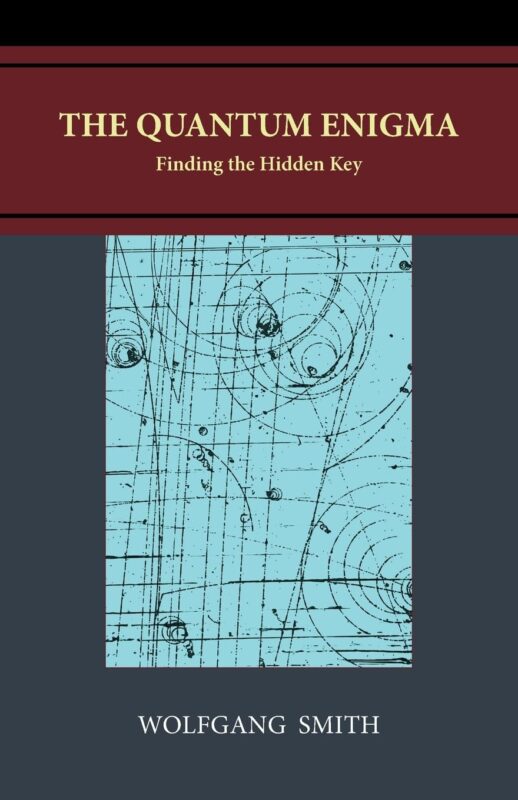
The Quantum Enigma: Finding the Hidden Key by Wolfgang Smith presents a profound reinterpretation of quantum mechanics through the lens of perennial metaphysical philosophy. Smith, both a seasoned physicist and a philosopher grounded in the Scholastic tradition of St. Thomas Aquinas, challenges the conceptual underpinnings of modern science, identifying Cartesian assumptions as the primary obstacle to an ontological understanding of quantum phenomena.
The Rediscovery of the Corporeal World
Smith begins by dismantling the Cartesian dichotomy between res extensa (extended substance) and res cogitans (thinking substance), which he asserts has led to a fragmented and incoherent worldview. This dualism, by stripping reality of qualitative attributes and assigning them solely to subjective experience, precludes any ontologically grounded comprehension of the physical world. In his view, this philosophical reduction renders physics incapable of explaining what reality is, despite its prowess in predicting how it behaves. He proposes instead a recovery of the corporeal world—a realm not reducible to physical quantities but rooted in qualitative being.
Quantum Indeterminacy and Ontological Reformulation
The centerpiece of the book is the analysis of quantum indeterminacy, particularly the state vector collapse, which defies classical causality. Smith interprets this phenomenon not as a breakdown of determinism, but as a manifestation of a higher order of causation—what he calls “vertical causality.” This concept opposes the closed-system model of the universe prevalent in modern science and reinstates the presence of an ever-operative creative agency, or natura naturans. Quantum events, in this light, are not random but reflect a supra-temporal act of determination analogous to artistic creation, uniting freedom and necessity.
From Chaos to Cosmos: The Primordial Substrate
In elaborating his ontology, Smith identifies the quantum realm with the ancient metaphysical concept of a primordial substrate—Chaos, materia prima, or prakriti. This substrate contains potentialities without quiddity or essence, and thus lacks full ontological status. The physical universe, as described by quantum mechanics, represents a threshold between pure potential and actualized being. Measurement, then, is not merely a registration of pre-existing conditions but a cosmogenetic act—an ontological event that lifts quantum potential into corporeal reality. Thus, every observation in quantum mechanics recapitulates creation.
Rejection of Scientism and Cartesianism
Smith directs sharp critique at scientism and the Cartesian legacy, which he identifies as the roots of the intellectual impasse in physics. The mechanistic worldview reduces reality to quantifiable matter, dismissing qualitative dimensions as illusory. This reduction, he argues, leads inevitably to conceptual absurdities, such as the view that reality consists only of what can be measured. Against this, Smith reinstates a holistic metaphysical structure in which being, form, and purpose play essential roles.
Intelligent Design and Vertical Causality
One of the book’s most innovative contributions is its linkage between vertical causality and the theory of intelligent design. According to Smith, phenomena often described as “anthropic coincidences” are in fact logically entailed by the ontological hierarchy he describes. He asserts that modern science, when stripped of Cartesian biases, supports rather than undermines a metaphysical vision of order and purpose. Vertical causality, thus, provides a conceptual foundation for understanding how higher ontological levels influence the empirical world without violating its coherence.
Towards a Unified Worldview
Smith's approach aims to dissolve the perceived conflict between science and traditional cosmology. He asserts that the supposed incompatibility between ancient worldviews and modern physics arises not from empirical findings but from unexamined philosophical premises. By removing Cartesian filters, Smith contends, one sees that many traditional cosmographies are not disproven by science but merely occluded by it. His synthesis points toward an integration of scientific discovery into a framework of perennial wisdom, restoring meaning to both the cosmos and human understanding.
The Role of Mathematical Archetypes
Another major theme is the Platonic vision of mathematical archetypes. Smith affirms that the ultimate goal of physics is not the manipulation of empirical data, but the apprehension of universal forms that underlie the phenomena. These archetypes are not abstractions from sensory data but ontologically prior realities that structure the physical world. Quantum mechanics, with its reliance on Hilbert spaces and formal structures, reveals these archetypes more clearly than classical mechanics ever could.
Implications for the Philosophy of Science
The implications of Smith’s thesis are far-reaching. He challenges the epistemological foundation of science itself, asserting that the true objects of scientific knowledge are not empirical data points but the formal and ontological structures from which these arise. He calls for a redefinition of physics not as a study of matter-in-motion but as an inquiry into being as it manifests within the constraints of measurement and observation. This move restores to science its rightful place within a broader philosophical and theological framework.
Integration into the Perennial Philosophy
Throughout, Smith situates his analysis within the perennial philosophy—a universal metaphysical tradition that spans cultures and epochs. His invocation of thinkers such as Plato, St. Thomas Aquinas, and Coomaraswamy underlines his commitment to a worldview in which science serves the higher aim of understanding reality in its fullness. He positions his work as a counterweight to contemporary efforts that interpret traditional metaphysics through the lens of modern science. Instead, he reverses the vector, interpreting science through the lens of metaphysical truth.
The Quantum Enigma as Ontological Revelation
Ultimately, The Quantum Enigma reveals quantum theory as a profound pointer to metaphysical reality. Rather than constituting a scientific anomaly or an epistemological puzzle, quantum mechanics becomes a privileged site of ontological insight. It demands a reconfiguration of thought that transcends the limits of empirical verification and enters the domain of being. Smith does not provide a new interpretation of quantum mechanics in the conventional sense; he offers instead a new paradigm for understanding reality itself, one that reconnects science with wisdom and restores coherence to a fragmented intellectual landscape.