The Genesis of the World War: An Introduction to the Problem of War Guilt
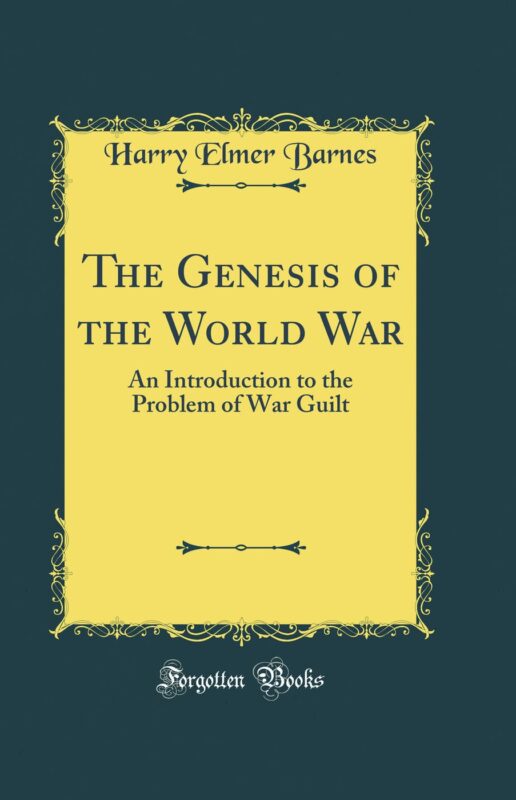
The Genesis of the World War: An Introduction to the Problem of War Guilt by Harry Elmer Barnes reorients the foundational assumptions behind the causes of World War I through documentary scrutiny and diplomatic reevaluation. Barnes positions his analysis as a direct challenge to the Versailles Treaty’s Article 231, which assigned war guilt solely to Germany. He constructs an argument grounded in newly released government documents, memoirs, and diplomatic correspondences, exposing a matrix of strategic miscalculations and political motives shared across several European powers.
The premise does not rely on absolving Germany. Barnes targets the structure of international relations and ideological commitments that led to war. The chain of events, according to him, begins far earlier than the Sarajevo assassination. It embeds itself in decades of imperial ambition, secret treaties, and a diplomatic culture unrestrained by public accountability. His focus centers on how internal political pressures, strategic insecurity, and elite manipulation led multiple states to escalate rather than defuse the crisis.
Origins of conflict in state design
Barnes identifies the modern sovereign nation-state as the structural base for sustained conflict. The Westphalian model—absolute in its assertion of national interest and unqualified in its pursuit of strategic autonomy—creates a geopolitical environment where compromise signals weakness. Within this system, foreign policy operates as a closed circuit, guided by elite consensus and insulated from democratic oversight. War arises not as a failure of diplomacy but as a mechanism to secure hegemonic interest under the guise of national honor.
The text traces how the obsession with sovereignty translates into a persistent refusal to submit inter-state disputes to arbitration. Decision-making rests in the hands of military staff, monarchs, and foreign ministries locked in patterns of mutual suspicion. By the time alliances coalesce into military guarantees, deterrence collapses into compulsion.
The diplomatic revolution of 1912–1914
Barnes describes a coordinated shift in Franco-Russian policy that set the stage for escalation. He argues that France, under Raymond Poincaré, and Russia, through the maneuvering of Sazonov and Izvolsky, worked to solidify military arrangements that positioned Germany as the fulcrum of their containment strategy. These pre-war alignments, masked as defensive, evolved into offensive instruments by 1914.
Poincaré’s visit to St. Petersburg in July 1914 marked a moment of critical convergence. Barnes contends that this meeting did not seek to defuse tensions but to ensure Russian mobilization in response to Austria’s pressure on Serbia. The entente powers, according to Barnes, anticipated that German support for Austria would trigger a broader conflict—one they believed would restrain or destroy German power. Barnes reads this calculation as a strategic gamble, not a defensive necessity.
The Sarajevo assassination as catalyst
Barnes dissects the assassination of Archduke Franz Ferdinand as the pretext, not the cause, of a war already primed by systemic tensions. He underscores Serbia’s entanglement with nationalist conspiracies and Russia’s willingness to shield Belgrade from scrutiny. Austria’s ultimatum and Germany’s subsequent endorsement appear, in this narrative, as reactive measures to provocation rather than the initiation of conquest.
The assassination becomes the spark, but the powder lay in mutual mistrust and the entanglements that prevented disengagement. Barnes presents a detailed chronology of diplomatic correspondence to show how opportunities for de-escalation were repeatedly bypassed. He emphasizes the extent to which decisions were made with awareness of their consequences, suggesting premeditation among leaders seeking strategic rebalancing.
The myth of the Potsdam Crown Council
Central to Barnes’ critique of the traditional war guilt narrative is his demolition of the so-called Potsdam War Council on July 5, 1914. Barnes argues that this meeting, often cited as Germany’s decision for war, was neither a council nor a directive. It lacked operational detail and did not signify an irreversible commitment. Instead, it was a routine discussion framed by Austria’s request for political support.
Barnes uses this point to dismantle the image of German premeditation. He asserts that German leaders, including the Kaiser, underestimated the likelihood of Russian mobilization and overestimated the restraining influence of France and Britain. The subsequent escalation, he argues, caught Berlin in a vice of diplomatic misjudgment and strategic inertia.
Russian mobilization and the point of no return
The trigger for war, in Barnes’ structure, is Russian general mobilization. He identifies July 30, 1914, as the decisive moment. The transformation of partial mobilization into a full military posture crossed a threshold that made German military planning inevitable. The Schlieffen Plan, rigid and time-bound, could not accommodate strategic delay.
Russia’s decision, influenced by assurances from France and internal pressures to support pan-Slavic allies, forced Germany into an ultimatum cycle. Barnes asserts that Russian policymakers understood this dynamic and used mobilization as a diplomatic weapon to assert primacy in the Balkans. He builds this claim through a granular reading of Russian diplomatic cables and memoirs, revealing intent behind formal declarations.
France’s concealed initiatives
France, in Barnes’ view, orchestrated a covert alignment to ensure war readiness without parliamentary authorization. He describes how Poincaré and his allies concealed military understandings from the public and manipulated diplomatic language to maintain a posture of injured innocence. This duplicity extended to media influence, where the government allegedly subsidized war-affirming newspapers to shape public opinion.
Barnes presents French policy as the synthesis of revanche nationalism and strategic calculation. The desire to reclaim Alsace-Lorraine intersected with the opportunity to dismantle German power through coordinated action. France’s refusal to pressure Russia toward restraint becomes, in this narrative, a deliberate act.
The British decision and the illusion of neutrality
Barnes dedicates significant analysis to Sir Edward Grey’s handling of the crisis. He presents Grey as evasive, reluctant to clarify Britain’s position, and ultimately enabling escalation by refusing to restrain either Russia or France. Grey’s ambiguous posture misled Germany and hardened Austria’s resolve.
When Belgium emerged as a pretext for war, Barnes argues that the British cabinet used the violation of neutrality as a retrospective justification rather than a cause. He highlights how British policymakers downplayed their entente commitments and allowed public opinion to interpret neutrality as a legal imperative rather than a strategic convenience.
American entry and the long consequences
The narrative expands to include the United States, where Barnes critiques Woodrow Wilson’s handling of submarine warfare and neutrality rights. He argues that financial and commercial interests tied American policy to the Entente powers. Neutrality gave way to intervention not through direct threat, but through entanglement in a global financial structure benefiting from war.
Barnes situates American entry into the war as a reinforcement of a peace narrative later codified in Versailles. He portrays Wilsonian rhetoric as a mask for geopolitical realignment and economic consolidation. The moral framing of the war, in this reading, obstructed meaningful examination of its origins.
The Versailles Treaty and the perpetuation of myth
Barnes sees the Treaty of Versailles as the culmination of historical misrepresentation. By embedding guilt into international law, the treaty institutionalized a false narrative that distorted future diplomacy. Article 231, by assigning exclusive blame to Germany, eliminated space for genuine reconciliation.
This clause became the moral foundation for reparations, territorial adjustments, and military restrictions. Barnes argues that its retention prevented critical engagement with the structural conditions that made war likely. The treaty’s moral absolutism, he asserts, locked Europe into a cycle of resentment and revisionism.
Historical method and the burden of truth
Barnes calls for a methodological shift in how historians approach war guilt. He urges scholars to engage documentary evidence without allegiance to national myths or diplomatic whitewashes. He defines revisionism not as contrarianism, but as fidelity to source criticism and logical coherence.
He confronts the reticence among historians to challenge wartime narratives, framing this hesitation as intellectual failure. His critique extends to educational systems, media institutions, and public discourse, where wartime illusions persisted unexamined.
Strategic clarity through historical reappraisal
The Genesis of the World War: An Introduction to the Problem of War Guilt constructs a cohesive narrative from disparate archives, diplomatic correspondences, and policy statements. Barnes pursues a clear line of causality, anchored in decisions made by identifiable agents under concrete pressures. He claims that accountability lies in action, not ideology. His purpose is diagnostic. He insists that without naming the sequence of misjudgments and the individuals responsible, future policy will repeat the same structural failures. The book stands as an indictment of diplomatic secrecy, elite manipulation, and the mythology that masks war as necessity.