Historians’ Fallacies
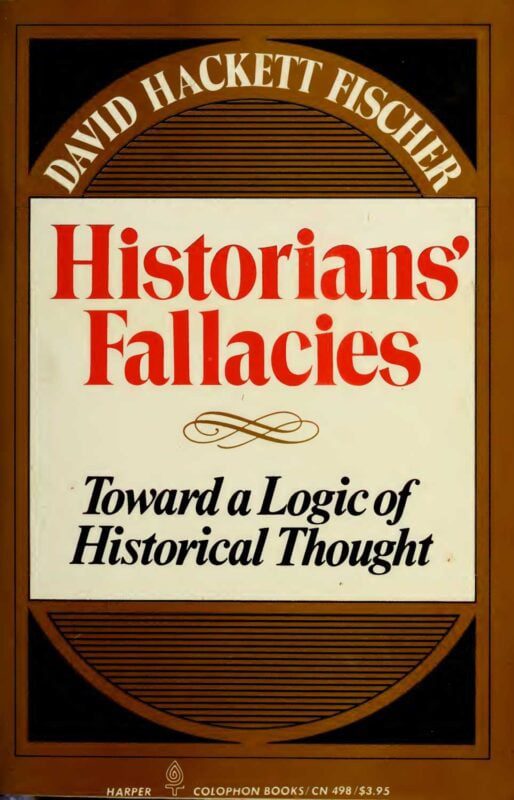
David Hackett Fischer's Historians' Fallacies: Toward a Logic of Historical Thought reshapes how historical reasoning functions by dissecting the errors that distort interpretation, inference, and argument in historical scholarship. The book identifies and categorizes fallacies that hinder historical inquiry, pressing for methodological clarity grounded in logic and empirical rigor.
The Architecture of Historical Reasoning
Historical inquiry operates through the formulation and testing of questions. Fischer defines historical logic as adductive: historians propose explanations that fit evidence, neither deducing from laws nor inducing from facts. He structures the book around three domains—Inquiry, Explanation, and Argument—each hosting distinct categories of fallacy. Fischer argues that good historical thinking begins with disciplined question-framing, advances through precise explanatory models, and culminates in coherent argumentation.
Question-Framing and the Foundation of Inquiry
Fischer targets the Baconian fallacy, which assumes that historians can derive truth merely by collecting facts. Without questions to guide evidence selection, inquiry becomes aimless. Historians who avoid hypotheses in the name of neutrality surrender clarity. Specificity defines productive research: asking what motivated a policy, how institutions evolved, or when ideologies changed directs attention to relevant evidence. Questions shape the research process and determine its success.
False dichotomies compromise clarity by forcing choices between exaggerated alternatives. When historians pose dilemmas such as "Was Andrew Johnson a hero or a failure?" they restrict inquiry to binary options that obscure complexity. Better questions open space for contingent, conditional answers grounded in evidence. Fictional questions, such as "What if Napoleon had won at Waterloo?" misuse historical method by imposing counterfactual speculation without evidentiary footing. These distort the purpose of historical reasoning, which examines what happened and why it mattered.
Verification and the Integrity of Facts
Factual verification depends on the reliability of sources and the methods used to interpret them. Fallacies arise when historians assume facts are self-evident or extract isolated data without context. Fischer examines the fallacy of misplaced literalism, in which metaphors or symbolic language are misread as plain statements. Another danger lies in presentism—reading past actions through modern assumptions. Accurate interpretation requires understanding sources within their temporal and cultural frameworks.
Fischer emphasizes corroboration, consistency, and contextual sensitivity as the pillars of factual integrity. Interpretive claims about events or actions must rest on verifiable patterns, not scattered anecdotes. Testability distinguishes sound historical statements from speculative ones. He urges historians to avoid the illusion of omniscience by acknowledging evidentiary limits and the selective nature of documentation.
Significance and the Weight of Evidence
Historians often struggle to determine what matters. Fischer identifies the fallacy of factual significance, in which irrelevant or trivial details overwhelm central issues. Prioritization becomes essential. A fact gains significance through its role in an explanatory model or its impact on the broader narrative. Historians must assess both the internal coherence of their evidence and its relevance to the questions posed.
Weighting evidence requires judgment and synthesis. Numerical data must be interpreted in light of qualitative meaning. Conversely, qualitative sources should be assessed for representativeness and frequency. Fischer resists formulaic rules for evaluating importance, proposing instead that significance emerges through interrelation, not isolation.
Causation and the Engines of Explanation
Causation in history defies linear models. Fischer critiques monocausal explanations, which attribute complex developments to a single factor. He promotes causal pluralism, recognizing that historical outcomes often result from interlocking forces—economic shifts, political decisions, ideological movements, social changes—acting in concert.
Simplistic narratives often reflect the fallacy of sequential causation, mistaking chronology for consequence. Just because B followed A does not mean A caused B. Effective causal models require explicit mechanisms: what linked one event to another, what agency existed, what constraints applied. Historians who skip these steps drift into speculation.
Motivational explanations, especially those that rely on hidden intentions, introduce further fallacies. Fischer warns against psychological reductionism and motivational monism. He argues that people act for mixed reasons and within institutional frameworks that mediate intent. Sound historical accounts anchor motive in documented discourse and observable behavior.
Narration and the Construction of Meaning
Historical narrative requires selection, structure, and sequence. Fischer interrogates the fallacies of narrative form, particularly the temptation to impose coherence where none existed. The fallacy of the dramatic plot distorts events by retrofitting them into a satisfying arc. This compresses causation, simplifies agency, and elevates outcomes over process.
He proposes that narrative clarity emerges from fidelity to problem-solving structures. Historians should organize their narratives around the resolution of empirical questions, not the demands of storytelling conventions. This shift transforms history from literature into inquiry, without sacrificing intelligibility or engagement.
Group composition and collective identity pose further problems. Generalizations about classes, nations, or races often rest on reified abstractions. Fischer calls for disaggregation—analyzing individuals, subgroups, and situational roles—before making collective claims. Statistical generalizations should be derived from evidence, not assumed in advance.
Analogy and the Limits of Comparison
Analogical thinking, when unexamined, leads to distortion. Fischer identifies the fallacy of false analogy: assuming similarity without verifying equivalence. Superficial resemblances often conceal structural differences. Comparisons between the American and French Revolutions, or between historical leaders, must specify points of convergence and divergence.
Analogies gain explanatory power when grounded in parallel functions, causal mechanisms, or institutional roles. They fail when imposed for rhetorical effect or used to circumvent analysis. Fischer emphasizes that analogies are heuristics, not conclusions. They may suggest hypotheses but cannot substitute for evidence.
Semantics and the Language of Argument
Words shape perception. Fischer explores semantic fallacies that arise when historians use terms inconsistently, obscure meaning, or shift definitions mid-argument. Loaded language, euphemisms, and jargon weaken clarity. Precision in terminology becomes a logical requirement, not a stylistic preference.
Fischer examines the fallacy of persuasive definition, where a term is redefined to serve argumentative goals. If one defines “freedom” as private property, then claims about the defense of freedom become circular. Semantic clarity ensures that debate focuses on evidence, not rhetorical sleight of hand.
Substance and the Distraction of Rhetoric
Historians often wander from evidence into ideology. Fischer identifies fallacies of substantive distraction—irrelevant appeals to authority, tradition, or sentiment that displace empirical reasoning. Appeals to moral judgment, aesthetic preference, or national pride become tools of persuasion rather than inquiry.
He calls for argumentative rigor that distinguishes between evaluation and explanation. Moral claims require separate justification from historical claims. The success of an argument depends on its logical structure, evidentiary support, and responsiveness to counterexamples. Historians must clarify what they are asserting, why it matters, and how it holds up under scrutiny.
Toward a Logic of Historical Thought
Fischer's project culminates in the development of a field-specific logic: a system of disciplined inquiry tailored to the distinctive features of historical knowledge. He proposes that history is a problem-solving discipline, structured by adductive reasoning and defined by the interplay of question, evidence, and explanation.
This logic is empirical, procedural, and purposive. It does not require universal laws or predictive power. It requires clarity about assumptions, precision in method, and accountability in inference. Historians improve their practice by understanding where and how their reasoning goes wrong, and by adopting procedures that increase the likelihood of coherent, useful conclusions.
The Stakes of Method
Fischer warns that the neglect of logic has cost historians their intellectual footing. Misology—contempt for logic—erodes disciplinary coherence. Without procedural norms, history dissolves into narrative opinion. To reverse this trend, historians must take responsibility for the logic of their thought, recognizing that method governs meaning.
By reconstructing the logic of inquiry, explanation, and argument, Fischer offers a roadmap for more robust historical scholarship. The book’s enduring value lies in its insistence that clarity of thought leads to depth of understanding. Historians who internalize these insights reshape not only how they interpret the past, but also how they contribute to the present.