Kissinger: The Secret Side of the Secretary of State
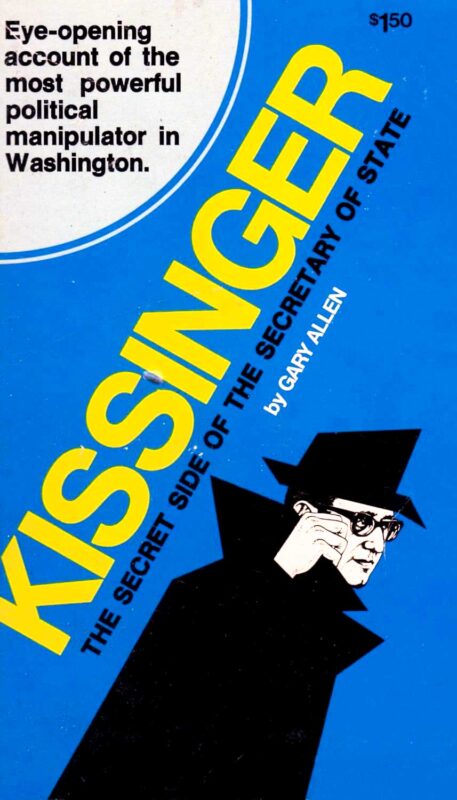
Kissinger The Secret Side of the Secretary of State by Gary Allen interrogates the ascent and strategic dominance of Henry Kissinger within American foreign policy. Through documented episodes and public records, the book constructs a portrait of Kissinger as an operative deeply aligned with elite financial and geopolitical interests, particularly those centered in the Rockefeller dynasty and the Council on Foreign Relations (CFR). The narrative does not appeal to sentiment or reputation. It inspects Kissinger's role in structuring outcomes that reshaped America's global posture and internal political coherence.
The Architecture of Power Consolidation
Gary Allen maps Kissinger’s transformation from a German-Jewish immigrant named Heinz Alfred to the most powerful unelected official in American history. The analysis follows a trajectory from Kissinger’s early education at Harvard to his immersion in intelligence during World War II. His appointments, initially supported by the Rockefeller Foundation, positioned him inside influential circles. His role in the Harvard International Seminar, funded by the CIA, reveals early links between academia, intelligence, and foreign policymaking.
His appointment as National Security Adviser by Richard Nixon, and later as Secretary of State, marks the moment when Kissinger’s influence crystallized. Nixon’s reliance on Kissinger escalated to such a degree that he became the principal architect of U.S. foreign relations, outflanking traditional cabinet roles and consolidating channels of intelligence, diplomacy, and strategic counsel under his own command.
Detente as Strategic Erosion
The concept of detente, presented as a diplomatic thaw with Communist states, emerges as a central theme. The book details how Kissinger’s interpretation and execution of detente systematically tilted advantage toward the Soviet Union. Arms reduction treaties like SALT, presented to the American public as mutual de-escalation, allowed the Soviets to surpass U.S. missile deployment. In eight years, Soviet ICBMs surged while U.S. forces stagnated.
While Soviet naval expansion outpaced U.S. capabilities, Kissinger advised the shutdown of defensive systems like the North Dakota anti-ballistic missile complex. His policy apparatus also facilitated favorable technology transfers and credit-based food deals to the USSR, undermining domestic producers and strengthening adversarial infrastructure.
Middle East Mediation and Dual Allegiances
Kissinger’s orchestration of ceasefire negotiations during the Yom Kippur War placed him simultaneously as a negotiator for both the U.S. and Soviet Union, according to statements by Soviet Ambassador Dobrynin. His structuring of peace accords functioned less as stabilizing resolutions and more as geopolitical realignments that entrenched Soviet influence in the region.
The narrative implicates Kissinger in the strategic isolation of Israel, the marginalization of Taiwan through rapprochement with Beijing, and the weakening of American positions in Greece, Turkey, and the broader Mediterranean. Each diplomatic move is presented as part of a coherent grand strategy with Rockefeller backing—a design aiming at a realignment of power and sovereignty, rather than isolated errors of judgment.
The Rockefeller Nexus
Allen defines the centrality of the Rockefeller family in orchestrating Kissinger’s rise. Citing sources like U.S. News & World Report and direct quotations from Nelson Rockefeller, the text illustrates how Kissinger operated not as an independent intellectual but as a deployed strategist for the Rockefeller worldview. Financial support, social endorsements, and eventual integration into globalist structures formed by the family positioned Kissinger as both their envoy and executor.
The book extends this thesis by identifying Kissinger’s policy moves as aligned with Rockefeller business interests, particularly those involving multinational oil, banking, and infrastructure firms operating in Communist and Third World nations. His proximity to Council on Foreign Relations strategy, and his praise for its influence on his career, consolidates this view.
Council on Foreign Relations and Shadow Governance
Allen introduces the CFR as the organizing intelligence behind a shadow government structure that supersedes electoral transitions. The CFR, comprising financial elites, media executives, academic leaders, and political operatives, functions as a placement agency for key administrative posts regardless of party.
Citing data from Christian Science Monitor, Harper’s, and insider accounts, the book shows how CFR members shaped the United Nations, Bretton Woods institutions, and post-war U.S. foreign policy frameworks. Kissinger’s role within this network, and his vocal acknowledgment that the CFR “invented” him, positions him as a case study in how policy continuity is enforced beyond public scrutiny or democratic rotation.
Vietnam, Intelligence, and Disinformation
Kissinger’s negotiation of the Paris Peace Accords is presented as an engineered defeat. His strategy secured American withdrawal and enabled Communist victory, despite the public framing of peace. The book reviews how Kissinger conducted secret missions to North Vietnam under both Johnson and Nixon, reflecting bipartisan continuity in outcomes beneficial to adversaries.
As National Security Adviser, Kissinger centralized intelligence flow. Nixon’s 1971 restructuring placed the CIA, the Defense Department, and the Joint Chiefs under a committee chaired by Kissinger. This funneling of intelligence created a single interpretive gateway for presidential decision-making, eliminating dissenting hardline analyses in favor of “moderate” or conciliatory readings of Communist objectives.
The Myth and the Man
The book deconstructs the public mythologizing of Kissinger. Profiles in Time and Newsweek, portrayals of Kissinger as a charming womanizer, and his cultivated image as a pragmatic intellectual are presented as deliberate constructs. The account investigates his personal life, citing reports of emotional abuse, careerism, and orchestrated media appearances. It frames his image not as an organic public response but as a designed promotional campaign to legitimize his extraordinary accumulation of power.
The “Ministry of Fear” atmosphere in his offices, staff surveillance, and media blackmail threats during bugging investigations expose a managerial style driven by paranoia and control. This pattern extends to Kissinger’s manipulation of Congress and the press during controversies, including threats to resign if inquiries were pursued into his domestic surveillance actions.
New World Order and Ideological Alignment
Allen introduces the framework of the “New World Order” as articulated by CFR and Rockefeller operatives. The book ties this to Kissinger’s consistent endorsement of internationalism, merger of Western and Communist systems, and advocacy for supranational governance structures. His books, especially “The Troubled Partnership,” serve as templates for dissolving national sovereignty in favor of regional and global blocs.
Statements by CFR figures and Rockefeller advisors underscore a strategic drive to transfer decision-making from democratic national governments to elite-controlled transnational entities. Allen presents Kissinger’s foreign policy as a direct implementation of this strategic ethos, executed with systematic precision across successive administrations.
Legacy of Strategic Surrender
The outcomes of Kissinger’s tenure, according to Allen, define a coherent trajectory of American deconstruction. He asserts that Kissinger’s policies contributed to the rise of Soviet strategic parity, the decline of NATO coherence, and the economic empowerment of adversarial states. The deliberate marginalization of pro-American regimes and the promotion of Communist-aligned governments are chronicled as outcomes flowing from an intentional ideological framework rather than a pattern of misjudgments.
The book closes its argument with a structural warning. It positions Kissinger not as an anomaly but as a prototype for a new kind of governance—one that routes power through global institutions, elite networks, and technocratic control structures rather than representative mandates. Through the figure of Kissinger, Allen reveals the mechanisms by which American strategic strength is rechanneled to serve a transnational agenda.


About the Book
https://youtu.be/95mK3SeSx4g