Science and Myth: With a Response to Stephen Hawking’s The Grand Design
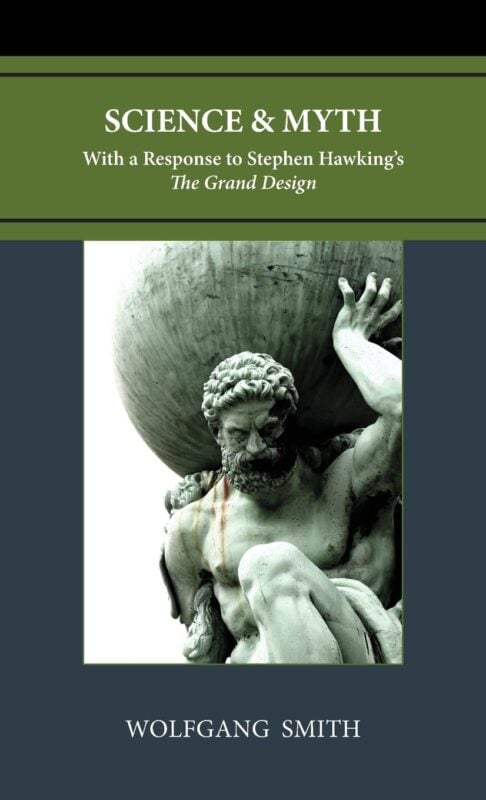
Science and Myth: What We Are Never Told by Wolfgang Smith dissects the philosophical underpinnings of modern science and reveals its embedded metaphysical assumptions. Smith argues that contemporary scientific paradigms function as cultural myths, shaping human perception and belief more profoundly than their empirical content suggests.
The Mythical Structure of Scientific Paradigms
Scientific thought operates through paradigms that shape both method and interpretation. Smith identifies Newtonian mechanics, Darwinian evolution, and the Copernican cosmological model as dominant myths—constructs that guide what counts as fact. These frameworks, often presumed neutral, actually encode metaphysical premises. They do not merely describe reality; they impose a specific interpretive grid that determines what reality is allowed to mean.
Newtonian physics presents the universe as a closed system of mechanistic interactions. In this model, motion arises from measurable forces applied to mass in absolute space and time. This vision excludes qualitative distinctions and renders the cosmos a silent machine. Its mathematical success conceals its conceptual violence: it severs reality from essence, experience from structure, and observer from the observed.
Darwinian evolution tells a story of accidental mutations and survival-driven adaptation. Smith targets this model's reliance on unobservable historical chains and its assumption of purely material causation. The absence of transitional forms in the fossil record undermines its empirical foundation, while its explanatory appeal rests on a tautology—those who survive were fit to survive. This removes final causality and extinguishes intrinsic form, replacing symbolic cosmologies with stochastic narratives of descent.
The Copernican principle asserts that matter disperses uniformly across space, negating cosmic hierarchy and purpose. This assumption, embedded in contemporary cosmology, frames the universe as spatially homogeneous and devoid of privileged centers. Smith calls this an epistemic dogma, unsupported by observational necessity yet foundational for current astrophysical models.
Science Generates Its Own Mythology
Scientific paradigms encode unexamined assumptions that shape cultural consciousness. These assumptions are not neutral. They carry ontological weight. Smith argues that paradigms become mythic when their operational utility expands into ontological claims. The empirical method, designed to investigate phenomena, then becomes a metaphysical doctrine asserting that nothing exists beyond measurable effects.
This expansion of function into philosophy generates a closed epistemic system. Science no longer examines the world; it defines the world. The mythologized paradigm silences other ontologies by claiming exclusivity. Smith identifies this as the rise of "scientistic belief," which surpasses empirical boundaries and asserts itself as ultimate truth. This belief masks itself as objective knowledge while performing the role of myth: it tells a story about origins, structure, and meaning that governs collective perception.
Epistemic Closure and the Limits of Formal Knowledge
Smith draws from Jean Borella’s concept of epistemic closure to explain how science restricts itself to formalisms that eliminate unquantifiable reality. In prioritizing measurable variables, scientific language excludes phenomena resistant to formalization. This deliberate closure excludes qualitative and symbolic knowledge. It seals off the intellect from higher modes of understanding by declaring that only the formally expressible is real.
The consequences of epistemic closure extend into cultural perception. When science declares only measurable reality valid, traditional cosmologies appear irrational. The dismissal of metaphysical knowledge does not arise from disproof but from systemic blindness. The modern scientific worldview thus becomes a form of collective amnesia: a forgetting not of facts, but of ways of knowing.
Perception as Direct Encounter
In examining the enigma of visual perception, Smith draws on James Gibson’s ecological theory, which breaks from Cartesian dualism. Gibson demonstrates that perception is not internal image-construction but direct attunement to environmental affordances. This refutes the model of the mind as an isolated interpreter decoding retinal input. Instead, vision is relational. The organism participates in the field of its own awareness.
Smith interprets Gibson’s theory through metaphysical insight. True perception is not the mind’s projection but the intellect’s recognition of form. When vision becomes symbolic and integrative, it restores the connection between seeing and knowing. The eye no longer consumes objects; it enters a reflective alignment with the real.
Mind Beyond Brain
Smith investigates the binding problem in neuroscience: how does the brain unify dispersed neuronal firings into coherent thought or perception? Roger Penrose’s theory of quantum gravity proposes that consciousness emerges from non-algorithmic processes inaccessible to computation. Smith goes further, invoking Vedantic anthropology to explain that consciousness is layered, structured through koshas or sheaths that transcend material substrates.
Neuroscience, despite its empirical rigor, cannot cross the threshold into subjective awareness. Smith argues that the mind does not emerge from the brain but interfaces with it. The organism’s form and function reflect a deeper metaphysical anatomy. Intelligence cannot be synthesized. It descends. Thought is not a computation. It is participation in the Logos.
Macrocosm and Microcosm
Smith presents the work of Oskar Marcel Hinze, who discovered correlations between the Indian chakra system and planetary orbits. Each chakra, traditionally associated with specific Devanagari letters and petal counts, corresponds to planetary motions in ways that cannot be explained by chance or symbolic projection alone. The pattern reveals an isomorphic structure linking inner human constitution and celestial geometry.
This discovery undermines contemporary astrophysical models that assume randomness in planetary formation. It also affirms the metaphysical principle of analogy: as above, so below. The universe reveals itself through form, proportion, and harmony, not statistical noise. The cosmos is symbolic, not stochastic.
Phenomenology and the Return to Reality
Smith turns to Edmund Husserl’s phenomenology to recover the original meaning of phenomenon: that which shows itself in itself. The Cartesian split replaced this immediacy with a representational model, where the real hides behind perception. Husserl restores the object as given, not inferred. Goethe’s scientific method, rooted in intuitive seeing (Anschauung), likewise reveals that truth appears through the form that reveals it, not through abstraction or analysis.
Quantum theory confirms this philosophical insight. In a participatory universe, the observer co-constitutes the observed. There is no reality independent of perception—not because reality is subjective, but because the act of knowing involves real participation in being. Smith interprets this as metaphysical evidence: the cosmos is not an object to be measured. It is a mystery to be received.
The Logos as Ultimate Phenomenon
Smith concludes by affirming that the Real cannot be captured by conceptual analysis. It eludes grasp because it precedes grasp. It discloses itself not to control, but to surrender. The highest form of seeing requires purification, openness, and faith. Sacred myth speaks in this voice. It does not explain; it evokes. It reveals reality through symbol, narrative, and gesture because only these forms can carry truth beyond calculation.
At the summit of metaphysical vision stands the Logos—the divine Word, the intelligible principle of the cosmos. This Logos is not an abstraction. It is the Person in whom all meaning converges. The Real, in its fullness, is neither a system nor a structure. It is a presence. Myth prepares the soul for this encounter. Science, when it forgets its limits, cannot. Only the purified intellect—guided by sacred tradition and freed from the closure of paradigms—can see the Real and say: It is He.