The 2001 Anthrax Deception: The Case for a Domestic Conspiracy
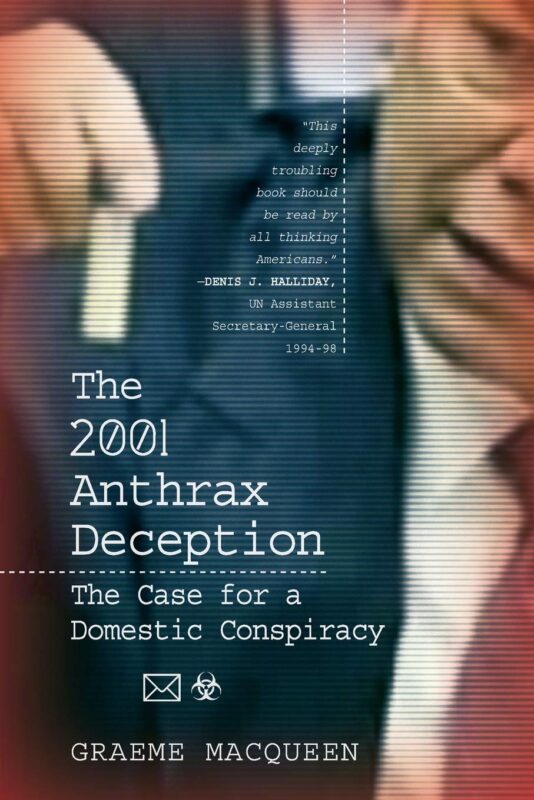
The 2001 Anthrax Deception: The Case for a Domestic Conspiracy by Graeme MacQueen constructs a forensic and political case that the anthrax attacks following 9/11 were orchestrated from within the U.S. government to consolidate executive power, manufacture consent for war, and erode civil liberties under the guise of national security. Drawing on scientific data, legal frameworks, historical parallels, and media analysis, MacQueen argues that the anthrax letters were not an isolated act of bioterrorism but a strategic component in the rollout of the Global War on Terror.
Setting the Stage: Bioterrorism and Statecraft
The anthrax letters arrived days after the collapse of the Twin Towers. Their timing synchronized with the most rapid constitutional transformation in modern U.S. history. Five people died from inhalation anthrax, and several others became ill. The letters, laced with high-grade Bacillus anthracis, were sent to media outlets and Democratic Senators. The government claimed a lone-wolf scientist within a U.S. military lab committed the crime. MacQueen dissects this narrative by foregrounding the contextual mechanics of power consolidation. What does it mean when the biological agent originates from the U.S. military’s own stockpile, yet the threat is attributed to external enemies?
High-Grade Spores and the Military Origin
MacQueen presents detailed evidence about the quality of the anthrax used. Spores in the Daschle and Leahy letters were weaponized using a sophisticated method that produced a high degree of dispersibility. This method required advanced equipment, specific strains, and technological expertise possessed only by a handful of U.S. military and intelligence laboratories. The FBI’s eventual conclusion implicated Dr. Bruce Ivins, a government scientist at Fort Detrick, but MacQueen demonstrates that the strain Ivins had access to lacked the characteristics found in the attack spores.
Fabricated Linkages: Hijackers and Anthrax
The narrative linking the anthrax attacks to the 9/11 hijackers collapsed under scrutiny. Despite initial claims in media and government briefings suggesting connections between Mohamed Atta and anthrax lab personnel, no verifiable evidence supported this assertion. MacQueen traces how officials amplified these unsubstantiated links to generate public support for sweeping counterterror measures. Why did the government promote these associations before completing the forensic analysis of the spores?
Legislative Catalysts: The Patriot Act and War Authorization
As the anthrax scare unfolded, Congress passed the USA PATRIOT Act. The bill granted unprecedented surveillance and detention powers to the executive. The timing of the anthrax letters, particularly those sent to Senators Daschle and Leahy—both critical of the bill—created an atmosphere of fear that hastened its passage. The narrative of emergency overrode procedural caution. MacQueen points out that the law’s expansion of state power, justified by threats including bioterrorism, relied heavily on the anthrax attacks’ perceived foreign origin. What consequences unfold when legislation is enacted under chemically induced panic?
Redefining the Enemy: Transition from Cold War to Terror War
The end of the Cold War left a vacuum in the American military-industrial narrative. MacQueen situates the anthrax attacks as part of a strategic redefinition of threats. Instead of monolithic communist states, the new enemy became a shadowy network of Islamic extremists allegedly allied with rogue regimes. The anthrax letters, combined with early Iraq War lobbying, introduced the specter of Saddam Hussein possessing WMDs. Through legislative and psychological engineering, the U.S. government shifted its security paradigm. The specter of anthrax helped construct a world where enemies were both unseen and omnipresent.
Suppression of Evidence and Manipulation of Science
Key scientific findings about the anthrax strain’s origin were suppressed. Reports identifying the strain as Ames, a rare and highly specific lineage maintained by the U.S. Army, were buried or delayed. The FBI’s Amerithrax investigation produced a changing narrative that adapted to public pressure rather than evidentiary clarity. MacQueen outlines contradictions in the official account, from misrepresented timelines to questionable behavioral analyses of Ivins. He shows how science was politicized to support a narrative of lone culpability, deflecting attention from institutional responsibility.
Media as Amplifier and Gatekeeper
MacQueen highlights how mainstream media both echoed and enforced the official narrative. Early reports speculated on Saddam Hussein’s role. Experts were selectively quoted or excluded based on alignment with state narratives. Those who questioned the government’s claims were dismissed as conspiracy theorists. The term “conspiracy theory” itself, MacQueen argues, became a rhetorical weapon used to inoculate the public against skepticism. Journalists and scholars self-censored to maintain credibility, leaving civil society unarmed against narrative manipulation.
Advance Knowledge and Tactical Readiness
The government demonstrated readiness for an anthrax event before the first letter was even discovered. MacQueen describes how the White House staff began taking Cipro, the antibiotic used to treat anthrax, weeks before the first confirmed case. He examines how this foreknowledge challenges the government’s timeline and raises questions about internal communication. If only the attackers knew the substance used, how did top officials know to preemptively medicate?
Integration with the 9/11 Script
The anthrax attacks are inseparable from the broader theater of 9/11. MacQueen illustrates how they acted as a second beat in a psychological campaign: the planes were the overt strike, the spores the covert threat. This sequencing framed a dual-front enemy—kinetic terrorism and biological infiltration. It sustained a heightened state of fear, extended the justification for emergency governance, and solidified the image of a new kind of war. The convergence of events appeared designed, not coincidental. The scripting was too tight, the reactions too rehearsed.
Anatomy of a High-Level Domestic Conspiracy
MacQueen constructs his core thesis from converging lines of evidence. The sophistication of the anthrax, the false linkage to foreign actors, the targeting of political opponents, and the legislative exploitation of the crisis all point to a coordinated domestic operation. The perpetrators operated within the highest echelons of government, leveraging bureaucratic resources and media compliance. This was not the act of a rogue technician. It was a campaign designed to remap legal, military, and epistemic boundaries.
Why the Anthrax Case Matters
The implications extend beyond historical inquiry. MacQueen asserts that the anthrax attacks altered the structure of American democracy. They facilitated a permanent wartime footing, authorized global military interventions, and normalized invasive surveillance. The case remains unresolved not because of technical difficulty, but because resolution would expose institutional culpability. Understanding the anthrax deception is essential to grasping how power operates in a post-9/11 world.
A Blueprint for Crisis Exploitation
The book functions as both investigation and warning. It reveals how crises—real or manufactured—can be harnessed to transform governance. By documenting the anthrax attacks’ role in this transformation, MacQueen provides a template for recognizing future manipulations. His work demonstrates the necessity of forensic vigilance, evidentiary rigor, and public skepticism when emergency becomes pretext.
Conclusion: From Fear to Framework
The 2001 anthrax letters catalyzed legal, political, and cultural shifts that defined the early 21st century. Through meticulous analysis, Graeme MacQueen reframes the attacks not as aberrant bioterrorism but as structural instruments in a domestic strategy of power expansion. His account challenges assumptions, exposes hidden mechanisms, and underscores the critical need to confront the architecture of state-sponsored narratives. The transformation they engineered endures. Recognizing its design is the first step in resisting its replication.