Rush To Judgment
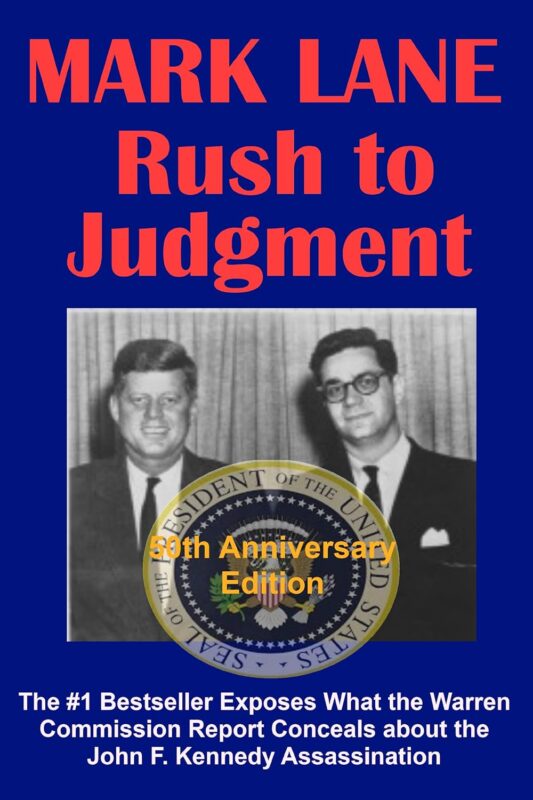
Rush to Judgment by Mark Lane challenges the conclusions of the Warren Commission through a systematic critique of its methods, evidence handling, and assumptions about the assassination of President John F. Kennedy. Drawing from transcripts, witness statements, and forensic inconsistencies, Lane presents a documented argument that the official investigation suppressed or distorted vital leads.
The Commission’s Investigative Design
President Lyndon B. Johnson created the Warren Commission within a week of the assassination. He selected Chief Justice Earl Warren to chair a panel of politicians and bureaucrats with no criminal investigative experience. The Commission depended entirely on the FBI, Secret Service, and local Dallas police for its evidence. These agencies had already shaped a narrative within days: Lee Harvey Oswald acted alone.
No commission member attended all hearings. Senator Russell of Georgia only attended five of fifty-one sessions. Most of the investigatory labor fell to junior staff divided into specialized panels. None were tasked with asking whether Oswald committed the crime. They only explored why and how he did. This procedural assumption removed the core burden of proof and restructured the investigation into a confirmation exercise.
Suppressed Witnesses and Ignored Testimony
Lane details how key eyewitnesses—who saw activity on the grassy knoll, heard shots from multiple directions, or observed suspicious vehicles and individuals—were excluded from the official narrative. Julia Ann Mercer saw two men unloading a long case from a green truck near the knoll. She identified one man carrying what looked like a rifle. Police stood nearby. None intervened. Her affidavit exists in the public record, yet the Commission never called her.
Lee Bowers, a railroad employee stationed in a tower overlooking the area, described unusual cars entering the lot behind the fence and two men standing precisely at the point where multiple witnesses saw smoke at the moment of the shooting. During the Commission’s questioning, Bowers mentioned an undefined flash or movement behind the fence. The counsel interrupted and changed the subject.
Dozens of witnesses reported hearing shots from the front. Many ran up the knoll or toward the fence immediately after. Railroad men on the overpass—including S.M. Holland—testified to seeing a puff of smoke in the trees. Several law enforcement officers joined the search in that exact area. The Commission claimed no credible evidence pointed to shooters elsewhere.
Forensic Contradictions and Medical Disputes
Parkland Hospital doctors described entrance wounds to Kennedy’s throat and head suggesting shots from the front. These statements appeared in early reports, before the narrative solidified. Later, under Commission questioning, their conclusions shifted subtly toward the rear-origin theory, often after suggestive prompts or inconsistent questioning.
The autopsy was conducted under naval supervision. The doctors were not trained forensic pathologists. They relied on incomplete notes, failed to dissect all wounds, and later admitted to destruction of preliminary documents. No photographs were included in the original Commission Report. Later analysis raised major questions about bullet trajectories and entry angles.
The so-called “magic bullet”—Commission Exhibit 399—supposedly passed through Kennedy’s neck, entered Governor Connally’s back, exited his chest, broke a rib, shattered his wrist, and embedded in his thigh. Yet it emerged almost pristine. Lane shows that Connally’s own testimony contradicted the timing required for this theory. He believed he was hit by a separate bullet.
Chain of Custody and the Rifle
Oswald allegedly brought the assassination weapon into the Depository concealed in a paper bag. Witnesses reported him carrying a package, but their estimates of size do not match the rifle’s dimensions. One claimed it looked like curtain rods. Fingerprint evidence on the bag and rifle was inconclusive. A palmprint reportedly found on the rifle stock did not appear in early crime scene photographs. It surfaced only later, after Oswald’s death.
The paraffin test performed on Oswald’s hands and cheek showed nitrate traces on the hands, common among those handling paper, but none on the cheek. This result undermined the claim that he fired a rifle that day. The Commission dismissed the test as unreliable.
Officer Tippit and the Timeline Gap
Oswald allegedly shot Officer J.D. Tippit forty-three minutes after the assassination. Lane shows that multiple eyewitness accounts and a convoluted timeline weaken the state’s case. Several witnesses identified other suspects. The shell casings recovered did not all match the revolver allegedly used. The sequence of events Oswald would have had to follow after leaving the Depository strains plausibility, given distances, routes, and timing.
Multiple witnesses stated that the man who fled the Tippit scene did not resemble Oswald. One witness, Helen Markham, gave inconsistent statements about the identification. Her testimony formed a major plank of the case linking Oswald to Tippit’s death.
Jack Ruby and Police Collusion
Two days after Oswald’s arrest, Dallas nightclub owner Jack Ruby shot him inside the police basement. Dozens of reporters and officers were present. The Dallas Police claimed Ruby walked down an unsecured ramp. Lane exposes the fallacy of this explanation. Witnesses confirmed that officers were guarding all entrances. Surveillance footage and police logs raised doubts. Ruby had deep ties to local law enforcement. He was a known hanger-on, regularly socializing with officers.
Ruby told multiple people before and after the killing that he was connected to events beyond his act. He asked to speak outside Dallas, claimed he feared for his life, and expressed distress over his actions. The Commission refused to move his testimony venue. Ruby died in prison without full disclosure.
Commission Bias and Evidence Shaping
Lane documents how the Warren Commission’s staff built conclusions around early assumptions. The Commission filtered evidence through a model that required a lone gunman, three shots, and a single rifle. When testimony conflicted, it was sidelined, reworded, or ignored. Witnesses were rarely cross-examined to explore inconsistencies favorable to Oswald. Alternative interpretations were structurally excluded.
The investigative record shows a pattern. Leads pointing away from Oswald were truncated. Witnesses who contradicted the official narrative were deemed confused, unreliable, or irrelevant. In contrast, evidence that reinforced Oswald’s guilt, however tenuous, received full development. This asymmetry shaped the final report.
The Role of Advocacy and Public Judgment
Mark Lane served as legal counsel for Oswald’s mother. He requested to represent Oswald’s interests before the Commission. The request was denied. Instead, the Commission appointed a lawyer from the American Bar Association who attended two sessions and spoke only once. No defense perspective received formal standing. The result, Lane argues, was an unopposed prosecution masquerading as inquiry.
Why did this matter then? Because the judgment formed in the absence of contradiction carries the force of consensus. The public—pressured by emotion, reassured by institutional confidence—accepts closure. Dissent becomes stigmatized as paranoia. Evidence loses traction.
Lane insists on an adversarial standard. If Oswald’s guilt depended on evidence tested only by those seeking conviction, then his case remains open. Lane does not claim to prove who killed Kennedy. He insists only that the structure of proof must support the weight of the conclusion.
Toward a Standard of Historical Certainty
Rush to Judgment holds the Warren Commission accountable to the legal and logical standards it claimed to meet. Lane’s critique forces a reevaluation of what constitutes a credible investigation. A process that predefines outcomes, excludes contrary voices, and filters evidence through political constraints cannot deliver certainty.
The case against Oswald relied on procedural collapse, not incontrovertible fact. The government’s version emerged through exclusion, not competition. Lane restores the counterpoint. By presenting suppressed witnesses, challenged timelines, and forensic inconsistencies, he reopens the file on a question framed as settled. He asserts the obligation to doubt in the face of engineered consent.
The enduring value of Lane’s work lies in its structural demand: that facts must stand against scrutiny, that guilt requires tested proof, and that history cannot be closed by fiat. Rush to Judgment rejects closure without contest and insists that judgment requires confrontation, not rehearsal.


https://youtu.be/FEdjql8g5_8