Debunking 9/11 Debunking: An Answer to Popular Mechanics and the Other Defenders of the Official Conspiracy Theory
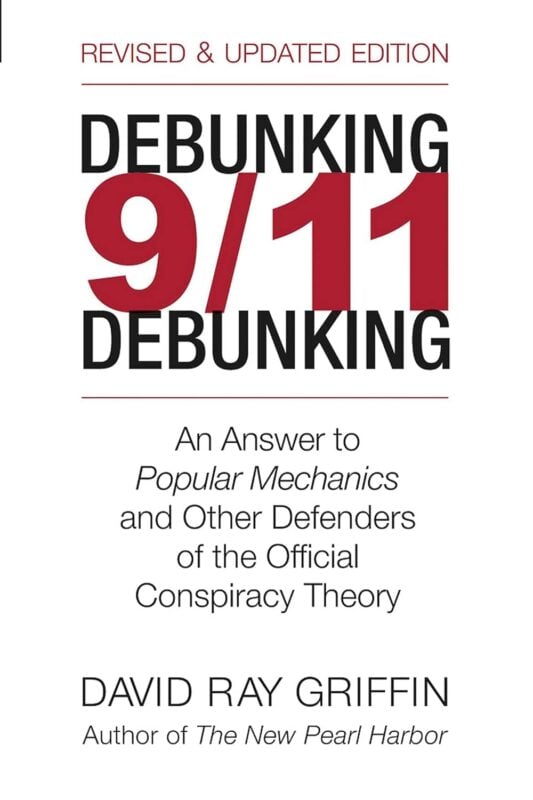
Debunking 9/11 Debunking by David Ray Griffin dismantles official narratives surrounding the events of September 11, 2001, by exposing systemic distortions, omissions, and contradictions perpetuated by government agencies, mainstream media, and institutional defenders of the official conspiracy theory. Griffin presents a layered critique that targets the 9/11 Commission Report, the National Institute of Standards and Technology (NIST), and the widely circulated Popular Mechanics article, asserting that each source fails to meet the evidentiary and logical standards required for public truth.
The Architecture of Deception
Griffin defines the official 9/11 narrative as a conspiracy theory—one that identifies Osama bin Laden and al-Qaeda as the principal perpetrators. He insists that this theory gained dominance not through empirical scrutiny but through a convergence of state sponsorship, media amplification, and psychological conditioning. He contests the reflexive dismissal of alternative explanations by reclaiming the term “conspiracy theory” as a neutral descriptor for any account positing a coordinated effort to commit a criminal act. Within this framework, he scrutinizes the widespread semantic manipulation that equates all alternative hypotheses with irrationality.
Controlled Narrative, Manufactured Consensus
Institutional reports and media counterclaims dominate the public's perception of 9/11. Griffin examines the NORAD tapes presented by Vanity Fair and the revised military timeline constructed by the 9/11 Commission. These narratives, he argues, emerged only after the original testimonies became untenable. The revised account relocated culpability from the military to the FAA without resolving the core anomalies: delayed interceptions, the disappearance of standard protocol, and contradictory radar data. Griffin presents this timeline revision not as clarification but as narrative substitution designed to suppress deeper inquiry.
He then dissects Without Precedent, authored by Commission co-chairs Thomas Kean and Lee Hamilton. The book acknowledges deception by military officials, yet paradoxically affirms the Commission’s core findings. Griffin questions this logical incongruity and identifies it as a rhetorical strategy: the report absorbs criticisms to preserve its authority. The presentation of inconsistencies becomes an act of controlled transparency rather than a trigger for reinvestigation.
Collapse, Freefall, and the Logic of Demolition
Griffin’s investigation into the destruction of the World Trade Center focuses on Building 7, which collapsed without impact from an airplane. He exposes the failure of the NIST Final Report to explain this phenomenon without invoking free-fall acceleration—an observation incompatible with the gradual structural failure hypothesis. The NIST FAQ, published in response to growing skepticism, selectively addresses public questions while avoiding the implications of symmetrical collapse and uniform pulverization.
The gravitational collapse theory assumes progressive failure across numerous structural points, yet Griffin draws attention to eyewitness accounts of explosions, seismic data, and thermitic residue as evidence of intentional demolition. He introduces the findings of physicist Steven Jones and the testimonies of firefighters to construct a cumulative case for pre-planned explosive action. Griffin asserts that the omission of these data from official reports reflects not an oversight but a suppression of counter-evidence.
Media Gatekeeping and the Perception of Rationality
Popular Mechanics’ Debunking 9/11 Myths attempts to invalidate the alternative accounts through appeals to expertise and ridicule. Griffin identifies methodological flaws: false dilemmas, appeals to authority, and selective fact presentation. He notes that one of the article’s lead authors, Benjamin Chertoff, is a cousin of Michael Chertoff, then head of the Department of Homeland Security. This familial link, combined with the article’s reliance on government sources, undermines the appearance of journalistic independence.
Griffin critiques the media’s deployment of psychological dismissal. Critics of the official story are labeled conspiracy theorists, a term equated with paranoia and cognitive distortion. Griffin highlights a coordinated discursive strategy where questioning official narratives becomes synonymous with irrationality. He emphasizes that rational critique depends not on the popularity of a claim but on its evidentiary coherence.
Why Didn’t They Talk?
A common objection to any insider conspiracy claims that someone would have spoken out. Griffin dismantles this argument through historical parallels and structural analysis. He points to the Manhattan Project, which involved over 100,000 people yet remained secret for years. He emphasizes that covert operations compartmentalize tasks, isolating individuals from full knowledge of the event. Griffin also notes the presence of whistleblowers whose testimonies have been ignored, discredited, or silenced through institutional pressure.
He examines the coercive mechanisms that maintain secrecy: professional risk, threats to personal safety, and social ostracism. The belief that exposure is inevitable presumes a transparency and accountability infrastructure that, according to Griffin, does not exist in cases of high-level state crime. He argues that power enforces silence through intimidation, media control, and institutional denial.
The Role of Paradigms and Psychological Anchors
Griffin addresses the deeper resistance to alternative explanations by identifying two psychological forces: paradigmatic thinking and wishful thinking. Paradigms structure belief systems. A worldview that frames the United States as a fundamentally benevolent actor cannot accommodate the idea of domestic orchestration of terror. Wishful thinking reinforces this resistance by denying the plausibility of high-level criminal intent.
He emphasizes that this resistance is not grounded in data but in emotional aversion. The idea that the U.S. government could facilitate mass murder for geopolitical gain collides with cultural myths of democratic virtue and moral exceptionalism. Griffin challenges this aversion by pointing to historical instances of deception-driven warfare: the Gulf of Tonkin incident, Operation Northwoods, and the Iraq War’s WMD narrative.
Who Controls the Evidence?
Griffin interrogates the claim that evidence for the official story is overwhelming. He examines the lack of verifiable proof directly linking bin Laden to the attacks, including the FBI’s omission of 9/11 from his Most Wanted page. He challenges the authenticity of the bin Laden confession video, citing inconsistencies in appearance, speech patterns, and translation. Griffin warns against treating state-authenticated materials as epistemologically secure when access to original evidence is limited or mediated through government channels.
Scientific Legitimacy and Institutional Capture
Griffin critiques the presumption that government-sponsored scientific reports possess epistemic superiority. He argues that scientific legitimacy derives from methodological transparency and peer contestation, not institutional origin. NIST’s refusal to release simulation data, its failure to test for explosives, and its speculative use of unprecedented fire-induced collapses violate core scientific standards.
He identifies a pattern where agencies function as rhetorical shields, displacing inquiry through technical language and selective release. Griffin insists that genuine science invites replication and contradiction. He urges readers to differentiate between science and scientism—the invocation of scientific authority without empirical accountability.
Reframing the Discourse
Griffin seeks to reclaim the possibility of rational dissent. He aligns the 9/11 truth movement not with dogma but with forensic investigation. He calls for a new inquiry with subpoena power and evidentiary transparency. He positions his critique as a civic imperative, not an ideological stance. For Griffin, the stakes transcend historical revisionism. They involve the structural integrity of democratic accountability.
Through this analysis, Griffin urges a transformation in the terms of debate. Instead of framing questions around feasibility or motive, he directs attention to method and result. He asks what happens when a society accepts implausible explanations without scrutiny, when narrative control replaces evidentiary testing, and when investigative closure precedes factual resolution. Griffin’s work stands as a call to reopen the case—not in the service of speculation, but in defense of structural truth.