Hocus Pocus: The Magical Power of St. Peter
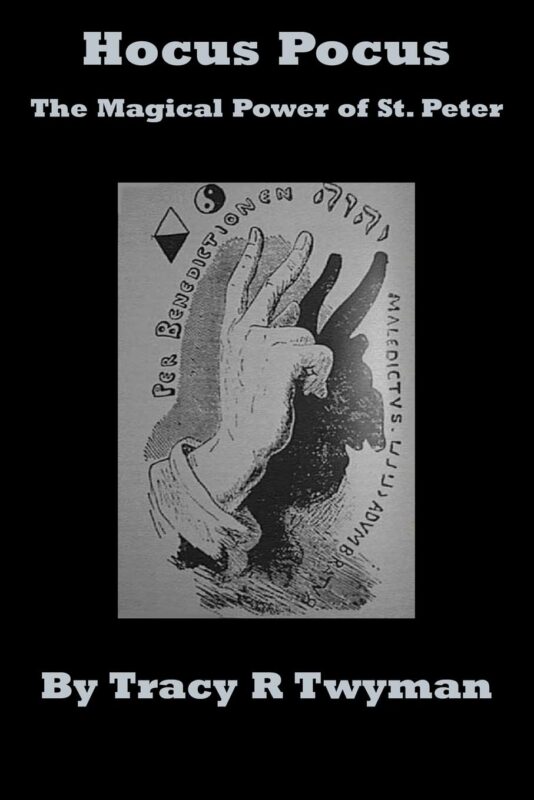
Tracy R. Twyman's Hocus Pocus: The Magical Power of St. Peter (Quintessential Publications, 2007) traces the Catholic Church's institutional authority back to a single scriptural act — Jesus granting Simon Peter the "keys of the kingdom of Heaven" — and follows that chain of spiritual transmission forward through two millennia of priesthood, heresy, occult practice, and papal power.
Twyman opens with the Gospel accounts of Jesus performing miracles through a force the texts call "virtue" or the "Holy Spirit." Luke 6:19 describes crowds seeking to touch Jesus because virtue flowed from him and healed them. Mark 5:30 records a woman touching his garment and receiving healing without Jesus consciously directing it. Twyman reads these passages as evidence that a supernatural agency accompanied Jesus and could operate independently of his intent. She connects this agency to the Judaic tradition that God possesses a secret name, and that anyone who knows how to pronounce it can command God to perform miracles. The sixth-century Jewish text Toledoth Yeshu describes Jesus discovering the Foundation Stone of the Temple of Jerusalem, where the secret name was inscribed, and concealing it in a wound on his own thigh — an origin story Twyman acknowledges as hostile to Christianity yet structurally informative.
The Transmission of the Keys
When Jesus renamed Simon as "Peter" (rock) and told him that whatever he binds on earth shall be bound in heaven and whatever he looses on earth shall be loosed in heaven, Twyman interprets the "keys" as the letters of the divine name and the acts of "binding" and "loosing" as commands over spirits. She links this to Islamic and esoteric Jewish legends in which Adam received dominion over the angels, and Satan fell because he refused God's order that the angels bow to Adam. Moses parted the Red Sea with this same knowledge, Aaron activated the Ark of the Covenant through it, and King Solomon used it to conjure demons as laborers for his temple. Twyman positions Jesus as the latest bearer of this authority, and Peter as the designated heir.
Peter became the first Bishop of Rome, and through the Catholic doctrine of apostolic succession, priests ordained by the laying on of hands — called "chirothesy" — received the same spiritual dispensation. This chain extends, Twyman argues, in an unbroken line from Peter to the present papacy, creating what she calls a "spiritual pyramid scheme" that multiplies energy at every level of the institutional hierarchy.
Transubstantiation and the Eucharist as Ritual Mechanism
A central argument of the book concerns the Catholic rite of Transubstantiation, in which a priest calls Jesus down from heaven and causes him to incarnate physically into the bread and wine of the Eucharist. Twyman draws parallels to the cult of Mithras, where initiates consumed bread called the "mizd" — a small round cake embossed with an equilateral cross — in commemoration of Mithras's last meal with the sun god Helios before ascending to heaven. She derives the word "Mass" from "mizd" and links it to the Persian deity Ahura-Mazda and the Hebrew "matza."
Twyman describes how the Eucharistic host functions as a vessel for spiritual invocation: a priest calls a spirit into a physical object and then controls it. She cites the Gospel of John 13:26–27, where Jesus invokes Satan into a piece of bread and gives it to Judas, who then becomes possessed. Protestant critics, she notes, coined the term "jack-in-the-box" as a derogatory reference to the host inside the tabernacle — "Jack" being old slang for a spirit or demon. The phrase "hocus pocus" itself derives from the Latin consecration formula Hoc est corpus Jesu Christi ("This is the body of Jesus Christ"), and from that phrase also descend "hokum," "hokey," and "hoax."
How does a believing Catholic priest, endowed with this authority regardless of personal character, channel that power toward specific outcomes? Twyman describes a documented tradition of clergy selling masses — an offense called "simony" — to fulfill personal desires, and she quotes Sir James Frazer's The Golden Bough on French peasants who evaluated incoming parish priests according to whether the new incumbent possessed "the power" (pouder) to constrain the Holy Spirit into granting requests.
The Black Mass and the Mass of Saint Secaire
Twyman devotes substantial attention to the Black Mass and its historical instances. She describes the "Mass of Saint Secaire," recorded by Frazer, as a death curse performed in a ruined church at midnight — the regular Mass said backwards, the host colored black, the chalice filled with water from a well containing the body of an unbaptized infant. She notes that no "Saint Secaire" existed; the name relates to French words for dryness and wasting.
The historical cases she examines include Catherine de Medici, queen consort of Henry II of France, whom the political writer Jean Bodin accused of employing a priest to sacrifice young boys in black masses intended to extend the life of her ailing son Philip. Catherine wore a magical amulet featuring the sigil of the demon Asmodeus, and her son Henry III maintained an altar in his home with cloven-hoofed devils facing their backsides toward the Cross.
The most detailed case Twyman presents involves Abbe Guiborg and Catherine Deshayes (known as La Voison), mistress to King Louis XIV. According to trial confessions and documentary evidence — including signed demonic pacts between La Voison and Asmodeus — the pair performed hundreds of black masses invoking Asmodeus and sacrificing children. La Voison served as the naked altar; the host was inserted into her body during consecration; and the resulting mixture of blood, consecrated bread, and bodily fluids was secretly added to the King's food as a love spell.
Wandering Bishops and Occult Currents
Twyman traces how the Church's own doctrinal framework enabled the proliferation of breakaway Catholic orders led by "wandering bishops" — priests validly ordained through apostolic succession who then established independent churches. St. Augustine's "doctrine of orders" holds that the laying-on of hands transmits apostolic succession regardless of the recipient's orthodoxy. The Dutch Old Catholic Church, the Old Catholic Church in Great Britain, and the Liberal Catholic Church descend from this tradition. Several of these churches became intertwined with occult secret societies, including the Ordo Templi Orientis and the Golden Dawn. C.W. Leadbeater, Theosophist and founder of the Liberal Catholic Church, described the spiritual power flowing from Jesus through the priesthood as a "reservoir" whose officials could draw upon it through "certain ceremonies, words, and signs of power."
Twyman introduces the concept of "magical currents" — lines of spiritual authority transmitted from a founding pact with a patron deity down through an organization's initiatory structure. Occult groups consistently claim lineage from the Knights Templar or other historical orders to access these currents. Apostolic succession from Peter, in Twyman's analysis, represents the most powerful such current available, and multiple esoteric organizations have structured themselves specifically to tap into it.
Pagan Assimilation and the Conquest of the Gods
The book documents how the Catholic Church absorbed pagan symbols, feast days, and deities into its structure as a deliberate strategy of spiritual conquest. Constantine, the "Thirteenth Apostle," simultaneously practiced Christianity and the cult of Sol Invictus; his mother Helena designated sacred sites and authenticated relics in the Holy Land. The Church co-opted December 25 from the Natalis Invictus (the day of the Sun's rebirth) and renamed it Christmas. The Jewish Sabbath was moved to Sunday, the traditional day of solar worship. The Virgin Mary inherited the iconography of Ishtar, Isis, and Venus — the crown of stars, the crescent moon beneath her feet, the title "Queen of Heaven."
Twyman connects this practice to the Roman military-religious strategy of elicio, described by Robert Graves in The White Goddess: conquering armies extracted the secret names of enemy gods from captured priests, then rededicated those gods under new names and incorporated them into the Roman pantheon. The Catholic Church continued this pattern by re-baptizing pagan deities as saints, plugging established spiritual currents into the Church's own energy-multiplying hierarchy.
The Grimoire of Pope Honorius and the Superforce
Among the Popes accused of practicing witchcraft, Twyman lists Sylvester II, John XXI, Benedict IX, Benedict XII, Gregory VII, Clement IV, and Boniface VIII. She gives particular attention to the grimoire attributed to Honorius III, first published around 1670. Its introduction claims that through the keys given to Peter, the Head of the Church has become "the Lord of Hell," and that the power to command spirits — formerly reserved for the papacy — would now be shared with the broader priesthood. The grimoire contains spells for obtaining money, sexual favors, and invisibility.
Twyman closes the book with the claims of Malachi Martin, an exorcist and confidant of Pope John Paul II, who warned of a cabal of Satanic priests he called the "Superforce" operating within the Church's highest offices. Martin linked this group to the priest pedophilia crisis and described a network of mutual protection and advancement. William H. Kennedy's Lucifer's Lodge: Satanic Ritual Abuse in the Catholic Church (2004) expanded on these allegations. Twyman also discusses the Masonic lodge Propaganda Due (P2), which infiltrated the Vatican Bank during the 1970s and 1980s, and the Priory of Sion, which hinted publicly at its intention to control the papacy.