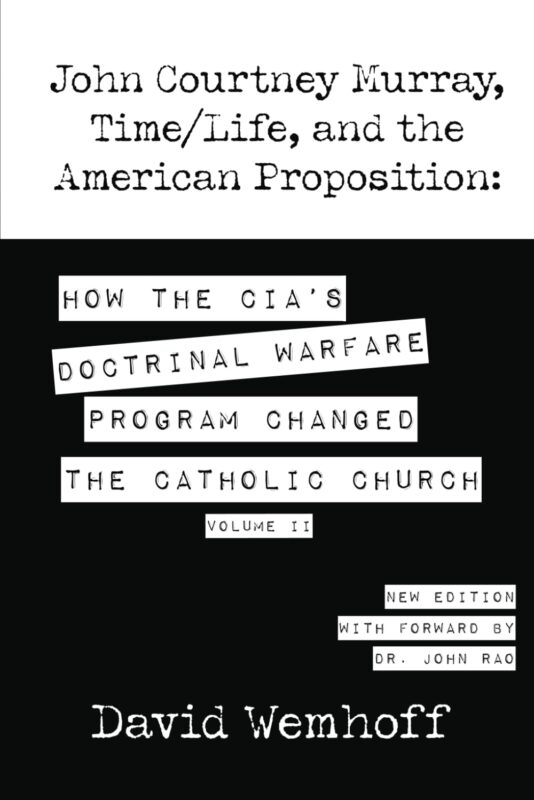
John Courtney Murray, Time/Life, and The American Proposition: How the CIA’s Doctrinal Warfare Program Changed the Catholic Church – Volume I
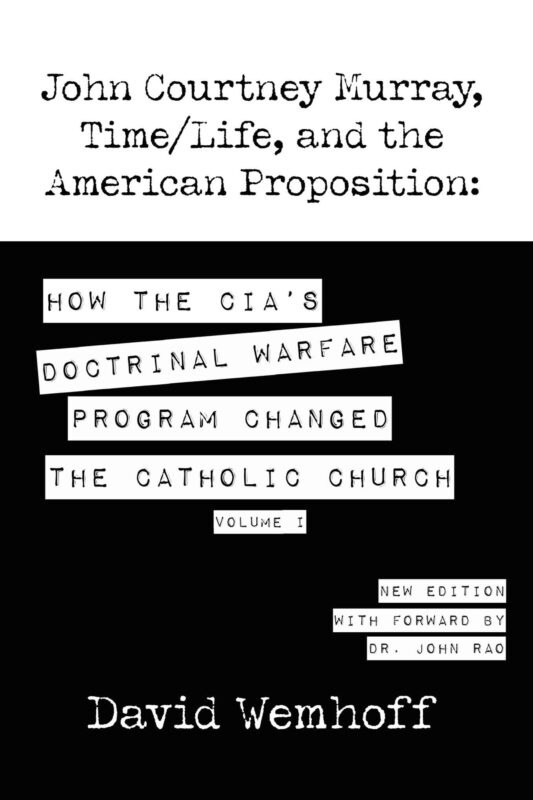
John Courtney Murray, Time/Life, and The American Proposition: How the CIA’s Doctrinal Warfare Program Changed the Catholic Church by David Wemhoff traces the convergence of American ideology, elite media strategy, and the transformation of Catholic doctrine during the twentieth century. Wemhoff identifies the critical mechanisms that carried American political, economic, and cultural values into the heart of the Catholic Church, documenting a campaign that altered religious authority, reshaped faith communities, and refashioned the moral vocabulary of the modern West.
Origins of the American Proposition
Henry Luce, the architect behind the Time/Life publishing empire, emerges as a central figure in the formation and dissemination of the American Proposition—a doctrinal synthesis promoting limited government, individual liberty, religious freedom, and material prosperity as normative goods. Luce’s upbringing as the son of a Presbyterian missionary and his education at Yale, culminating in his entry to the secretive Skull and Bones society, positioned him within the nexus of Anglo-American elite networks. Guided by the mentorship of Walter Lippmann, Luce developed news magazines as instruments of psychological influence, uniting imagery, language, and emotion to drive the adoption of American ideological frameworks both domestically and abroad.
Shaping Minds Through Media and Power
Time, Life, Fortune, and Sports Illustrated functioned as more than information platforms; they shaped the cognitive environment of their audiences. Luce orchestrated the use of psychological warfare, borrowing from emerging behavioral sciences and propaganda theory to manufacture consent for American values and policies. The “American Century” article, published in Life during the heat of World War II, set the ideological trajectory: America would use its military, economic, and cultural clout to reorder global societies according to its foundational principles. The assertion of material goals, alongside a moral vision grounded in liberty and pluralism, defined the postwar mission.
Strategic Doctrinal Warfare
The book reveals how, in the Cold War’s shadow, the U.S. government codified a program of “doctrinal warfare.” This project extended the reach of American ideology into the most sensitive arenas of cultural and religious life. Intelligence operatives, led by the CIA and coordinated with the Psychological Strategy Board, targeted global religious communities. Wemhoff identifies Dr. Edward P. Lilly as a principal architect of this campaign, which sought to infiltrate religious associations, universities, and media organizations in order to align their teachings and influence with American interests. The campaign elevated freedom, human dignity, and individualism as global ideals, using religion as both shield and spear.
Theological Engineering and John Courtney Murray
The arrival of Jesuit theologian John Courtney Murray catalyzed a profound transformation within Catholic thinking. Sponsored by the National Conference of Christians and Jews (NCCJ) and supported by prominent Catholic elites, Murray promised to develop a theological justification for reinterpreting church-state relations. His argument positioned the American system—separation of church and state, religious liberty, and limited government—as compatible with natural law and therefore legitimate within Catholic teaching. Murray became the intellectual vanguard of a movement to harmonize Catholic doctrine with the American political order, providing the rational apparatus for widespread doctrinal change.
Clare Boothe Luce and Elite Catholic Influence
Clare Boothe Luce, Henry’s wife and a high-profile Catholic convert, demonstrates the personal and institutional entanglements between American elites and the Church. As ambassador to Italy and confidante to influential clerics, she advanced American interests abroad while also recognizing the destabilizing effects of American religious liberty on Catholic institutions. Her correspondence with church leaders and active sponsorship of doctrinal reform underscore the sophisticated interplay of faith, power, and politics at the highest levels.
Conflict Within the Church
Intense debate erupted among theologians and prelates as Americanists, led by Murray and Gustave Weigel, challenged traditionalists like Msgr. Joseph Fenton and Fr. Francis Connell. The Americanists articulated a vision of Catholicism that prioritized natural law, pluralism, and civil peace, arguing that governmental authority should rest on rational principles accessible without revelation. Opponents insisted on the imperative to recognize Christ the King in law and policy, maintaining the historic duty of governments to defend the Catholic faith. These disputes reached the pages of journals, the halls of Catholic universities, and the deliberations of the Vatican itself.
Intelligence, Media, and the Machinery of Influence
The collaboration between media conglomerates and intelligence agencies propelled doctrinal change. The CIA and Time, Inc. maintained a “cozy and ongoing relationship,” exchanging information, leveraging influential figures such as CD Jackson, and embedding operatives within religious and cultural institutions. The Vatican, already beset by internal divisions, witnessed the infiltration of Americanist ideas through both overt and covert channels. Figures like Jesuit Robert Leiber—confidant to the Pope and American intelligence source—accelerated the internal adoption of Murray’s propositions.
The American Proposition Injected into Catholic Doctrine
The decisive moment arrived in 1953 when Henry Luce delivered the “American Proposition” speech in Rome at Pro Deo University—a Dominican institution funded by American elites and the CIA. This doctrinal weapon recast the Declaration of Independence and the U.S. Constitution as sacred texts, foregrounded individual freedom, and advanced the notion that religion should retreat from public influence into private life. The American Proposition functioned as both an intellectual and operational campaign, providing justification for the reshaping of social and religious structures throughout the Catholic world.
Vatican II and Its Consequences
The Second Vatican Council institutionalized many of the arguments that Murray and his allies advanced. The Council’s embrace of religious liberty, pluralism, and a reorientation of church-state relations marked a dramatic turn in Catholic teaching. Wemhoff identifies this as the culmination of decades of psychological warfare, elite lobbying, and theological innovation. The alignment of the Church with American liberalism did not occur by accident; it followed a deliberate, orchestrated process involving both religious and secular actors, backed by immense resources and strategic calculation.
Materialism, Capital, and Cultural Reordering
As American ideas saturated European and Latin American societies, Wemhoff traces the resulting transformation of cultural priorities. The rise of consumer capitalism, the decline of public religious authority, and the ascendancy of individualism followed the spread of American ideology. Elites harnessed religious language to sanctify the pursuit of wealth and consumption, marginalizing spiritual values and recasting them as private, subjective choices. The capitalist spirit, described by Italian Catholic statesman Amintore Fanfani and cited throughout the book, thrives as faith recedes from public policy and collective life.
Resistance and Accommodation
Within the Church, resistance continued even as Americanist influence grew. Msgr. Fenton, Fr. Connell, and a core of European theologians pressed for the preservation of doctrinal clarity and the defense of Catholic social teaching. However, institutional pressures, elite sponsorship, and the overwhelming power of American media systems often overwhelmed dissent. The Church’s hierarchy adopted a dualistic approach, allowing Murray’s views to circulate among elites while providing traditional doctrine for lay audiences, creating a “two Gospels” reality that signaled the depth of transformation.
Globalization and the Expansion of American Power
The book charts the extension of American doctrinal warfare beyond Europe, targeting Latin America, Asia, and the broader global South. Conferences convened by Luce and his collaborators gathered leaders in banking, industry, intelligence, and government to design strategies for exporting American finance and values. The machinery of globalization, deeply entwined with elite religious and cultural networks, served as the engine for restructuring entire societies in the American image.
The Continuing Legacy
David Wemhoff closes his narrative by examining the persistence of the American Proposition in contemporary Catholicism and world affairs. The alliance of media, intelligence, and religious elites produced a global order oriented toward liberal democracy, market economies, and secular governance. Catholic doctrine, redefined and Americanized, now serves as both participant in and witness to a world shaped by the priorities of private capital, psychological operations, and elite consensus. The consequences reach into debates over religious authority, public morality, and the meaning of freedom in an age defined by material abundance and spiritual uncertainty.
Structural Causality and the Logic of Transformation
John Courtney Murray, Time/Life, and The American Proposition: How the CIA’s Doctrinal Warfare Program Changed the Catholic Church unfolds as a structural history in which agency, ideology, and institution combine to effect lasting change. Luce’s vision, operationalized through media and government, finds its intellectual counterpart in Murray’s theological innovations. The CIA, acting as both sponsor and partner, fuses the interests of the state with those of cultural and religious elites. Together, these actors do not merely reflect the world; they engineer it, building systems that generate, defend, and perpetuate the American Proposition.
What persists when doctrinal change follows elite design and operational coordination? Wemhoff’s account supplies the answer: new social arrangements, altered loyalties, and a recasting of spiritual life in terms of market logic and civic ideology. The result—visible in the architecture of modern Catholicism and the structure of global power—demonstrates the inextricable link between psychological warfare, cultural engineering, and the faith traditions that once defined collective meaning.
Key Agents, Enduring Questions
Henry Luce, Clare Boothe Luce, John Courtney Murray, Msgr. Fenton, Dr. Lilly, and a network of collaborators shaped the course of religious and political history. Their actions raise questions about the limits of doctrinal adaptation, the responsibilities of religious leadership, and the fate of belief in a world saturated with material abundance and ideological control. Wemhoff’s work leaves readers with a sharpened sense of the causal relationships that underlie cultural transformation and a deeper appreciation for the structures—visible and invisible—that mold the contours of belief, authority, and identity in the modern age.