Phantasmagoria: The Spectacle of 9/11 and the “War on Terror”
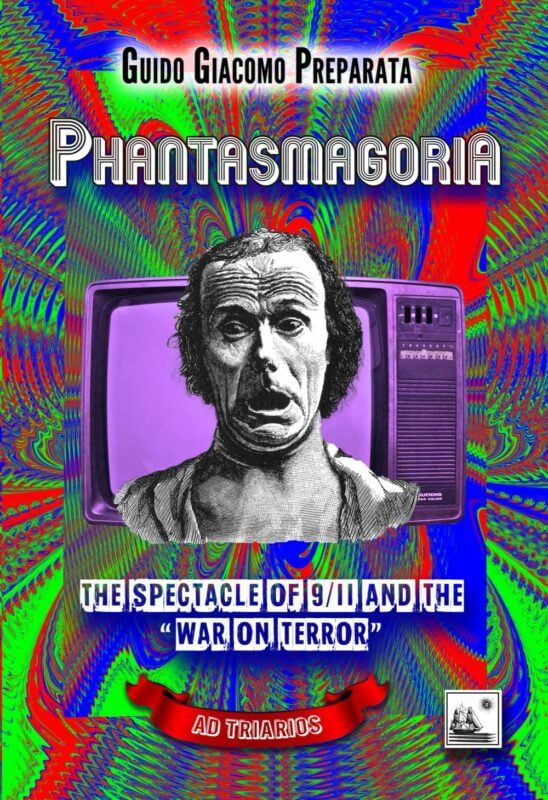
Phantasmagoria: The Spectacle of 9/11 and the “War on Terror” 2001–2021 by Guido Giacomo Preparata dissects the political mythology constructed around 9/11 and its aftermath. Preparata positions the attacks and the subsequent two-decade conflict as a theatrical performance engineered to obscure imperial logistics and financial operations. He attributes the narrative control to a transnational Anglo-American elite that has historically operated through covert influence, manipulating both geopolitical landscapes and domestic sentiment through a media-fed pageantry of terror.
The Engineered Myth of Al-Qaeda
Preparata traces the genesis of the 9/11 mythos to the CIA’s Cold War interventions. The Soviet invasion of Afghanistan created a narrative opportunity: fund Islamic fighters, label them mujahedeen, and eventually rebrand them as existential threats. Al-Qaeda emerges in this telling not as an organic terror network but as a bureaucratic fiction designed to deliver a visually compelling antagonist. Bin Laden functions as a made-for-TV villain. His biography, from construction magnate heir to jihadi ghost, reflects cinematic structure more than battlefield chronology.
Narrative mechanics take precedence over military strategy. Preparata argues that Al-Qaeda’s defining feature—its ethereal, global, “networked” structure—is a narrative solution to a strategic problem: how to sustain fear without territorial threats. Intelligence agencies, especially those in the Anglo-American axis, require enemies that regenerate through ideology rather than infrastructure. The diffusion of the jihadist threat supports continuous intervention and limitless surveillance expansion. Preparata sees this design as a model of psychological governance, not military necessity.
Algeria’s Dirty War as Prequel
To reveal the architecture behind this spectacle, Preparata points to Algeria’s civil conflict from 1988 to 2002. The war, framed publicly as a battle between Islamist insurgents and a besieged republic, masks a deeper struggle over energy control. Preparata reads the GIA’s theatrical savagery—decapitations, village massacres, and bombings—as a coordinated campaign of psychological warfare. Western intelligence, through proxies, funded and armed factions to destabilize Algeria in pursuit of influence over oil exports. The war’s grotesque narrative, televised and moralized, rehearses the tropes later used to define Afghanistan and Iraq.
This precedent matters. Algeria provided a test case for the manufacturing of Islamic terror as an optic of global disorder. Preparata connects the Algerian GIA and Afghanistan’s Taliban through shared traits: sudden emergence, media visibility, ideological opacity, and implausibly swift organizational development. The spectacle operates under conditions of deliberate confusion. Real intelligence operations depend on public misdirection, and the proliferation of implausible characters—jihadist masterminds, blind sheikhs, tribal warlords—serves as both smokescreen and symbolic script.
Geo-Hollywood and the Manufacture of War
Preparata defines the modern conflict arena as geo-Hollywood. In this schema, wars are not waged for territorial gain but for domestic mobilization. The public, conditioned by screens, consumes warfare as serialized entertainment. The invasion of Afghanistan becomes the pilot episode of a decades-long epic. Its premise—vengeance for the towers, pursuit of bin Laden, the liberation of Afghan women—yields maximum narrative friction. Preparata asserts that the actual objective was control of the heroin trade. The Taliban, he claims, functioned as a logistical interface for drug distribution, not ideological governance.
The financial logic proves essential. Heroin dollars, once laundered, supplement Wall Street liquidity. Imperial finance requires dark pools of untraceable capital to lubricate its speculative instruments. Preparata draws a direct line between poppy fields in Helmand and derivatives desks in Manhattan. The military occupation of Afghanistan facilitates extraction, not democratization. Media narratives of terror create justification for presence. Preparata treats battlefield reports, embassy leaks, and journalistic embeds as stage direction. The war’s script adapts in real time to political need.
Devotion, Compliance, and the Theocratic State
Preparata identifies two poles of devotion: the fanaticism of religious fundamentalists and the patriotic fervor of Western citizens. He finds both to be ritualized subservience. The worship of divine authority converges with the submission to technocratic governance. The state assumes theological form. Preparata deploys the term theocracy to describe the Anglo-American system, not metaphorically but structurally. It constructs obedience through spectacle. Ritual commemoration—September 11, the bin Laden raid, the fall of Kabul—sacralizes imperial decisions. Political consent transforms into civic piety.
Compliance is engineered through trauma. Preparata interprets the post-9/11 moment as a liturgical reordering. The citizen is baptized in loss, inducted into a faith of state supremacy. The architecture of surveillance and preemptive war rests on a shared mythology of vulnerability. Preparata emphasizes the absence of empirical interrogation. Mainstream discourse, shaped by intelligence briefings and media consensus, operates within a closed epistemology. He dissects this paradigm through the lens of religious ritual, treating belief in terror threats as catechism, not analysis.
The Anglo-American Technocracy
Preparata locates the origin of this governance in the ideologies of the Milner Group and the Rhodes network. These transatlantic elites, through control of education, media, and foreign policy, sought to perpetuate British global dominance by merging with emerging American hegemony. Their goal was not mere statecraft but cultural engineering. Preparata identifies a managerial caste that fuses Fabian socialism with imperial administration. This hybrid governs through data, media saturation, and strategic charity. Its legitimacy rests on a technocratic eschatology: the belief in salvation through progress.
He connects this managerial theology to what he calls Gnostic governance. The Gnostic heresy, as interpreted by Eric Voegelin and echoed by Preparata, rejects transcendence in favor of material salvation. It seeks heaven on Earth through control. Preparata maps this aspiration onto American foreign policy. Wars become rites of purification. Enemies serve as scapegoats for global insecurity. The apparatus requires sacrificial victims to affirm its own righteousness. Preparata calls this the politics of the very worst—a system that engineers crisis to validate its supremacy.
From Heroin to Synthetic Order
As heroin yields to synthetic drugs, Preparata observes a pivot in imperial logistics. The state loses interest in Afghanistan because the commodity base has shifted. Fentanyl and methamphetamine require different vectors—labs, ports, digital marketplaces. Preparata views this transition as a recalibration of spectacle. The next theater may emerge in Africa, Latin America, or urban Europe. What remains constant is the model: a manufactured threat, a morally inflected intervention, and a financial mechanism masked by public anguish.
Preparata positions this model as a form of governance. The spectacle does not conceal power; it constitutes it. The war on terror operates as a media logic. Policy emerges from narrative needs. Preparata emphasizes the shift from strategy to dramaturgy. He invites the reader to observe the machinery of performance: the sudden emergence of villains, the ritualistic execution of justice, the oscillation between chaos and control. These tropes do not represent events—they generate them.
Political Theology as Systemic Infrastructure
Preparata concludes by situating the war on terror within the longue durée of Western secular religion. From Augustine’s City of God to the UN’s trusteeship doctrine, the West has reconstituted political action as sacred duty. Preparata sees the Afghan war as part of this lineage. It functioned as a catechism of compliance. The media’s incessant framing of Islam as both threat and target reinforces the belief that Western intervention is both necessary and redemptive.
This theological infrastructure supports a closed circuit of consent. Preparata asserts that the only real battle is for narrative control. The war on terror, viewed through this lens, is a disciplinary apparatus. It organizes social behavior through fear, loyalty, and ritualized grief. Preparata does not propose an alternative system. He demands recognition. Until the spectacle is understood as system, analysis remains trapped within its design. The question is not whether terror exists. The question is who scripts its meaning, and to what end.