The 9/11 Commission Report
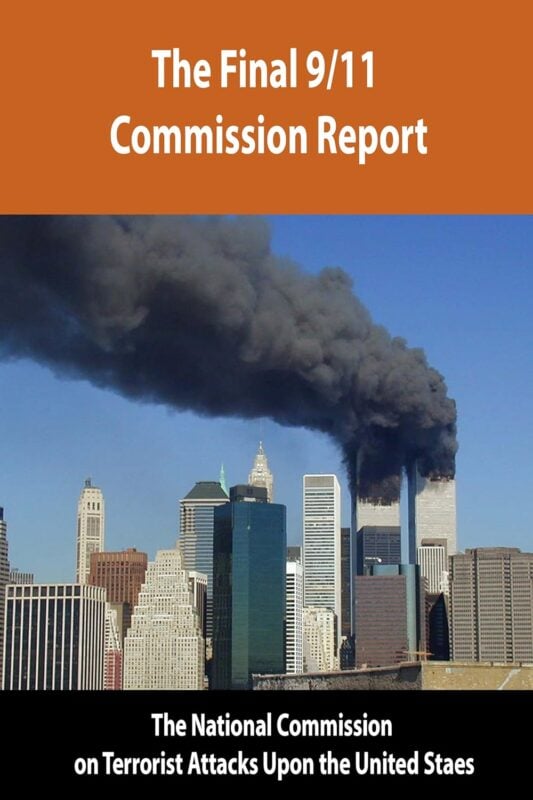
The 9/11 Commission Report by the National Commission on Terrorist Attacks Upon the United States begins with an assertion that reshaped American history. The authors—bipartisan commissioners led by Thomas H. Kean and Lee H. Hamilton—detail the events of September 11, 2001, with precision and forensic authority. The report uncovers the operational planning, organizational infrastructure, and strategic intent of the 19 terrorists who hijacked four commercial airliners and carried out the most devastating foreign attack on American soil.
Flight Paths and Fatal Timing
The attack unfolded with brutal coordination. Hijackers boarded flights in Boston, Newark, and Washington, D.C., using legitimate identification and blending into early-morning passenger traffic. The planes targeted were bound for the West Coast, chosen for their large fuel loads. American Airlines Flight 11 crashed into the North Tower of the World Trade Center at 8:46 a.m., followed by United Airlines Flight 175 slamming into the South Tower at 9:03. American Airlines Flight 77 struck the Pentagon at 9:37, while United Airlines Flight 93, redirected toward Washington, crashed into a Pennsylvania field at 10:03 after a passenger uprising.
The attackers exploited lapses in aviation security. Screening systems flagged several hijackers, but protocols merely delayed baggage, not boarding. Weapon detection failed, and none of the screeners recalled suspicious behavior. By the time federal agencies recognized the pattern, the system had already collapsed under the weight of coordinated violence.
Al Qaeda’s Strategic Architecture
The report traces the organizational rise of al Qaeda from its roots in the Afghan jihad against the Soviets to its maturation under Osama bin Laden’s leadership. Between 1992 and 1996, bin Laden operated out of Sudan, merging with other Islamist factions. By 1996, after declaring war on the United States, he reestablished operations in Afghanistan under Taliban protection. Training camps, financial conduits, and ideological propaganda merged into an operational infrastructure capable of global strikes.
What made al Qaeda lethal was its ability to merge vision with tactical decentralization. Bin Laden provided strategic intent; operatives like Khalid Sheikh Mohammed (KSM) devised operational specifics. In 1999, the Hamburg cell, including Mohamed Atta, Marwan al Shehhi, and Ziad Jarrah, entered the plot as the selected pilots. The final plan, refined over 2000–2001, was straightforward: hijack planes, fly them into high-value American targets, and die on impact.
Institutional Paralysis and Systemic Blindness
Government agencies failed to connect known fragments of intelligence into a coherent threat picture. The CIA tracked key operatives like al-Mihdhar and al-Hazmi but failed to notify the FBI until it was too late. Immigration and visa control mechanisms faltered, allowing known terrorists to enter the country. FAA protocols assumed hijackings aimed at negotiation, not destruction.
The report identifies a structural flaw—separate silos within intelligence, law enforcement, and defense communities. Information moved vertically within agencies but rarely crossed horizontally between them. Intercepts were untranslated. Leads on pilot training and visa irregularities were compartmentalized. Decision-makers lacked the tools, urgency, and institutional mandates to act on emerging patterns.
Command Breakdown and Tactical Confusion
On the morning of the attacks, confusion reigned. The FAA did not alert NORAD until after American 11 had hit the North Tower. The military lacked protocols to track or intercept domestic airliners. NORAD focused on external threats, not internal hijackings. Radar gaps and procedural delays compounded the response failure. Even when fighter jets scrambled, they received no clear intercept orders. Authorization to shoot down hijacked aircraft was issued by President Bush, but the order was not transmitted clearly through the chain of command.
The FAA’s command center in Herndon, the Boston and New York Centers, and the Pentagon operated without a common picture. Air traffic controllers improvised with gut instinct. Information was delayed, conflicting, or missing. By the time United 93 crashed, NORAD still believed it was tracking American 11.
Voices from the Sky
The passengers of United 93 received critical information from loved ones on the ground. Real-time phone calls conveyed the fates of the other flights. Informed and resolute, they devised a plan. The cockpit voice recorder captures the uprising. Shouts, crashes, and the hijackers' panicked response fill the final moments. The plane rolls, pitches, and finally dives. The passengers’ revolt denies al Qaeda its final target. Their sacrifice ends the attack sequence.
Government Reforms and Structural Realignments
In the aftermath, the Commission prescribes systemic reengineering. Intelligence coordination requires a National Intelligence Director with clear authority. A National Counterterrorism Center should fuse intelligence, strategic planning, and operational execution. Congressional oversight must shift from fragmented committees to unified, specialized structures.
The report proposes homeland defense reorganization—consolidating security functions, reinforcing aviation safeguards, and enhancing emergency response integration. Preparedness must become doctrine, not improvisation.
Strategic Imperatives in a New Era
The Commission defines the struggle as generational. The ideological roots of Islamist terrorism require both tactical suppression and strategic prevention. Attack networks must be dismantled. Financial lifelines must be severed. Recruitment pipelines must be obstructed with credible alternatives. The report urges investment in global partnerships, economic development, and education as tools for shaping long-term outcomes.
A layered defense strategy must balance international engagement with domestic resilience. Border control, biometric screening, and infrastructure protection demand unified strategy. Threat anticipation must replace reaction. Intelligence must inform diplomacy, law enforcement, and covert action alike.
Lessons Etched in Steel and Fire
The report’s core insight lies in the principle of imagination. Planners must conceive the adversary’s ambition without projecting their own constraints. Policy must anticipate the use of technology and tactics in asymmetric ways. Bureaucratic culture must reward disruptive insight, not rigid process.
What does it take to act before a catastrophe, not after? The answer lies in unity of effort—fusing institutions that were designed for Cold War threats into a flexible architecture for dynamic danger. Leadership must define the threat, align resources, and hold systems accountable for outcomes.
Memory as Mandate
The 9/11 Commission Report functions as both a factual narrative and a civic call to action. It anchors the trauma of 9/11 in documented choices, missed opportunities, and the resolve that followed. The victims’ stories, the responders’ valor, and the citizens’ defiance coalesce into a national ethic of vigilance.
The Commission’s investigation covers 2.5 million documents and over 1,200 interviews. The evidence speaks with clarity. September 11 was preventable. The system designed to safeguard the nation did not fail by accident. It failed by design.
National Cohesion and Future Resolve
The report concludes with a reaffirmation of constitutional resilience. Unity does not demand unanimity, but it does require shared purpose. The challenge is not merely to hunt terrorists, but to defend what terrorism seeks to destroy: the pluralism, freedoms, and deliberative self-government that define the United States.
What mechanism will preserve liberty while confronting lethal intent? The Commission points to law, transparency, and civic responsibility. The strength of American democracy lies in its ability to adapt without capitulation, to reform without retreat. The September 11 attacks tested that foundation. The enduring response is a living structure of vigilance, accountability, and public trust.