The Cutting of the Orm: The Secret Calendar of the Priory of Sion
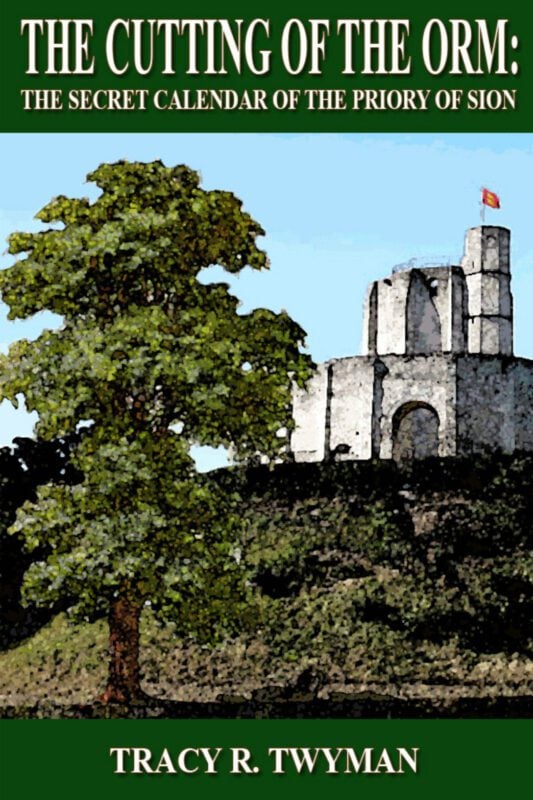
The Cutting of the Orm: The Secret Calendar of the Priory of Sion by Tracy R. Twyman, originally published in 2002 through Dagobert's Revenge Magazine and Quintessential Publications, decodes a layered numerological and calendrical system that Twyman attributes to the Priory of Sion. The work traces its central thesis from the 1188 ceremony known as "the Cutting of the Elm" at Gisors, through Hebrew and English cabalistic alphabetic systems, to a proposed thirteen-house zodiac and a 364-day lunar calendar, synthesizing material from the Priory's Secret Dossiers, Masonic tradition, astronomical cycles, and the Fibonacci sequence.
Interactive Priory of Sion Calendar
The Cutting of the Elm at Gisors
Twyman opens with the event described in the Priory of Sion's Secret Dossiers, discovered at the Parisian Bibliotheque Nationale and examined by the authors of Holy Blood, Holy Grail. In 1188, the Priory separated from its military arm, the Knights Templar, during a ceremony called the "Cutting of the Elm." The historical trigger was the fall of Jerusalem in 1187 to the Saracens under the Templar Grand Master Gerard de Ridefort, whom the Dossiers accuse of treason. The historical record confirms that an elm tree standing on the "Champ Sacre" — the Sacred Field at Gisors — was cut down during a meeting between Philippe II of France and Henry II of England. The tree, more than 800 years old and large enough to require nine men linking hands to encircle its trunk, stood as the only source of shade on the field. After a skirmish broke out, Henry reinforced the trunk with iron bands; Philippe dispatched five squadrons with carpenters, slingsmen, and axes. Richard Coeur de Lion fought to protect the tree, spilling considerable blood, yet the elm fell.
Ormus, the Serpent, and the Alphabet
Twyman identifies a linguistic key in the word "orm." The French word orme means "elm," and the ceremony's French name — decoupage de l'orme — renders literally as "cutting of the elm." In Sumerian and Babylonian, orm means "worm" or "serpent." Twyman reads the "Cutting of the Elm" as a coded reference to the "cutting of the serpent." After the schism, the Priory adopted the name "Ormus," taken from a Gnostic mystic of Alexandria who, according to Masonic tradition, founded an order of initiates in 46 A.D. using the Rose Cross as his symbol. The Priory also appended to its name the subtitle "Ordre de la Rose-Croix Veritas," and Jean de Gisors — the first Grand Master after the split — founded the Order of the Rose-Croix in 1188, according to a manuscript by Robert Denyau, the cure of Gisors.
Twyman then links the serpent to the Hebrew alphabet, the Teli — a serpent biting its own tail — which Jewish mystics equate with the ring of the zodiac. The twenty-two Hebrew letters distribute across the Tree of Life, with the Teli slithering up the paths between the Sephiroth. The serpent combined with the World Tree recurs across mythology, from the Garden of Eden to Yggdrasil. This convergence of tree and serpent, Twyman argues, sits at the center of the Gisors ceremony.
The Compass of Enoch and the Twenty-Six-Letter Cipher
Twyman departs from the twenty-two-letter Hebrew system and proposes a parallel cabalistic system using the modern twenty-six-letter English alphabet, arranged on the Compass of Enoch — a twenty-six-pointed geometric configuration detailed by Boyd Rice. When the alphabet occupies the Compass according to specific clues Twyman discovered, it splits at the letter M, the thirteenth letter. The second half reverses, mirroring the first in symmetry: A sits opposite Z, showing what Twyman calls a reflective relationship between "Alpha and Omega." A continuous zigzagging line connects each letter to its opposite — the equivalent of the Teli serpent, the Orm.
The title "Ormus" encodes this cipher. The Priory wrote it with the letters O, R, U, and S placed inside the letter M, rendered as the astrological symbol for Virgo. The Templars possessed a skull named Baphomet, titled "Caput 58M," with the M written as the Virgo sign. Since M is the thirteenth letter and five plus eight equals thirteen, some researchers read "Caput 58M" as a code for "MM" — Mary Magdalene. Twyman adds a second reading: thirteen plus thirteen equals twenty-six, the number of letters in the English alphabet, split at the M on the Compass of Enoch. The Compass itself produces a geometric pattern containing thirteen oblong M-shapes.
The Priory of Sion's Numerological Structure
Twyman parses the Priory of Sion's organizational statutes — three versions published in the Secret Dossiers and signed by Grand Master Jean Cocteau — and finds a consistent mathematical architecture. The post-1956 statutes describe 9,841 members across nine grades, from Novices (6,561) down to a single Nautonnier. The Cocteau statutes describe five grades totaling 121 ranked members, plus 243 "Enfants de Saint Vincent" created in 1681. In each version, the number of members per grade multiplies by a factor of three.
Twyman divides these membership totals by nine and discovers a cascade: 9841 ÷ 9 = 1093.444..., yielding 1093, the pre-1956 total. 1093 ÷ 9 = 121.444..., yielding 121, the Cocteau total. 121 ÷ 9 = 13.444..., yielding 13, the number of members in the "Arch of the Thirteen Rose-Croix." She subtracts thirteen from the totals that resist clean division by nine and finds the results divide perfectly: 9841 − 13 = 9828, and 9828 ÷ 9 = 1092; 1093 − 13 = 1080, and 1080 ÷ 9 = 120. The digits of 1093 sum to 13. The digits of 364 sum to 13. And 364 ÷ 13 = 28 — the average number of days in a lunar cycle.
The 364-Day Calendar and the Thirteen-House Zodiac
This calculation leads Twyman to the core of her thesis: the Priory of Sion encoded a 364-day lunar calendar in its membership structure. Thirteen lunar cycles of twenty-eight days yield 364 days — the time the Moon takes to travel through the zodiac. Such a calendar would produce thirteen months, seven days per week, four weeks per month, and fifty-two weeks per year, with months beginning and ending on the same day of the week.
Twyman connects this to the Priory's own publication, CIRCUIT, which described a thirteen-house zodiac system adding the constellation Ophiuchus — "the Serpent-Holder" — as the thirteenth house. The Priory also published Le Serpent Rouge, a poem attributed to Grand Master Jean Cocteau, consisting of thirteen stanzas dedicated to thirteen zodiac houses, beginning with Aquarius and ending with Capricorn — the sign under which the Merovingian king Dagobert II died. Ophiuchus, traditionally associated with the science of medicine, corresponds in Twyman's system to Mercury, whose symbol — the caduceus — features two serpents intertwined around a winged staff.
The Golden Ratio, Planetary Orbits, and the Nineveh Constant
Twyman maps the Fibonacci sequence onto her calendrical thesis. She notes that the thirteen-note musical scale, the growth patterns of natural organisms, the structure of a piano keyboard (eight white keys and five black keys per octave — containing the Fibonacci numbers 2, 3, 5, 8, and 13), and the orbits of the planets share a common mathematical ratio: Phi, or 1.6180339.... She cites Henry Lincoln's geometric study of the Rennes-le-Chateau landscape, where mountain peaks form a pentagram encoding the golden ratio. Lincoln calculated that 365.25 (the number of days in Earth's year) divided by 1.618 produces approximately 225 — the length of Venus's year in days.
The Nineveh Constant — a fifteen-digit number (195,955,200,000,000) discovered on a clay tablet during an 1857 excavation of the ancient Assyrian city — enters Twyman's analysis through the work of Maurice Chatelain, a French communications specialist. Chatelain interpreted the number as an expression of time in seconds, equal to 2,268 million days — exactly 240 precessional cycles. He found that the revolutionary cycle of each planet in the solar system divides evenly into this constant. A slight discrepancy in the sixth decimal place, when accounted for by the Earth's gradual rotational slowdown, placed the constant's accuracy at 64,800 years before the present, suggesting to Chatelain that someone calculated it at that date.
The Hypothesis: A Primordial Catastrophe and the Loss of Harmony
Twyman synthesizes these threads into a speculative cosmological narrative. She proposes that the Earth once had a perfectly circular orbit of 360 days with a perpendicular axis, matching the Sumerian 360-degree circle and creating a perpetual equinox — a "Golden Age" without seasons, where astronomical relationships were easy to observe with the naked eye. A cosmic catastrophe tilted the Earth's axis, introduced the Moon into orbit, disrupted the golden relationships between planetary orbits, and severed the zodiacal serpent — the Orm — from humanity's direct perception. This event, Twyman argues, corresponds to the Fall in the Garden of Eden narrative, the destruction of the Tower of Babel, the loss of the secret name of God in Masonic tradition, and the "Cutting of the Elm" at Gisors.
The Moon introduced a "silver" or feminine element — the number 13 — into a previously solar or "golden" system governed by the number 9. Twyman identifies 9 as the Sun's number (nine planets, the nine-based Nineveh Constant, the 360-degree geometry of circular orbits) and 13 as the Moon's (thirteen lunar cycles, the thirteen-house zodiac, the thirteen-letter split on the Compass of Enoch). The Priory of Sion's membership numbers, built on the interplay of 9 and 13, encode this solar-lunar synthesis. Aleister Crowley's Gematria assigns to 9 the meaning "stability in change" and to 13 the meaning "Luna" and "the scale of the highest feminine unity."
Virgo, the Gate of the Sun, and the Grail
Twyman closes by identifying Virgo as the zodiacal figure who guards the "Gate of the Sun" — the herald of seasonal change and of time itself. She draws on Albert Pike's Morals and Dogma to connect Virgo with Isis, Ophiuchus, and the Virgin Mary, and to connect Venus with Mary Magdalene. Virgo crowned with stars at the Vernal Equinox, with the Moon beneath her feet, provided the template for Catholic iconography of the Virgin Mary as "Queen of Heaven." The sum of 9 and 13 is 22, the number of letters in the Hebrew alphabet, and the number stressed throughout the layout of Rennes-le-Chateau, including the twenty-two teeth on the skull-and-crossbones at the entrance to the graveyard at Saint Magdalene's church. The Hebrew letter Mem — equivalent to M, the thirteenth letter — means "water." The ninth letter, Teth, means "serpent."
The book concludes with a proposed thirteen-based Tarot system: twenty-six Major Arcana (two per zodiac house) and fifty-two Lesser Arcana (four suits of thirteen court cards), restructured from the traditional seventy-eight-card deck to reflect what Twyman identifies as the Priory of Sion's secret calendrical and alphabetic architecture.