The Pentagon’s B-Movie (Looking Closely at the September 2001 Attacks)
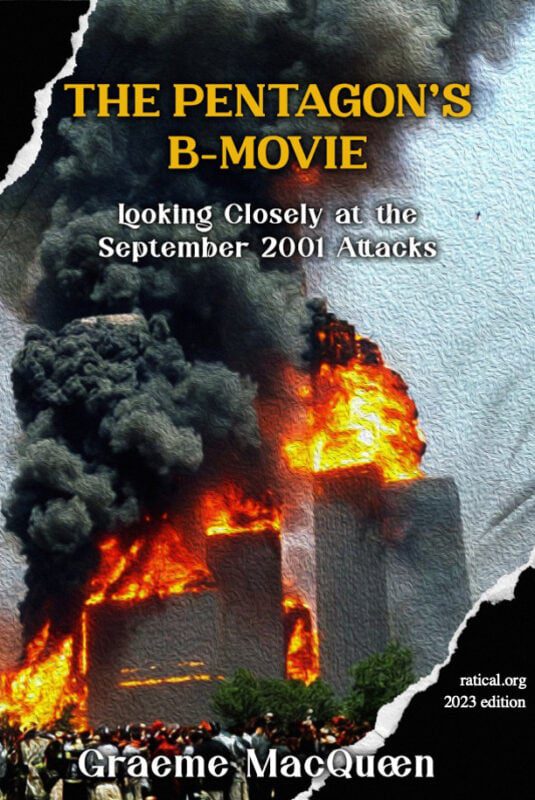
The Pentagon’s B-Movie: Looking Closely at the September 11 Attacks by Graeme MacQueen reframes the 9/11 attacks through the lens of theatrical production, asserting that the events followed a tightly scripted and executed plan orchestrated by elements within the U.S. national security state.
The Premise of Production
The author treats the 9/11 attacks as a staged spectacle rather than spontaneous tragedy. He outlines how the attacks display the hallmarks of a cinematic narrative: timed sequences, dramatic visuals, media saturation, and carefully controlled story arcs. MacQueen identifies scripting in the simultaneity of the plane impacts, the collapse of the towers, and the rollout of media commentary. He highlights directorial control through coordinated media reactions and the Pentagon’s consultations with Hollywood screenwriters following the attacks.
Filmic Design of Catastrophe
The structures of the day resemble film, not only in delivery but in origin. MacQueen locates premeditation in the logistical coordination of multiple aircraft hijackings, the seamless response mechanisms, and the immediate assignment of blame. He identifies actors—both real and constructed—in the hijackers, political figures, and media voices. These characters performed within a framework created to induce shock, mobilize public sentiment, and enable policy transformation.
Manipulation Through Media
The book exposes television’s central role in embedding the official story in public consciousness. It tracks how early live reports, which included eyewitness testimony of explosions, gradually gave way to uniform narratives centered on bin Laden and al-Qaeda. MacQueen documents the erasure of contradiction as news networks silenced deviation and amplified state-scripted commentary. Reporters who initially described secondary explosions or questioned the timeline were later muted or edited.
Controlled Demolition of Evidence
MacQueen focuses extensively on the destruction of World Trade Center Building 7. He highlights foreknowledge among media and first responders of the building’s collapse hours before it occurred. He scrutinizes the National Institute of Standards and Technology (NIST) explanation and challenges its failure to account for symmetrical free-fall motion over several stories. Witness statements, seismic readings, and video evidence converge to support the theory of controlled demolition. The author underscores a pattern of data omission in official reports.
The Anthrax Link
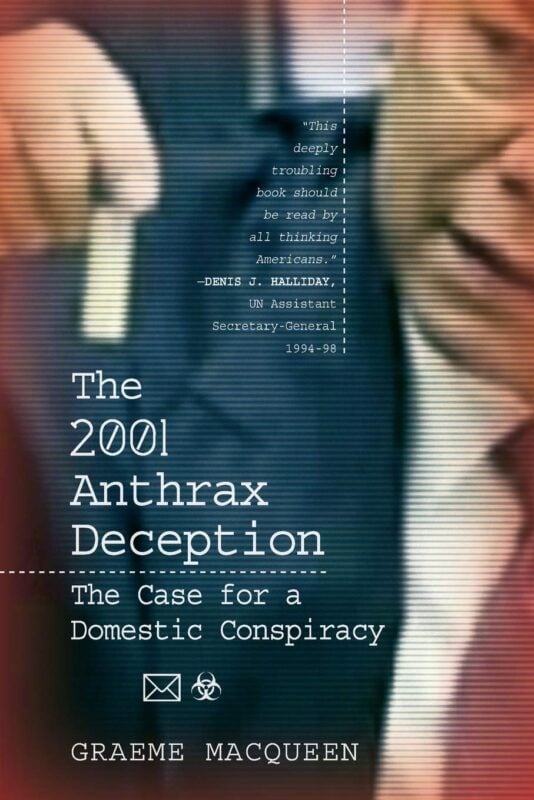
The anthrax attacks followed 9/11 and reinforced the terror narrative. MacQueen presents this sequence as a complementary operation, not a separate incident. He explores the coordinated timing of anthrax-laced letters sent to media figures and U.S. senators who opposed the PATRIOT Act. He tracks the FBI’s shifting suspect profiles and emphasizes the case’s collapse under forensic scrutiny. The alleged lone culprit, Bruce Ivins, received no trial, and key evidence remained classified. MacQueen shows how anthrax functioned to intensify fear, suppress dissent, and justify invasive legislation.
Institutional Complicity and Silence
The narrative extends into the role of major institutions in legitimizing the official account. MacQueen analyzes the 9/11 Commission’s methodology, showing how it ignored or reinterpreted testimony contradicting its conclusions. He identifies systematic suppression in congressional hearings, judicial processes, and the media. This institutional convergence produced what MacQueen calls the “triumph of the official narrative.”
The Manufactured War on Terror
MacQueen traces the function of 9/11 as a catalytic event that launched decades of military aggression. He details the rapid expansion of executive power, domestic surveillance, and global warfare under the justification of national security. He argues that 9/11 enabled pre-existing agendas, including invasions of Afghanistan and Iraq. He identifies how fear became a mechanism for public consent, transforming resistance into marginal dissent.
Leftist Gatekeeping and Ideological Control
A pivotal section addresses the failure of prominent left-wing intellectuals and media outlets to confront the anomalies of 9/11. MacQueen critiques figures like Noam Chomsky, Chris Hedges, and outlets such as The Nation, Democracy Now!, and Common Dreams. He accuses them of moral abdication and complicity through silence, which prevented broader public discourse and investigation. Their refusal to engage with primary evidence allowed the official narrative to ossify.
Recurrent Patterns in False Flag Events
The book situates 9/11 within a longer historical pattern of provocations used to initiate war. MacQueen draws parallels to the JFK and MLK assassinations, the Gulf of Tonkin incident, the 2008 Mumbai attacks, and the October 22 Ottawa shooting. He analyzes how each event produced rapid shifts in policy, public opinion, and surveillance. By comparing structure, outcome, and media response, he builds a taxonomy of state-driven deception.
Firsthand Testimony of Explosions
MacQueen compiles extensive oral histories from FDNY firefighters and emergency personnel. He catalogs specific references to explosions, implosions, and timed detonations. He presents their testimony as empirical data—categorized, quantified, and cross-referenced. These accounts contrast starkly with NIST’s and the 9/11 Commission’s exclusion of explosive evidence. The author argues that this firsthand data forms the core of an alternative hypothesis grounded in physical experience rather than speculative theory.
Expert Dissent and Scientific Rebuttal
Several chapters feature the work of physicists, architects, and engineers who challenged the collapse narrative. MacQueen includes critiques of the Bazant-NIST hypothesis, which lacked the “jolt” necessary to initiate pancaking collapse. He documents video analysis showing symmetrical descent incompatible with gravitational failure alone. He correlates seismic data with explosion timing, identifying pre-collapse vibrations that contradict the sequence proposed by official agencies.
Patterns in Media Realignment
The final chapters track the transformation of media coverage from initial shock to narrative enforcement. MacQueen presents statistical analysis of on-air statements by anchors, field reporters, and interviewees. He identifies an inflection point at which language shifted from observational to doctrinal. He documents how network executives and military consultants shaped framing in real time. This recontextualization turned early signs of internal demolition into fixed assumptions about foreign attack.
Imagination as a Tool of Propaganda
The text explores how the U.S. government invoked a “failure of imagination” to explain intelligence breakdowns, only to subsequently rely on Hollywood for strategic storytelling. MacQueen argues that imagination was deployed selectively—to plan simulations, write policies, and frame global threats. He describes how the Pentagon hosted Hollywood figures to brainstorm future attack scenarios, revealing the intentional crafting of plausible terror scripts.
The Real Monster Behind the Curtain
MacQueen challenges readers to discard fictional accounts and confront the source of power that scripted the violence. He identifies a network of agencies, contractors, and policymakers who benefited materially and strategically from the attacks. This network used spectacle to erase constraints on military force, dissolve civil liberties, and redirect geopolitical agendas. He urges a shift from narrative consumption to structural investigation.
A Call to Reopen the Case
The author compels readers to reconsider foundational assumptions. He rejects the framing of 9/11 as a failure or tragedy and instead presents it as a successful operation. The evidence points toward deliberate orchestration, systematic cover-up, and structural complicity. He demands renewed investigation grounded in primary data, legal accountability, and public mobilization.
Legacy and Consequence
The consequences of this deception remain active. The War on Terror continues to justify military deployments, surveillance, and domestic repression. MacQueen’s work functions as both indictment and archive. It offers a foundation for forensic inquiry and political awakening. It invites researchers, activists, and citizens to confront the reality behind the story.
Why Read The Pentagon’s B-Movie Today
Graeme MacQueen combines academic rigor with investigative courage. His analysis reframes an event that reshaped the 21st century and continues to justify authoritarian power. This book delivers a comprehensive, evidence-based critique that transcends theory and enters the domain of legal and political consequence. It serves as a crucial resource for understanding how visual spectacle becomes a weapon of statecraft.