The Politics of Linguistics

The Politics of Linguistics by Frederick J. Newmeyer traces the development, influence, and ideological stakes of the autonomous approach to linguistic theory, grounding it in historical, academic, and political forces that shaped twentieth-century thought. Newmeyer dissects the structural tensions between humanistic, sociological, and formalist traditions, mapping the rise of grammatical autonomy as both a scholarly advance and an institutional alignment. He locates linguistic theory within intellectual history, revealing its role in shaping disciplines and its intersection with power, authority, and legitimacy.
Language as Human Infrastructure
Language defines the parameters of cognition, interaction, and expression. Philosophers, psychologists, and technologists converge around its analysis because language constructs the framework through which thought and social life emerge. Autonomous linguistics focuses on internal structure, isolating phonological, morphological, and syntactic rules. These regularities create a model of grammar that operates independently of speaker beliefs, historical variation, or social context. The pursuit of this model produces a science of language rooted in formal consistency and predictive rigor.
The Structural Foundations of Autonomy
Comparative linguistics laid the groundwork. Beginning with William Jones's identification of Indo-European language kinship in 1786, linguists sought historical patterns in phonetic and grammatical change. They formalized methods to reconstruct proto-languages through systematic sound correspondences. Jacob Grimm's identification of regular phonological shifts led to Grimm's Law, demonstrating that language evolution followed rule-governed paths. Scholars developed a view of languages as structured entities that evolve under internal constraints.
Franz Bopp and August Schleicher extended this theory by framing languages as organisms—entities governed by internal principles of life and development. Schleicher’s classification of languages into evolutionary stages gave linguistic autonomy a theoretical framework. Though biology later abandoned the organism metaphor, linguistic theory retained its structural independence.
Saussure and the Cours de Linguistique Générale
Ferdinand de Saussure transformed linguistic focus from diachrony to synchrony. He distinguished langue, the shared structural system of a language, from parole, the individual act of speaking. By conceptualizing langue as a self-contained system of relational units, Saussure empowered linguists to study language in its own terms. Structuralism emerged as a method for uncovering phonological, morphological, and syntactic categories as internal components of a coherent system. This theoretical shift expanded the field’s capacity to generate testable, replicable descriptions of linguistic structure.
Institutional Power and Disciplinary Identity
As structuralism gained traction in European centers like Prague and Geneva, its American variant solidified around the work of Franz Boas, Edward Sapir, and Leonard Bloomfield. Boas rejected ethnocentric claims about “primitive” languages and insisted on the grammatical parity of all linguistic systems. Bloomfield emphasized formal rigor and empirical method, aligning linguistics with the logic of the natural sciences. He advocated for behaviorist models and the exclusion of semantics, treating meaning as beyond the scope of objective analysis.
In the United States, structural linguists codified the field’s identity around methodological uniformity, professional association, and textbook dissemination. The Linguistic Society of America emerged as a unifying institution. Texts like Fromkin and Rodman’s An Introduction to Language became standard-bearers, devoting most of their content to grammatical theory while marginalizing literary and stylistic study. The field’s internal coherence and scientific self-presentation helped consolidate its status within academia.
Language, Power, and Ideology
Autonomous linguistics attracted ideological critique from both Marxist and sociological perspectives. Critics argued that stripping language from its social context reproduces an idealized, decontextualized subject. For M.A.K. Halliday, George Lakoff, and Dell Hymes, linguistic structure must be embedded in communicative function, social hierarchy, and political conflict. They viewed Chomsky’s generative grammar as an ideological artifact—epistemologically exclusionary, politically conservative, and sociologically blind.
Supporters of autonomy countered that only by isolating formal properties could linguistics produce explanatory depth. Noam Chomsky argued that universal grammar reflects innate cognitive structures. This claim enabled cross-disciplinary synthesis: philosophers embraced its rationalist implications, psychologists linked it to theories of mind, and neurologists searched for its biological substrate. Generative grammar presented language as a biological faculty with internal constraints, encoded in mental architecture.
The Chomskyan Paradigm
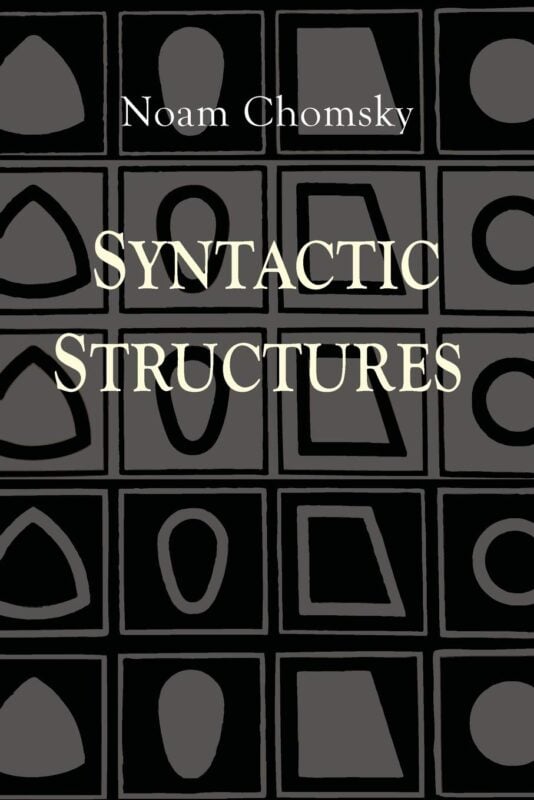
Chomsky’s transformational-generative grammar restructured linguistic inquiry. He proposed that humans possess an innate language faculty governed by a universal grammar, from which all natural languages derive. His early work, particularly Syntactic Structures, shifted the field’s focus from taxonomic description to explanatory theory. Syntax became the central site for investigating linguistic competence—the speaker’s implicit knowledge of grammatical rules.
By formulating formal grammars that generated infinite sentence sets from finite rules, Chomsky transformed linguistics into a theoretically-driven discipline. His approach required abstraction from usage, variation, and context. The resulting models revealed structural properties unavailable through descriptive fieldwork alone. Chomsky’s critics accused him of ignoring pragmatics, discourse, and communicative intention. He dismissed these charges by asserting the distinction between linguistic competence and performance, a division that shielded his models from sociolinguistic complexity.
Resistance and Reinscription
Outside the U.S., autonomous linguistics struggled for legitimacy. European scholars, particularly in Marxist and phenomenological traditions, resisted formal abstraction. Structuralism’s perceived indifference to ideology, identity, and power drew criticism from scholars seeking to ground language in human experience. Soviet linguistics branded it bourgeois formalism. Nazi and fascist regimes attacked its egalitarian implications. Structuralist methods were incompatible with state-sponsored theories that racialized or aestheticized national languages.
In France, structuralist ideas migrated into other disciplines, even as linguistic structuralism itself lost academic influence. Claude Lévi-Strauss applied linguistic models to anthropology, analyzing kinship systems as symbolic codes. Roland Barthes adapted structuralist concepts to literary theory. Michel Foucault explored discourse and power without embracing linguistic formalism. Structuralism catalyzed intellectual movements without sustaining disciplinary dominance.
Disciplinary Demarcation and Professional Strategy
Autonomous linguistics distinguished itself through institutional strategy. In the U.S., its adherents established departments, journals, and funding channels that reinforced their methodological norms. They rejected prescriptive grammar, yet urged adaptation to standard usage for practical advancement. They advocated for dialect equality while acknowledging sociopolitical constraints. This dual message—equality in theory, hierarchy in practice—provoked resistance from educators and cultural critics who viewed linguistics as complicit in linguistic decline.
The profession's commitment to egalitarianism sharpened its identity. Structural linguists rejected claims that some dialects lacked expressive capacity or logical structure. They demonstrated that linguistic rules operate systematically across varieties, regardless of prestige or status. This claim became a defining feature of American linguistics, shaping its public stance and educational interventions.
Legacy and Stakes
The Politics of Linguistics charts a field that sought scientific objectivity and encountered ideological scrutiny. It exposes how theoretical models reflect institutional interests, cultural narratives, and political alignments. Linguistics, Newmeyer shows, does not unfold in a vacuum. It participates in broader contests over authority, meaning, and representation.
The book establishes autonomy not as a neutral method but as a historically situated response to intellectual and institutional pressures. It reveals how linguistic theory enacts decisions about relevance, scope, and legitimacy. These decisions shape what counts as language, what qualifies as knowledge, and who controls its interpretation. In Newmeyer’s account, linguistic theory becomes a site where the boundaries of science, the role of ideology, and the structure of knowledge intersect.