Neuro-Linguistic Programming: Volume I (The Study of the Structure of Subjective Experience)
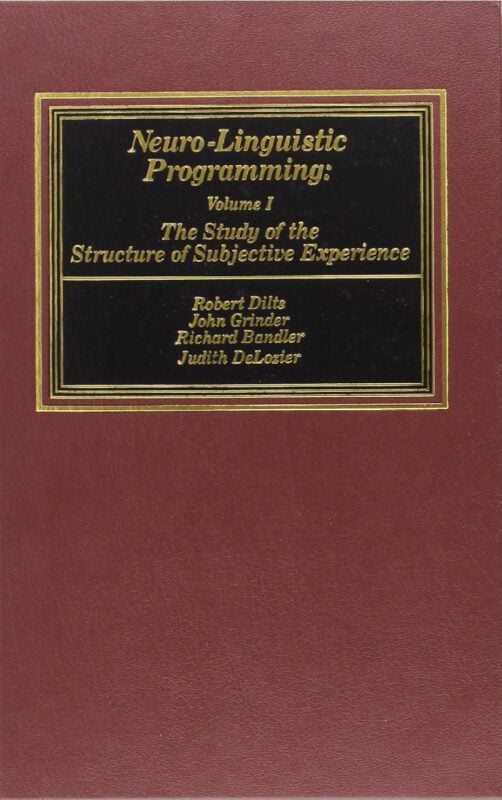
Neuro-Linguistic Programming Volume I: The Study of the Structure of Subjective Experience by Robert Dilts, John Grinder, and Richard Bandler introduces a discipline that transforms how individuals perceive, encode, and transform subjective experience. The authors position neuro-linguistic programming (NLP) as a model dedicated to clarifying the structures underlying human thought, communication, and behavior.
Origins of Neuro-Linguistic Programming
Robert Dilts, John Grinder, and Richard Bandler ground their work in the assertion that the structure of subjective experience determines the outcomes individuals can achieve. NLP emerges from collaboration among innovators seeking to formalize communication patterns that produced remarkable results in therapy, education, business, and law. This discipline does not pursue abstract theory. It operates as a pragmatic model—a set of procedures to organize, adapt, and expand behavioral possibilities. By analyzing what makes certain communicators effective, NLP makes those strategies transferable.
The Power of Modeling Human Experience
Modeling serves as the foundational act in NLP. Humans construct models—representational systems—to manage and navigate reality. These models function as cognitive maps, which encode the complex interactions between behavior and environment. Sensory experience provides the raw material for these maps, shaping beliefs, habits, and choices. Rather than addressing behavior in the abstract, NLP insists that models must account for the patterns by which individuals encode experience, select responses, and achieve outcomes.
The Map Is Not the Territory
NLP asserts that individuals never access objective reality directly. Sensory pathways—vision, audition, kinesthesis, olfaction, gustation—filter experience, creating internal representations. These representations form the basis of behavior, as the brain processes inputs through learned sequences. The authors define behavior to include both observable actions and internal representations. Driving a car, recalling a memory, experiencing an emotion—all exemplify behavioral output arising from structured sequences of sensory coding. This recognition places the locus of behavioral change within the individual’s sensory and representational systems.
Representational Systems: Foundations of Behavior
The core representational systems—visual (V), auditory (A), kinesthetic (K), and olfactory/gustatory (O)—form the elements from which behavior is constructed. The book introduces the “4-tuple” notation, a powerful analytic tool for mapping and transforming sensory experiences. Externally sourced (e) and internally generated (i) representations together define the structure of subjective reality at any moment. NLP demonstrates that patterns in sequencing and combining these modalities underpin strategies for decision-making, learning, creativity, motivation, and change.
From Modeling to Meta-Modeling
The authors frame NLP as a meta-model—a model of the modeling process. This stance sets NLP apart as a discipline concerned with how models arise, evolve, and deliver results. Strategies that produce superior outcomes in one domain can be extracted, unpacked, and installed in another. This process turns implicit expertise into teachable skills, democratizing access to successful behavior patterns. By elevating modeling itself to the object of study, NLP creates a recursive loop: practitioners continually refine their capacity to observe, adapt, and innovate.
Elegance in Modeling: Toward Simplicity and Power
Elegance, as defined by NLP, refers to the minimal number of rules and distinctions needed to achieve a broad range of outcomes. The pursuit of elegance drives practitioners to identify the simplest set of elements and organizing principles that govern complex behaviors. This process streamlines both analysis and application, maximizing learning efficiency. The most elegant models yield powerful leverage, allowing rapid and consistent replication of effective behaviors without requiring immersion in every detail or content area.
Strategies: Sequencing for Success
Every complex behavior decomposes into a sequence of internal and external sensory events—a strategy. By analyzing these strategies, practitioners make explicit the pathways that produce results, whether in sports, sales, negotiation, therapy, or creative endeavors. NLP provides systematic procedures for eliciting, mapping, and modifying these strategies, transforming talent into transferable knowledge. These methods enable the rapid acquisition of new abilities, refinement of existing skills, and remediation of maladaptive patterns.
Synesthesia and Pattern Correlation
Cross-modal patterns—synesthesias—link sensory channels, enabling rich meaning-making and behavioral versatility. Hearing a melody evokes a visual scene; a scent triggers a cascade of memories; a voice tone stirs emotion. Synesthesia underlies creativity, learning, and communication. NLP brings these cross-modal patterns to the surface, providing practical tools to leverage or rewire synesthetic linkages for personal or organizational growth.
Decision Variables and the Expansion of Choice
The progression of human development, as described in the book, involves shifting elements of experience from the realm of environmental variables (those considered outside one’s control) into decision variables (those brought under volitional management). NLP enables this transition by offering methods to reframe, reorganize, and claim agency over responses previously experienced as automatic or imposed. Through modeling, elicitation, and installation, practitioners expand the range of choices available in any context, from emotional regulation to high-stakes decision-making.
Form Versus Content: The Primacy of Structure
NLP holds that the structure of experience, rather than its specific content, determines outcomes. By emphasizing form—the rules governing the sequence and organization of sensory events—practitioners gain a universal toolkit. These tools enable adaptation across domains: a motivational strategy used in athletics can transform performance in business; a problem-solving pattern in engineering can enhance relationship communication. The book provides the analytic frameworks necessary to abstract and transfer structure, not just content.
Applications in Therapy, Education, and Business
NLP’s utility spans contexts. The book documents applications from rapid phobia resolution in therapy to skill acquisition in education and negotiation breakthroughs in business. Practitioners use NLP strategies to teach reading to students labeled “educationally handicapped,” to resolve conflict in entrenched organizational disputes, and to catalyze growth in high-performing individuals. The discipline's grounding in sensory-based, user-oriented procedures ensures that results can be observed, replicated, and refined in real time.
Elicitation, Design, and Installation: The Core Processes
The text delineates three key processes: elicitation (identifying and mapping the sequence of sensory representations in a strategy), design (streamlining or modifying the strategy for greater effectiveness), and installation (teaching or instilling the strategy in oneself or another). These processes follow a clear sequence: clarify the present state, define the desired state, and marshal resources to bridge the gap. Each step draws on explicit sensory cues—eye movements, gestures, voice tone, posture—to ground analysis and intervention.
Anchoring and Synesthesia: Creating Behavioral Leverage
Anchoring, a central technique in NLP, enables practitioners to attach specific states or responses to sensory cues. By consciously establishing anchors and linking them to resourceful states, individuals gain access to targeted behaviors or emotions on demand. This mechanism, rooted in synesthesia, supports rapid change and reliable performance. NLP provides a toolkit for identifying existing anchors (many of which operate outside conscious awareness), dissolving unhelpful ones, and installing new, generative patterns.
Reframing and Organizational Change
Reframing transforms the perceived meaning or context of an experience, unlocking new possibilities for action. NLP operationalizes reframing as a strategy, not a vague concept. The text extends this process from individuals to organizations, showing how systemic patterns—departments, teams, leadership structures—mirror the internal representational systems of a person. Practitioners can model, sequence, and re-sequence organizational behaviors to produce more elegant, adaptive outcomes.
Sensory Acuity and Feedback: The Engine of Learning
NLP insists that models prove themselves through results observable in the sensory channel. Practitioners cultivate acute sensory awareness—tracking subtle shifts in physiology, language, and behavior—to calibrate progress and adapt interventions. Feedback becomes the engine of accelerated learning, driving the iterative refinement of strategies. The live, interactive quality of NLP work ensures that change is anchored in present-moment experience rather than abstract formulation.
Meta-Strategies for Continuous Evolution
The book proposes meta-strategies—strategies about strategies—enabling practitioners to evolve their approaches continually. This recursive process builds flexibility, adaptability, and resilience. As new outcomes are achieved, strategies are refined, generalized, and applied to broader domains. NLP cultivates a learning stance that values discovery, experimentation, and the pursuit of greater elegance in every domain.
Narrative Structure and the Human Journey
Within the larger arc of the book, the narrative tension emerges from the quest to unpack and replicate the patterns that differentiate excellence from mediocrity, possibility from limitation. The journey unfolds as readers move from passive recipients of experience to active modelers, designers, and installers of new behavioral possibilities. The horizon expands with each new insight into how subjective experience takes form and how those forms can be shaped for greater meaning and achievement.
Subjective Experience and Human Potential
The authors claim that the ultimate aim of NLP lies in expanding human potential by rendering the structures of subjective experience accessible, modifiable, and generative. The power to model, transfer, and install effective strategies represents the core of this potential. NLP practitioners gain the tools to create new realities, both internally and in the world, by mastering the architecture of thought, language, and behavior.
The Convergence of Science, Art, and Practice
NLP draws from and integrates diverse fields—linguistics, psychology, neurology, cybernetics, communication theory, and information sciences—into a coherent, practical system. The convergence of these influences produces a robust, flexible methodology. The book’s structured approach bridges the gap between theory and application, ensuring that advances in understanding translate into practical outcomes. NLP stakes its value on usefulness, sensory grounding, and replicable success, not theoretical speculation.
Future Horizons
The narrative closes by urging readers to embrace the role of explorer, modeler, and creator. NLP’s foundational promise invites engagement with the evolving edge of subjective experience, promising discovery, growth, and transformation. As new models emerge and strategies evolve, the discipline extends its reach into new fields and challenges, embodying the adventure of mapping and shaping the unexplored territory of the mind.
What new behaviors, outcomes, and futures can arise when individuals seize control of the structures shaping their experience? How far can modeling, strategy, and sensory acuity take the discipline of NLP—and those who apply its principles? The answers unfold in action, grounded in the elegant forms and generative strategies described in this foundational work by Robert Dilts, John Grinder, and Richard Bandler.