The Invasion from Mars: A Study in the Psychology of Panic
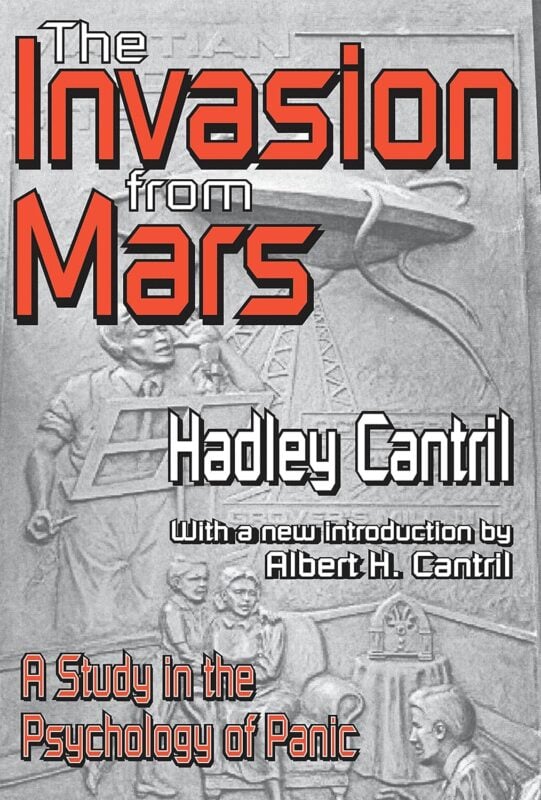
The Invasion from Mars: A Study in the Psychology of Panic by Hadley Cantril and Albert Cantril analyzes a landmark episode in American media history, tracing the origins, unfolding, and aftermath of the mass panic that followed the 1938 “War of the Worlds” radio broadcast. On the night before Halloween, Orson Welles and the Mercury Theatre on the Air delivered a performance that presented an imagined Martian invasion as a series of simulated news bulletins. Listeners, caught mid-program and unaware of the fictional premise, absorbed each report as authentic, fueling widespread distress, anxiety, and disarray.
Origins of a Broadcast: Media, Message, and Listener
CBS radio scheduled the Mercury Theatre adaptation during a period when listeners regularly tuned into the radio for authoritative news and entertainment. Radio had rapidly established itself as the nation’s voice, a source that fused immediacy with a sense of intimacy. The “War of the Worlds” production, leveraging the format of breaking news interruptions, generated a dynamic in which listeners heard authoritative voices and urgent updates, making the story’s fictional elements indistinguishable from standard reporting.
The program’s scriptwriter and actors layered cues of realism: scientific experts debated on-air, sound effects mimicked explosions and crowd panic, and actors portrayed government officials. The narrative’s escalation—initial sightings of mysterious explosions, military mobilization, and casualty reports—unfolded with clockwork precision. As listeners joined in progress, many missed the opening disclaimer, amplifying confusion and alarm.
Mass Reaction: Panic, Flight, and the Structure of Fear
The broadcast catalyzed a chain reaction across American cities and towns. Reports poured in of people abandoning their homes, jamming highways, and contacting police stations. Some listeners telephoned loved ones to say goodbye; others prayed, wept, or gathered in churches. Rumors of gas attacks, poisoned water, and falling meteors quickly circulated, extending panic far beyond the initial audience.
Hadley Cantril and Albert Cantril conducted over a hundred interviews, drawing from a broad cross-section of respondents to capture the psychological and situational dynamics at work. Listeners who panicked demonstrated acute emotional suggestibility, heightened by the credibility they attached to radio as a medium. The authors identified sequences of escalating response: initial skepticism yielded to mounting anxiety as familiar radio conventions, such as expert testimony and on-the-spot reporting, constructed a persuasive simulation of crisis.
Media Authority and the Psychology of Belief
Radio commanded trust. Its voices, amplified through living rooms and kitchens, held persuasive power. Cantril demonstrates how the authority of the broadcaster translated into the authority of the message. Listeners heard scientific language, military commands, and appeals to the president—all of which conferred legitimacy on unfolding events. The program’s technical realism, including fluctuating signal quality and urgent interjections, added to the perceived authenticity.
The panic did not stem merely from gullibility or a lack of intelligence. The authors trace its roots to an intricate matrix: recent European crises, mounting anxiety over war, and a volatile social climate. Many respondents, primed by global uncertainty, accepted the possibility of catastrophe without immediate question. The events of 1938 revealed that mass media, when wielded with dramatic force, can synchronize individual fears and create a collective emotional state.
Individual Difference: Education, Context, and Emotional Readiness
Cantril’s study charts how personal characteristics shaped reactions to the broadcast. Individuals with higher educational attainment or greater exposure to scientific thinking paused to verify the facts, seeking corroboration through other media or personal networks. Others, lacking such resources, responded with swift credulity, suspending disbelief in the face of urgent, unfamiliar information.
Religious background, previous experiences with crisis, and emotional stability all influenced outcomes. Listeners who experienced chronic insecurity or who lived in social environments marked by tension proved most susceptible to fear. The broadcast did not function as a one-size-fits-all trigger; it found fertile ground among those already attuned to anxiety or lacking the social and intellectual tools to contextualize extraordinary claims.
Techniques of Broadcast: Building Realism and Momentum
The Mercury Theatre’s mastery of radio conventions intensified the sense of immediacy. News bulletins interrupted regular programming, forcing listeners to recalibrate expectations. Actors shifted from calm reportage to frantic, eyewitness accounts, weaving escalating threat into the broadcast’s fabric. Sound design mimicked sirens, static, and the clamor of crowds, compounding the illusion of ongoing disaster.
The writers anticipated potential disbelief by embedding skeptics and naysayers within the story. These characters, voicing doubt, helped reinforce plausibility for those in the audience wavering between acceptance and suspicion. The script never settled into melodrama; it sustained momentum, providing no release from tension until well after many listeners had succumbed to fear.
Contagion of Panic: Social Networks and Information Flow
Panic seldom remained isolated within individual households. Listeners shared what they heard with family, friends, and neighbors, sometimes amplifying or distorting the message. Social networks functioned as accelerants, propagating anxiety as people repeated news or interpreted silence and ambiguity as signs of danger. The study documents cascading effects as telephone lines clogged, churches filled, and emergency services fielded calls from frightened citizens.
The dynamics of contagion revealed that panic operates through both direct communication and the anticipation of threat. People who missed the broadcast’s content responded to the alarm of others, internalizing a sense of urgency without access to the source. Fear, once kindled, traveled along pathways shaped by trust, rumor, and the need for collective reassurance.
Aftermath and Media Ethics: Lessons in Responsibility
Public outrage and concern followed the events of October 30, 1938. Newspapers chronicled the night’s events, calling for oversight and raising questions about broadcasters’ responsibilities. The radio industry responded by introducing more frequent disclaimers and reconsidering dramatic formats that might blur fiction and fact. Policymakers, educators, and the public engaged in debate about the limits of creative expression and the necessity of critical media literacy.
Cantril’s analysis led to enduring principles: dramatic presentations that mimic news reporting require safeguards. Media producers bear a duty to distinguish between dramatization and reporting. Audiences benefit from clear signals that define the boundary between fiction and actuality.
The Structure of Collective Belief: How Minds Meet Media
The book dissects how collective belief takes shape under specific conditions. Listeners, when confronted with unfamiliar cues and authoritative voices, synthesize information rapidly, filling gaps with imagination or prior anxieties. The authors trace how sequences of interpretation unfold—first, confusion; then, provisional belief; finally, action or emotional breakdown.
This process does not arise from naïveté alone. It reflects the convergence of media technique, social context, and personal readiness to believe. When media articulate scenarios that resonate with existing fears or expectations, belief becomes plausible, and mass action becomes possible.
Media, Memory, and the Evolution of Public Consciousness
The “War of the Worlds” panic occupies a singular place in the cultural memory of American media. Cantril’s study continues to inform research on media effects, the psychology of rumor, and the ethics of mass communication. The event’s legacy persists in contemporary concerns about fake news, viral misinformation, and the power of authoritative voices to shape public consciousness.
By tracing the line from broadcast to panic to analysis, the authors demonstrate that technological innovation often outpaces the development of interpretive habits. Societies that grant trust to new media must develop mechanisms—both cognitive and institutional—to assess, verify, and contextualize extraordinary claims.
Media Literacy and Public Resilience
The lessons of 1938 shape contemporary discussions about media literacy. Cantril’s research affirms the necessity of education that fosters skepticism, source evaluation, and verification. Schools, civic organizations, and families serve as critical environments for building these skills. Media organizations contribute by maintaining transparent boundaries between fiction and reporting, drama and documentary.
The convergence of storytelling, technical prowess, and authority can spark profound emotional and behavioral responses. The responsibility to channel these forces constructively, rather than exploit them for shock or sensation, falls to creators, educators, and audiences alike.
Continuing Relevance in the Digital Age
Contemporary digital platforms accelerate the velocity and reach of information, introducing new risks and opportunities. The underlying mechanisms that produced the “War of the Worlds” panic—trust in the medium, persuasive authority, and the rapid spread of rumor—persist in the age of viral news and algorithmic feeds.
The structure of belief, the contagion of panic, and the ethics of media endure as central challenges. Cantril’s work asserts that societies must continuously adapt interpretive strategies, cultivating resilience against manipulation while harnessing the creative potential of new media forms.
Conclusion: Synthesis of Event, Analysis, and Legacy
Hadley Cantril and Albert Cantril reveal the mechanisms by which mass media can catalyze collective emotion and action. Their study documents the convergence of technological innovation, narrative strategy, psychological readiness, and social context. The “War of the Worlds” broadcast illuminated how media, when deployed with authority and realism, can provoke extraordinary effects.
The authors embed their findings within a framework of accountability and growth. They establish media literacy, institutional responsibility, and public skepticism as foundations for healthy engagement with information. The legacy of the 1938 panic persists in the evolving landscape of communication, where the search for clarity, credibility, and context defines the horizon of possibility.