Seven Types of Ambiguity
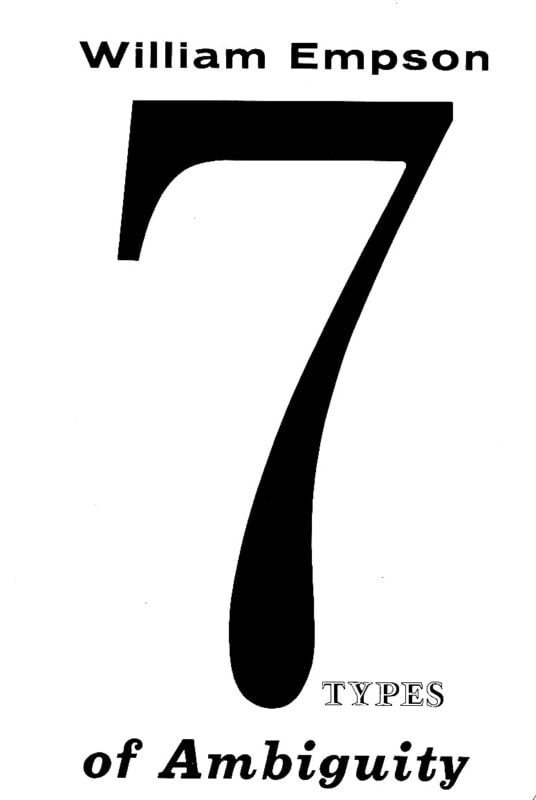
Seven Types of Ambiguity by William Empson redefined the intellectual foundations of literary criticism in the twentieth century by revealing the intricate patterns of meaning that language generates through its inherent multiplicity. Empson’s study of how words, phrases, and images resonate with layered implications transformed close reading into an art of perception, interpretation, and philosophical rigor. The book emerged from his work at Cambridge under I. A. Richards, whose psychological approach to meaning helped shape Empson’s method. Yet Empson expanded that inquiry into an independent system of thought, mapping the mechanics of poetic meaning with unmatched clarity and precision.
The Architecture of Meaning
Empson structures the book around seven distinct “types” of ambiguity, each representing a different degree of semantic complexity. The first type, in which a word or phrase performs multiple functions simultaneously, defines the foundation of poetic richness. A line like “Bare ruined choirs where late the sweet birds sang” demonstrates this multiplicity: the phrase evokes both the physical desolation of a monastery and the inner erosion of vitality. The image, for Empson, condenses historical, emotional, and linguistic forces into a single, self-sustaining structure.
As the types progress, ambiguity intensifies. The second type fuses alternative meanings into one resolved statement, while the third juxtaposes unconnected meanings that coexist within the same linguistic field. Later types extend into contradictions, psychological tensions, and even moral paradoxes that fracture and enrich the poet’s consciousness. The seventh type—the most complex—captures the full division of the author’s mind, where contradictory intentions remain irreconcilable yet mutually essential. Empson treats this structure as a record of thought rather than a flaw in coherence.
Analytical Precision and Theoretical Force
Empson’s method relies on rigorous verbal analysis, but his precision never isolates language from the life it expresses. He reads poetry as a record of intellect under pressure, where every word negotiates between feeling and idea. The book’s analysis of Shakespeare, Donne, Milton, Marvell, Pope, Shelley, and Yeats unfolds with almost mathematical confidence. Each example becomes an experiment in how thought materializes in syntax.
In Shakespeare’s sonnets, Empson identifies “double grammar,” moments when two syntactic readings operate simultaneously, forcing the reader to experience the oscillation of sense. In Pope, he finds a deliberate play of precision and irony that binds moral judgment to linguistic form. When Empson turns to Shelley and Swinburne, he interprets their apparent excess as a productive confusion—an aesthetic that mirrors the poet’s discovery of meaning in the act of writing.
His analysis does not dismantle poetry; it reveals how meaning grows by internal friction. He asserts that ambiguity is not an accident of language but its generative principle. Words are not inert symbols but living instruments shaped by human conflict, emotion, and cognition.
The Critic as Constructor
Empson’s approach positions the critic as a constructor rather than a judge. His task is to articulate how language operates, not to assign value by external standards. He rejects the separation of sound and sense, arguing that every element of poetic form participates in semantic construction. The sound of a line, its rhythm, and its grammatical structure act as converging pressures that define meaning.
The clarity of his definitions sustains the complexity of his examples. When he describes ambiguity as “any verbal nuance, however slight, which gives room for alternative reactions,” he offers a working principle rather than an abstraction. The critic’s role, then, is to trace these reactions through the poem’s architecture, reconstructing the paths by which thought becomes form.
Historical Context and Intellectual Influence
Written in the late 1920s and published in 1930, the book emerged from the ferment of modernist criticism that surrounded figures like T. S. Eliot, I. A. Richards, and F. R. Leavis. Empson’s synthesis of linguistic analysis and psychological insight extended beyond their frameworks. Where Eliot emphasized moral order and Richards emphasized psychological response, Empson revealed how language itself mediates between these domains.
The book’s influence spread rapidly through both British and American criticism, shaping the foundations of the New Criticism movement while maintaining its independence from academic orthodoxy. At the University of Sheffield and later at King’s College, Cambridge, Empson trained generations of readers to treat language as an active medium of thought. His later works, including Some Versions of Pastoral and The Structure of Complex Words, continued this project, expanding the theory of meaning into broader cultural and ethical terrain.
The Intellectual Engine of Ambiguity
Empson’s conception of ambiguity functions as both a linguistic principle and a moral philosophy. Ambiguity reveals the mind’s engagement with complexity, the way meaning survives contradiction without dissolving into uncertainty. In his analysis of metaphysical poets such as Donne and Herbert, Empson demonstrates that tension within a line mirrors the tension within the mind that wrote it. This relation between mental state and verbal form turns criticism into a study of consciousness.
His reading of Donne’s “A Valediction: Forbidding Mourning” shows how the compass image unites geometry, love, and faith in a single act of metaphoric precision. The image holds its balance through opposing forces—motion and stillness, separation and unity. For Empson, such equilibrium is not metaphorical decoration; it is the structure of meaning itself.
When Empson analyzes Milton or Gray, he treats language as a moral instrument capable of reconciling philosophical abstractions with emotional immediacy. The poet’s responsibility lies in maintaining coherence under tension, allowing contradiction to become expressive rather than destructive.
The Method of Reading
The strength of Empson’s method lies in its adaptability. He reads poems as systems of interdependent meanings, each element accountable to the others. Ambiguity operates as the mechanism by which poetry compresses complex experience into verbal form. This compression demands from the reader a parallel act of reconstruction.
His description of how readers process multiple meanings anticipates later developments in cognitive theory. He argues that understanding a poem often involves following alternate interpretations in sequence before perceiving their unity. The reader experiences ambiguity as a dynamic movement of thought, not a static puzzle.
This movement explains why great poetry resists paraphrase. Meaning in Empson’s sense is not a single statement hidden behind the text but a set of interrelated possibilities that generate emotional and intellectual force.
Style and Argument
Empson writes with a precision that reflects his mathematical training and his philosophical temperament. His prose builds arguments through cumulative reasoning rather than rhetorical flourish. He distrusts abstraction unless it clarifies an exact relation between language and perception. The density of his examples gives the book a texture of continuous discovery.
His engagement with predecessors such as Johnson, Newman, and Eliot grounds his theory in historical continuity. Yet his tone remains independent, often combative, sustained by confidence in the explanatory power of analysis. He does not treat ambiguity as a defect or a paradox to be resolved. It becomes a record of how language thinks.
Poetic Psychology and the Reader’s Role
Ambiguity for Empson defines a psychology of reading. The reader’s experience mirrors the poet’s process: both must hold multiple meanings in suspension without collapsing them into clarity. This capacity to endure complexity forms the basis of literary intelligence.
His engagement with Freud and psychoanalytic ideas extends this principle into emotional territory. The divided mind, the repressed desire, and the conflict of motives become linguistic as well as psychological facts. When Empson writes about the “seventh type” of ambiguity—the moment of full contradiction—he describes the psyche’s capacity to articulate what cannot be reconciled. The poet does not eliminate division; he gives it structure.
Language as Cultural Force
Empson situates poetic ambiguity within the history of English thought. He treats language as an evolving organism shaped by philosophy, religion, and social change. The destruction of monasteries, the Protestant temper, the Romantic interiorization of feeling—all enter his readings as contextual energies that language absorbs.
His study of metaphors, epithets, and syntax reveals how cultural history becomes embedded in linguistic habit. A word like “triumphant,” in his reading of Synge, carries traces of Latin, Irish, and biblical resonance. The critic’s task is to uncover these layers and show how they converge in use.
This approach transforms literary criticism into cultural analysis. The poem becomes a site where history, language, and consciousness intersect.
Endurance and Legacy
Seven Types of Ambiguity remains one of the most cited and enduring works in the study of English literature. Its influence extends into linguistics, philosophy, and even artificial intelligence, where theories of meaning and interpretation echo Empson’s insights. The book’s durability arises from its method: it teaches readers to see language as a dynamic system rather than a set of fixed meanings.
Empson’s later reflections on ambiguity deepened his sense that meaning depends on the cooperation between writer and reader. In his preface to the second edition, he writes that the critic’s work must remain open, since “the real mistakes will be seen later on.” That willingness to leave analysis provisional keeps his work alive.
The Continuing Relevance of Empson’s Vision
Why does ambiguity remain essential to the study of literature? Because it reflects how human thought operates in language. Meaning rarely arrives as a single assertion; it gathers through implication, resonance, and transformation. Empson’s taxonomy of ambiguity offers a grammar for that process.
The critic who reads through Empson’s lens learns to see language as an act of mind—structured, self-questioning, and creative. Each of the seven types describes a different mode of human reasoning: simultaneity, synthesis, contradiction, discovery, and self-division. These modes define how expression becomes understanding.
The precision of Empson’s method ensures its endurance. He built a system that honors the density of poetic language without dissolving it into abstraction. His readings of Shakespeare’s imagery, Donne’s conceits, and Shelley’s syntax continue to instruct because they reveal the mechanics of imagination at work.
Seven Types of Ambiguity shows that the beauty of poetry arises from the friction of meanings, from the coexistence of thought and feeling within the same verbal space. Ambiguity, for Empson, is the signature of intelligence—the mind’s ability to perceive more than one truth at once and to keep them both alive.
Here are William Empson’s Seven Types of Ambiguity, each representing a distinct way that language produces multiple meanings in poetry and prose. His classification moves from the simplest forms—where a word or phrase has several meanings used at once—to the most complex—where the author’s mind itself is divided.
The 7 Types of Ambiguity
1. The First Type: Multiple Meanings Effective Simultaneously
- Definition: A single word or phrase carries several connected meanings that reinforce one another, creating richness rather than confusion.
- Explanation: This is the most basic form of ambiguity. A line or phrase is “effective in several ways at once,” so that its different possible interpretations all contribute to its impact. The ambiguity arises because a detail functions through comparison, contrast, rhythm, and sound in multiple dimensions simultaneously.
- Example: In Shakespeare’s Sonnet 73, the line “Bare ruined choirs, where late the sweet birds sang” evokes both literal ruined monastery choirs and the figurative “choirs” of trees in winter. The image fuses history, religion, nature, and decay—each sense intensifies the others.
- Takeaway: The first type of ambiguity generates complexity by concentration of meaning, not by contradiction.
2. The Second Type: Two or More Meanings Resolved into One
- Definition: Two or more distinct interpretations are fully reconciled into a single coherent idea.
- Explanation: This type shows how apparently different meanings can coexist because the context fuses them into unity. The ambiguity does not confuse—it enriches through synthesis. The reader perceives multiple meanings, but they ultimately point in the same direction.
- Example: Empson cites Shakespeare’s sonnets and Chaucer’s verse, where grammatical or syntactic ambiguities create alternative readings that merge into a single emotional truth. A word may refer both to a literal and a metaphorical situation, producing layered coherence.
- Takeaway: The second type shows ambiguity as harmony within multiplicity—a deliberate poetic strategy for depth.
3. The Third Type: Two Unrelated Meanings Given Simultaneously
- Definition: A single phrase or image expresses two independent meanings that exist side by side without merging.
- Explanation: Here, the poet deliberately balances two separate ideas, creating tension rather than resolution. The reader must hold both meanings in mind at once. Empson describes this as a reference to “more than one universe of discourse.”
- Example: Puns and double entendres in Milton or Marvell—where a phrase can apply to both sacred and secular experience—illustrate this type. The reader perceives two parallel realities contained within one verbal form.
- Takeaway: The third type dramatizes the coexistence of multiple realities, revealing poetry’s ability to sustain contradiction without collapse.
4. The Fourth Type: Alternative Meanings Reflect a Complicated State of Mind
- Definition: The ambiguity represents the author’s complex or divided attitude toward the subject.
- Explanation: Instead of resting in the words themselves, the ambiguity reflects emotional or intellectual struggle within the poet. The competing meanings express different facets of a single consciousness.
- Example: In Empson’s analysis of Tintern Abbey, he argues that Wordsworth’s attempt to reconcile memory, morality, and nature exposes his internal conflict. Likewise, Donne and Hopkins often balance faith and doubt within one line.
- Takeaway: The fourth type reveals ambiguity as psychological depth—a window into the poet’s own divided awareness.
5. The Fifth Type: The Author Discovers the Idea During Writing
- Definition: Ambiguity occurs because the poet creates meaning in the act of composition, not through premeditated design.
- Explanation: Here, the writer’s thought is still forming, so the language shows the movement of discovery. The poem’s ambiguity reflects an unfolding process of thought, in which the writer’s partial formulations coexist.
- Example: Empson refers to Shelley’s drafts and Swinburne’s musical exuberance, where meaning expands as the verse proceeds. The poet does not fully control the implications; the language itself generates insight.
- Takeaway: The fifth type captures ambiguity as creative motion—the poem thinking itself into being.
6. The Sixth Type: Contradictory or Irrelevant Statements Force the Reader to Interpret
- Definition: The poet presents apparently contradictory or illogical statements that compel the reader to invent coherence.
- Explanation: This type marks the reader’s active role in constructing meaning. Because the language resists clear sense, the reader’s interpretive imagination must reconcile the inconsistencies.
- Example: In Shakespeare or Tennyson, moments of sudden tonal shift or self-contradiction challenge the reader to interpret emotion through form. The ambiguity lies in the gap between statement and meaning—a deliberate provocation to thought.
- Takeaway: The sixth type reveals ambiguity as readerly collaboration—meaning created through interpretation under tension.
7. The Seventh Type: Full Contradiction Expressing Division in the Author’s Mind
- Definition: The most complex form: the language embodies a fundamental, unresolved conflict within the author’s thought or feeling.
- Explanation: Here, ambiguity ceases to be linguistic and becomes psychological and philosophical. The writer’s divided state produces self-contradictory meanings that cannot be reconciled, yet both remain essential to the poem’s power.
- Example: Empson finds this in Shakespeare, Keats, and Herbert—moments where opposing beliefs coexist in genuine tension, revealing deep human contradiction rather than rhetorical play. Freud’s concept of divided consciousness informs Empson’s reading.
- Takeaway: The seventh type defines ambiguity as truth in conflict—language articulating the irreducible divisions of thought and emotion.
Empson’s sevenfold taxonomy maps the entire spectrum of poetic ambiguity—from the texture of words to the drama of consciousness. It moves outward from the linguistic surface to the psychological depth of creation. Each type demonstrates that meaning in literature is not singular, but stratified—a living interplay of alternatives through which thought and feeling achieve their fullest articulation.