Where Did the Towers Go? Evidence of Directed Free-Energy Technology on 9/11
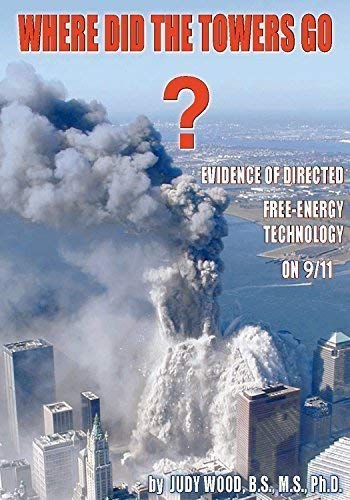
Where Did the Towers Go? by Dr. Judy Wood advances a detailed forensic investigation into the destruction of the World Trade Center on September 11, 2001. The book challenges assumptions embedded in both official reports and alternative theories by presenting empirical evidence that points to the use of directed energy technology.
Scientific Method and Empirical Discipline
Dr. Wood anchors her analysis in a strict sequence of forensic inquiry: identify what happened, determine how it happened, then address who might be responsible and why. She emphasizes that understanding the crime requires observing the physical aftermath with scientific detachment and engineering precision. She gathers visual, seismic, thermal, and material data and organizes them to show a cohesive and reproducible set of phenomena that define the mechanism of destruction.
Dustification of Steel and Absence of Rubble
The core anomaly Wood identifies is the transformation of the towers’ structural steel into fine particulate dust before reaching the ground. Photographic and seismic evidence show a near-absence of debris at the base of the towers. Steel columns disintegrated mid-air, failing to exert the expected force on the ground. Measured seismic activity recorded levels inconsistent with the collapse of structures weighing hundreds of thousands of tons. These observations form the foundational contradiction with conventional collapse theories.
Directed Energy Evidence
The book asserts that no combustion-driven or mechanical force explains the totality of effects observed at Ground Zero. Fires burned without consuming fuel or generating heat signatures typical of known ignition sources. Paper adjacent to flaming vehicles remained unscorched. Cars blocks away exhibited selective damage—engine blocks vanished, while rubber trim and window glass stayed intact. Steel showed signs of molecular disruption: curling, fissuring, and thinning inconsistent with high-temperature melting or impact stress.
Anomalous Fires and Vehicle Behavior
Wood introduces the category of “Weird Fires,” typified by colorless flames, absence of thermal radiation, and sporadic ignition of vehicle interiors without corresponding damage to exteriors. In one notable instance, a fire truck overturned and scorched, while nearby trees retained green foliage and pedestrians walked barefoot on pavement. The evidence converges around a set of behaviors consistent with electromagnetic field effects observed in experimental physics.
Visual Patterns of Field Effects
To decode these anomalies, Wood draws on her background in interferometry, material science, and photomechanics. She compares the physical traces at the WTC site with laboratory results of the Hutchison Effect—named after Canadian researcher John Hutchison—who demonstrated material levitation, fusion, and dissociation using directed energy fields. Wood maps observed effects—such as levitation, slicing, and spontaneous combustion—to corresponding experimental outcomes. Her photographic documentation supports a visual language of destruction aligned with interference-based energy phenomena.
Seismic Silence and Missing Impact Signatures
The towers' destruction failed to produce seismic waves matching their expected gravitational collapse. Using seismic data from USGS stations, Wood shows that the recorded durations and amplitudes fall below thresholds observed in controlled demolition or natural collapses. She highlights the bathtub structure—a reinforced foundation surrounding the WTC site—that remained intact, contradicting expectations of massive structural impact. She argues that absence of vibration and impact force signals a non-mechanical disintegration.
Empirical Disproof of Explosives and Thermite
Wood systematically dismantles alternative hypotheses involving thermite, mini-nukes, or conventional explosives. She catalogs the absence of heat scars, chemical residues, and detonation patterns. High-resolution imagery shows that key materials do not exhibit melting, slagging, or spallation typical of these weapons. Glass remained unmelted. No blast wave evidence appeared in surviving walls or streetscape structures. The collapse geometry showed upward ejections and lateral dispersal inconsistent with gravity-driven pancaking or explosive sequencing.
An Engineering Lens on Anomalies
With academic training in civil engineering, applied physics, and materials science, Dr. Wood leverages technical insight to interpret the data. She identifies bending stress signatures on steel that do not result from thermal expansion or shear failure. Her use of moiré interferometry methods allows microscopic comparison of deformation patterns. She applies full-field imaging techniques to detect material fatigue and surface anomalies. The cumulative evidence maps onto a destruction process that bypasses conventional stress trajectories and propagates through electromagnetic coupling.
Causal Role of Hurricane Erin and Geophysical Conditions
The book explores concurrent geophysical events, such as the proximity of Hurricane Erin and disturbances in Earth’s magnetic field. Wood points out that Erin hovered off the coast of New York, maintaining stable Category 3 wind speeds yet received no media coverage. Data from Alaskan magnetometers show fluctuations during key events on 9/11. She proposes that the environmental field conditions aligned to support a directed energy event, possibly coupling with natural plasma or ionospheric disturbances to amplify the effects.
Chronology of Disappearance
Wood charts the minute-by-minute visual sequence of building disintegration. She identifies an upward acceleration of debris and mid-air dustification beginning above impact zones. Whole floor slabs and steel beams appear to dematerialize. High-speed photography shows no pancaking or sequential floor collapse. She tracks object trajectories to reveal non-ballistic arcs and stationary floating masses—effects consistent with energy field suspension rather than gravitational fall.
Glossary of Observed Phenomena
To clarify unfamiliar patterns, the book introduces a new lexicon. Terms like “Lather,” “Fuzzballs,” and “Toasted Cars” describe visual and physical anomalies using neutral, observational language. These terms support categorical separation from conventional structural collapse, guiding the reader to approach phenomena without preconceptions. Wood underscores that forensic observation demands a vocabulary rooted in direct evidence rather than theoretical analogy.
Legal Challenge and Institutional Response
Dr. Wood filed a legal case under the Data Quality Act challenging the NIST report on the WTC collapse. She reveals that NIST limited its analysis to events leading up to collapse initiation and did not examine the collapse itself. She includes official responses admitting this scope limitation. Her legal brief argues that by failing to analyze the destruction phase, NIST violated its Congressional mandate and rendered its conclusions scientifically invalid.
Philosophical and Global Implications
The book frames its findings within a broader ethical and technological context. Wood asserts that the technology capable of disintegrating skyscrapers without heat or impact redefines the geopolitical landscape. She warns that such energy—derived from ambient field coupling and known through Tesla’s early research—holds the dual potential to destroy civilizations or liberate them from fossil fuel dependence. She poses the central question: who now controls this power, and to what end?
Memory and Testimony of the “Jumpers”
Wood includes a moving chapter on the victims seen falling from the towers. She analyzes photographic evidence showing people disrobing mid-air, a reflexive action often triggered by skin response to nonthermal energy fields. She considers their behavior as communicative, interpreting the images as messages from those affected by an unseen force. She urges that their testimony, through motion and posture, speaks volumes about the nature of their final experience.
Strategic Importance of Truth
The book concludes by asserting that identifying the actual mechanism of destruction is the only viable foundation for public accountability, policy correction, and historical understanding. Wood refuses to speculate on perpetrators, stressing that legal and moral judgment requires prior establishment of facts. She insists that without knowing what weapon was used, political responses remain misdirected and structurally incoherent. Her research invites future investigation into the implications of weaponized energy and its integration into global systems of control.
Directed energy exists. Someone used it on 9/11. The evidence speaks. The question is whether the public will listen, understand, and act before its silence enables further deployments of a technology powerful enough to erase buildings, narratives, and civilizations.