White Collar: The American Middle Classes – The Classic Sociological Study of the Office Worker and the Bureaucracies
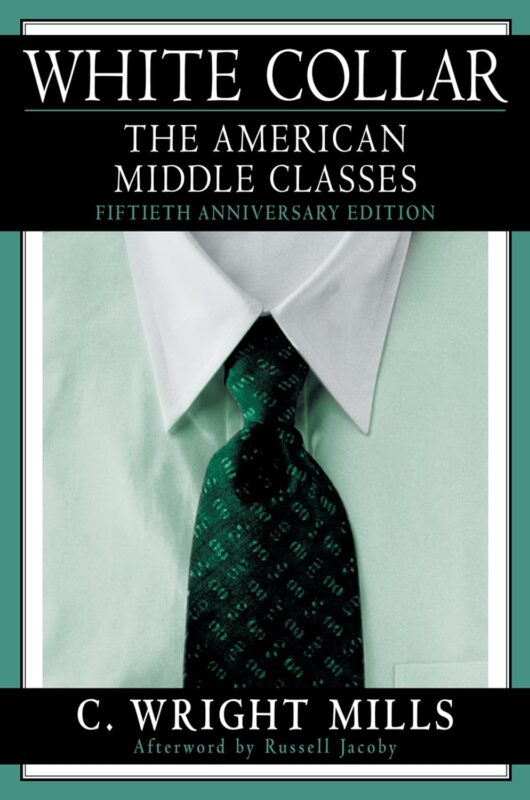
White Collar: The American Middle Classes by C. Wright Mills exposes the structural transformation of American society through the emergence and dominance of a new middle class rooted in bureaucratic employment, salaried dependence, and mass culture. Mills identifies the white-collar stratum as a decisive force in twentieth-century life, not because of their power or unity, but due to their scale, social placement, and symbolic importance.
The Quiet Rise of the White-Collar Class
This class rose without drama. It grew inside expanding bureaucracies, spread across office buildings, department stores, insurance firms, and government agencies. Its history contains no revolutions, no collective demands, no epic victories. Yet its implications saturate modern existence. The white-collar worker embodies the psychological tension of modernity: social visibility paired with political invisibility. Their proliferation dissolved the classic distinction between capitalists and workers. This class does not own production, nor engage in manual labor. It operates within managerial structures, selling time, skills, and personality.
Displacement of the Old Middle Class
Mills traces how the old middle class—farmers, independent artisans, and small shopkeepers—built a society of autonomous economic actors. They owned tools, controlled their labor, and imagined freedom as property. Their values emerged from direct engagement with land and production. This entrepreneurial ethos shaped Jeffersonian ideals and defined early American democracy.
Epochal economic shifts eradicated their world. As industrial capitalism centralized property and authority, independent producers became marginal. Railroads, tariffs, and finance capital severed the linkage between work and ownership. Small farmers were driven into tenancy, debt, and foreclosure. Artisans turned into employees. The market, once a space of freedom, became a mechanism of subordination.
Structure of the New White-Collar World
The new middle class occupies organizational hierarchies. Mills examines its subdivisions: managers, clerks, salespeople, technicians, and semi-professionals. Each position functions within a system that separates decision-making from execution, ownership from labor, appearance from substance.
Bureaucracy reorders ambition. It rewards conformity, punctuality, emotional regulation, and social tact. Performance becomes ritualized. The workplace transforms personality into a commercial asset. Employees do not merely perform tasks—they embody roles, mirror attitudes, and project charm.
Salesmen, secretaries, middle managers, and technicians all navigate performance regimes defined by institutional expectations. The clerk files, the secretary smiles, the salesman persuades. None creates value in the classical sense. Instead, they maintain the operational rhythm of corporate machines.
Alienation and Self-Sale
The white-collar worker sells personality. Unlike the industrial laborer alienated from a physical product, the white-collar employee becomes estranged from personal identity. Emotional traits—cheerfulness, calm, friendliness—become job requirements. This commodification of self fosters emotional exhaustion, resentment, and psychological instability.
Alienation intensifies when labor lacks meaningful connection to output. Office tasks produce no tangible object. The worker processes data, attends meetings, maintains decorum, answers phones. Their sense of efficacy fragments. They feel expendable, interchangeable, invisible. Their work neither builds nor creates—it sustains.
The price of this estrangement is social quietism. The salaried employee, caught between fear of job loss and pressure for loyalty, avoids risk. Their training emphasizes obedience. Their routines reward discretion. They adapt, comply, internalize discipline. They do not rebel. They do not organize.
Mass Culture and Synthetic Identity
Mass media shapes their worldview. Film, radio, television, advertising, and popular literature provide models of aspiration, behavior, and identity. These images do not arise from lived experience. They circulate as fantasies curated by corporations and marketers.
These workers adopt identities based on manufactured symbols. They aspire to be like the characters they consume—well-groomed, socially smooth, upwardly mobile. But this imitation lacks anchorage. The dissonance between image and reality corrodes confidence. The gap between presentation and experience creates anxiety.
They retreat into standardization. They buy what others buy, speak in approved idioms, mirror collective moods. Personality becomes performance. Individuality becomes a costume. Sincerity collapses into stylized politeness. Depth gives way to charm.
Work Without Craft
Craftsmanship once linked the worker to product, pride to labor, meaning to skill. White-collar labor breaks this link. Office jobs provide no object to admire, no skill to refine, no trace of individuality. Tasks consist of supervision, coordination, reporting, or display. Machines and procedures replace intuition and expertise.
This environment erodes morale. Bureaucratic routines dull initiative. Formality stifles creativity. Promotions reward conformity, not excellence. Managers judge attitude, not ingenuity. Workers perform without engagement.
The ideal of meaningful work dissolves. The worker drifts between frustration and passivity. They obey rules, complete forms, attend training, and smile for clients. Nothing they produce bears their imprint.
Social Status and Panic
Prestige anxiety saturates this world. Without ownership or clear class markers, status becomes unstable. White-collar workers define themselves through display—car, clothes, address, demeanor. They cultivate impressions, imitate symbols, and compete for minor distinctions.
The smaller the difference, the fiercer the competition. Salaried workers strive to differentiate themselves from clerks, blue-collar laborers, and each other. This panic propels consumerism, fuels credit debt, and drives image-conscious behavior.
They live with the fear of slipping down. Their jobs feel fragile. Their status feels borrowed. Their self-worth depends on external validation. The pressure to perform exceeds the rewards of success.
Success as Ideology
The ideology of success masks structural limits. Workers believe in mobility, meritocracy, and reward through effort. They internalize the myth that anyone can ascend. But structural barriers block their path. Promotions narrow. Raises stagnate. Ownership remains distant.
This disconnect generates bitterness. Workers blame themselves for failure. They question their abilities, doubt their worth, and fear exposure. The success ethic punishes introspection. It replaces critique with shame. It teaches adaptation, not resistance.
Unionism Without Solidarity
Unionization offers no clear solution. Professional identity, social aspiration, and individualized ambition dilute collective action. Salaried employees hesitate to organize. They fear losing their tenuous status. They distrust collective identity. They imagine themselves as exceptions.
When unions do emerge, they face fragmentation. The diversity of white-collar roles obstructs unity. The salesman, the secretary, the technician, and the middle manager inhabit separate mental worlds. Their interests diverge. Their self-conceptions resist solidarity.
Efforts at political mobilization remain weak. White-collar workers express indifference or fatalism. They participate sporadically, often under pressure. Their routines absorb their energy. Their media dulls their outrage. Their networks remain shallow.
Political Malaise
This class lacks a political voice. No party articulates their condition. No ideology reflects their contradictions. Politicians court them rhetorically, but no platform addresses their structural dilemma. They appear in slogans, vanish in policy.
Their political paralysis stems from disconnection. They do not recognize themselves as a class. They do not trace personal troubles to social structures. They navigate private stress, financial strain, and status anxiety without political interpretation.
Their detachment from tradition, community, and ownership leaves them vulnerable to manipulation. Mass culture fills the void with spectacle, distraction, and fantasy. Emotional appeal replaces rational argument. Loyalty replaces engagement.
Middle Class as Key to Social Insight
To understand American society, observe the white-collar world. It reflects the shift from ownership to employment, from individuality to standardization, from action to adaptation. This class concentrates the psychological effects of economic transformation.
Mills insists on the necessity of clarity. He urges sociologists to connect private experience with structural change. The task is diagnostic and imaginative. It demands conceptual tools that capture both social form and subjective response.
The new middle class reveals the texture of modern alienation. It dramatizes the psychological toll of bureaucratic rationality. It situates the self at the intersection of performance, dependence, and conformity.
Toward Structural Understanding
Mills rejects outdated frameworks. Liberalism, born from the ethos of small property, cannot describe a world of salaried dependence. Marxism, grounded in the industrial proletariat, misses the nuances of bureaucratic labor.
The task is to construct new categories. The white-collar worker is neither capitalist nor proletarian. They operate within institutions but lack authority. They consume symbols but produce none. They imitate power but wield none.
Their predicament demands a new sociology—one attentive to personality as labor, identity as commodity, and status as structure. Only then can analysis penetrate appearance and grasp the shape of emerging society.
The white-collar world holds no revolutionary promise. It offers insight. By studying its routines, values, and anxieties, analysts discern the architecture of mid-century life. In this architecture, freedom recedes, conformity advances, and personality becomes currency. Mills does not call for nostalgia. He demands recognition. Understanding begins when individuals grasp their position, situate their desires, and interpret their malaise. The white-collar world, through its scale and structure, makes this reckoning urgent.