Critical Mass: How Nazi Germany Surrendered Enriched Uranium for the United States’ Atomic Bomb
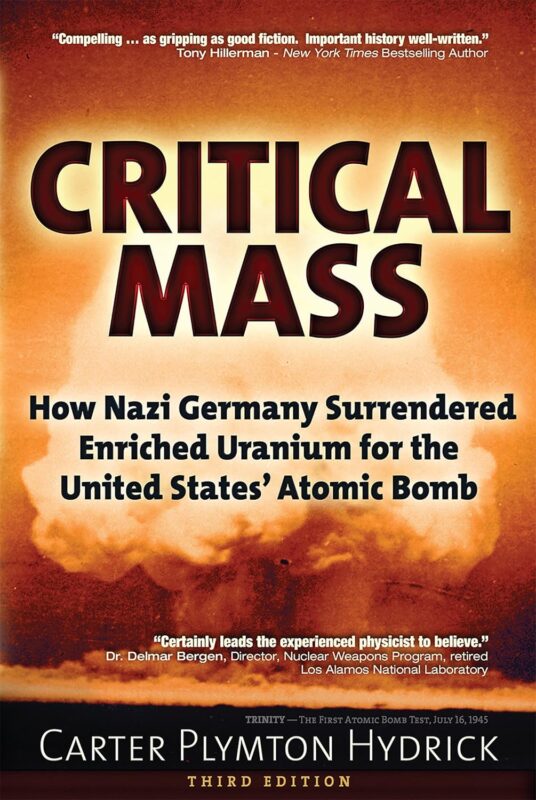
Critical Mass by Carter Plymton Hydrick asserts a transformative thesis: Nazi Germany’s enriched uranium and bomb components played a pivotal role in the United States’ atomic bomb program. Hydrick tracks the clandestine movement of materials, the strategic interplay between Allied intelligence and fleeing Nazi officials, and the implications these hidden exchanges had for the birth of the nuclear age. Drawing on declassified military records, original uranium enrichment logs, and firsthand testimony, the book builds a cumulative case that reconfigures the timeline and inputs of atomic development.
U-234 and the uranium handoff
In early 1945, the German U-boat U-234 departed Europe bound for Japan, carrying ten lead-encased cubes of uranium oxide labeled U-235. Eyewitness Wolfgang Hirschfeld described the cargo being marked in Japanese characters by two officers bound for Tokyo. U.S. intelligence intercepted U-234 before it completed its mission. Naval records and subsequent handling orders reveal the uranium arrived at Portsmouth Naval Yard and was quietly redirected into the Manhattan Project’s infrastructure. The enriched uranium was stored in gold-lined cylinders, a method used only for highly refined material. Clarifying this detail, Clarence Larsen of Oak Ridge confirmed gold containers were essential to prevent contamination of uranium with a high U-235 concentration. Hydrick demonstrates that the presence of these containers correlates with standard handling of bomb-grade material.
Documentation from the Manhattan Project reinforces the timeline. In June 1945, records from Oak Ridge show a sudden and otherwise unaccounted-for spike in uranium enrichment output. Internal correspondence between officers Major Smith and Major Traynor outlines the arrival of captured uranium powder—labeled simply “U”—in quantities previously unavailable. Major John Vance of the Army Corps of Engineers, directly tied to the Manhattan Project, supervised its offloading. This enrichment gap closed precisely as the final uranium bomb assembly was underway.
Manhattan Project shortfalls and external supplementation
By May 1945, the Manhattan Project had consumed two billion dollars and employed thousands across multiple sites. Yet project records indicate uranium supplies fell short of critical mass for a functional bomb. Eric Jette, Los Alamos’ chief metallurgist, projected only 15 kilograms would be available by May—far from the 50 kilograms required. Internal projections emphasized production bottlenecks, contamination issues, and resource redirection to the more scalable plutonium effort at Hanford. These obstacles left the uranium bomb initiative on the brink of failure.
The timing of U-234’s interception and the subsequent uranium delivery filled that breach. Hydrick correlates the transfer not only with Oak Ridge’s enrichment spike but also with metallurgical data from Los Alamos indicating a final inflow of enriched uranium weeks before the Hiroshima bomb assembly. This convergence suggests U-234’s cargo altered the course of the war. Without this material, the uranium bomb likely would not have been ready for deployment.
The plutonium trigger problem
Parallel to uranium enrichment, the Manhattan Project pursued a plutonium bomb. Detonating plutonium required a precise and rapid compression mechanism. U.S. scientists struggled to develop a working trigger. Hydrick introduces evidence that German infrared fuse technology, also captured aboard U-234 or via related transfers, provided the final element for a viable detonation system. The Nagasaki bomb, assembled under immense time pressure, relied on intricate implosion timing. The infrared fuses, originally intended for proximity detonators in artillery, matched the requirements for synchronized compression.
Through procurement logs and offloading records, Hydrick maps the appearance of German fuses in U.S. inventories within weeks of U-234’s surrender. The transition from nonfunctional prototypes to deployable bombs aligns closely with this timeline. Without explicit attribution, the sudden technical success gains context only when external inputs are considered.
Martin Bormann’s hidden diplomacy
Martin Bormann, Hitler’s private secretary and the shadow power behind the Nazi regime’s final days, emerges as a central figure in this geopolitical exchange. According to Hydrick, Bormann orchestrated a covert surrender of Germany’s atomic assets to the United States in return for asylum. Drawing on the work of authors like Paul Manning and William Stevenson, Hydrick reconstructs the possibility of secret meetings, intelligence arrangements, and personal negotiations that bypassed official surrender channels.
Declassified OSS and CIA materials support the premise of covert relationships involving high-ranking Nazi fugitives. Hydrick positions Bormann not merely as a fugitive but as a strategic broker of Nazi scientific assets. His absence from war crimes prosecution, combined with documented postwar sightings and Western intelligence reports, supports this claim.
Operational concealment and narrative construction
General Leslie Groves, director of the Manhattan Project, controlled the public narrative surrounding atomic development. Hydrick identifies a pattern of documentation that obscures the involvement of captured German technology. Official histories, including Groves’ own memoir “Now It Can Be Told,” emphasize total American innovation. Hydrick demonstrates how compartmentalization and selective declassification shaped that story.
Critical archives—Oak Ridge production records, cargo manifests, and captured U-boat logs—remained untouched for decades. Hydrick personally accessed boxes of declassified materials never reviewed by prior historians. These primary sources reveal shipment gaps, material inconsistencies, and logistical overlaps that contradict the traditional story. The cumulative pattern points to deliberate omission.
Technological convergence and the atomic outcome
The uranium bomb dropped on Hiroshima required more than conceptual physics. It demanded material precision, timed assembly, and functional deployment within a tight deadline. Hydrick shows that American production failed to supply the requisite fissile material within the needed window. U-234’s arrival filled this vacuum. The captured uranium, corroborated by naval orders and Manhattan Project logs, reached U.S. facilities in time for the final stages of bomb fabrication.
Similarly, the plutonium bomb faced technological deadlock until German fuses appeared. Hydrick synthesizes these timelines into a structural case: atomic victory required foreign input. Without these captured assets, the U.S. timeline would have extended, Soviet entry into the Pacific theater would have shifted postwar dynamics, and geopolitical leverage at the Potsdam Conference would have diminished.
Implications for nuclear history
Hydrick’s work invites reassessment of atomic origin stories. Critical Mass suggests that the boundary between Allied victory and Nazi surrender blurred through backchannel exchanges. The nuclear age began not solely in American laboratories but through the convergence of U.S. ambition and captured Axis capacity. This convergence was neither incidental nor peripheral. It shaped the timing, execution, and legacy of the first atomic bombs.
The implications extend beyond historical curiosity. Hydrick challenges assumptions about technological sovereignty, wartime ethics, and the nature of classified truth. Democracies function through informed oversight. Revisiting foundational myths of power invites accountability in future decisions. The weapons that shaped modern geopolitics emerged from a tangled crucible of desperation, espionage, and negotiated survival.
Through meticulous sourcing and structural coherence, Hydrick reorients the lens through which the nuclear era began. His claims redefine origin points, expand the cast of contributors, and complicate narratives long considered closed. The materials that incinerated Hiroshima and Nagasaki carried hidden histories, sealed in gold-lined cylinders, transferred by shadow deals, and buried beneath decades of silence.


About the Book