Wall Street and the Rise of Hitler: The Astonishing True Story of the American Financiers Who Bankrolled the Nazis
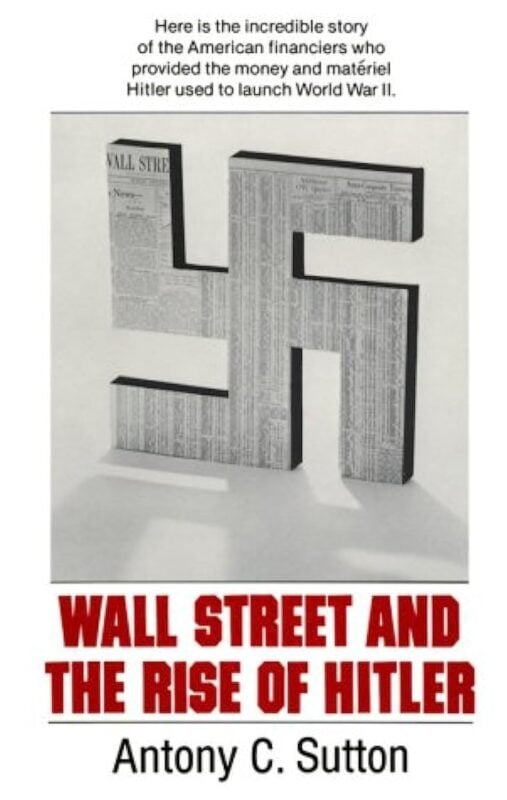
Wall Street and the Rise of Hitler by Antony C. Sutton opens with a claim of institutional convergence, tracing the financing and industrial support behind Hitler’s ascent to powerful American banks and corporations. Sutton identifies an elite network of financiers and executives who maneuvered capital flows, structured international agreements, and coordinated industrial alliances, not in secret, but through formal economic arrangements that built Nazi Germany’s war machine from the ground up.
The Dawes and Young Plans
The Dawes Plan of 1924 and the Young Plan of 1928 provided more than temporary relief from German reparations; they created a structured pipeline for U.S. capital to flow into German cartels. Sutton follows the money through J.P. Morgan & Co., Dillon Read, and National City Bank, exposing how these syndicates floated loans to chemical and steel conglomerates like I.G. Farben and Vereinigte Stahlwerke. These weren’t passive investments. American financial agents sat on supervisory boards, oversaw production strategies, and facilitated technology transfers. The capital that rebuilt Germany’s industrial base didn’t originate from nationalist fervor in Berlin—it moved through New York, guided by a calculus of transnational profit.
I.G. Farben and Industrial Alignment
I.G. Farben, the dominant chemical cartel in Germany, serves as Sutton’s central case. He details how Farben’s 1925 formation relied on U.S. financial backing, and how its expansion across the 1930s positioned it as the regime’s industrial cornerstone. Farben didn’t simply supply materials—it directed production for synthetic fuels, explosives, and chemical warfare. Sutton examines how Farben’s American partners—Standard Oil of New Jersey, DuPont, Alcoa—contributed patents, personnel, and materials. Farben’s role in developing Zyklon B and supplying it for use in concentration camps emerges not as a rogue operation but as a logical extension of its strategic alignments. Where did the technology for synthetic fuel originate? From Standard Oil’s hydrogenation process, licensed under mutual agreements, maintained throughout the 1930s.
Corporate Engagement Beyond Borders
Ford and General Motors operated factories in Germany producing military vehicles, coordinating closely with Nazi economic planning. Ford’s German subsidiary enjoyed tax exemptions and wartime profits. General Motors, via Opel, became the second-largest tank producer in Hitler’s arsenal. These were corporate decisions, directed by executives in Detroit and New York. Sutton illustrates how profits flowed through intra-firm accounting while public declarations in the U.S. emphasized neutrality. He doesn’t describe complicity; he defines integration. ITT’s continued ownership of Focke-Wulf—maker of Luftwaffe aircraft—further clarifies the strategic depth of American corporate involvement.
Wall Street, Central Banks, and Political Engineering
The Bank for International Settlements, headquartered in Basel, becomes Sutton’s symbolic apex of coordinated influence. Established to administer reparations and stabilize currencies, the BIS housed directors from the Reichsbank, the Bank of England, and the Federal Reserve. Sutton argues that BIS meetings, conducted during the height of World War II, maintained a continuity of financial dialogue among ostensible enemies. He identifies Hjalmar Schacht—Hitler’s economic architect and former Equitable Trust employee in New York—as the bridge between German rearmament and U.S. capital. Schacht’s relationships with Morgan partners, Standard Oil executives, and General Electric officials illustrate a pattern of sustained, institutional interdependence.
Election Financing and Political Delivery
The financial support of Hitler’s NSDAP in the crucial March 1933 election is documented through transfer slips and corporate correspondences. Sutton provides evidence that Farben and other firms funneled hundreds of thousands of Reichsmarks to Hitler’s campaign. The coordination was strategic. German industrialists needed political assurance; American financiers wanted economic continuity. The result was a fusion of interest where Nazi ideology became a delivery system for industrial consolidation. Sutton doesn’t ask whether Hitler was manipulated by industry. He demonstrates how the industrial framework constructed by American capital gave Hitler logistical dominance.
Legal Shielding and Postwar Reconstruction
When the Third Reich collapsed, its industrial partners in the United States mobilized to contain legal fallout. Sutton outlines how corporate representatives occupied positions on de-Nazification boards, shaped tribunal testimony, and secured minimal sentences for German executives. I.G. Farben directors received lenient treatment, while U.S. affiliates avoided prosecution. Sutton points to the curious role of former business partners in advising U.S. intelligence operations during the transition. The convergence of legal defense and economic reconstruction efforts reveals a deeper continuity—wartime collaboration didn’t end with Allied victory; it transformed into postwar management.
Propaganda, Intelligence, and Strategic Resources
Beyond capital and factories, American firms enabled Nazi control of strategic materials. Sutton details how Standard Oil restricted U.S. synthetic rubber development under cartel agreements with Farben. He documents how Chemnyco, a Farben affiliate in New York, relayed sensitive industrial intelligence to Berlin. These actions weren’t criminal anomalies; they were corporate strategies. Farben’s VOWI bureau, responsible for intelligence operations, functioned as an industrial espionage unit. Its links to American subsidiaries extended Nazi reach into the very core of U.S. manufacturing intelligence. Strategic delay in synthetic rubber cost the U.S. military months in wartime production. Farben didn’t discover vulnerability; it negotiated it.
Ideological Affinities and Social Engineering
Sutton draws a disturbing line between corporate support and ideological tolerance. He recounts Henry Ford’s repeated praise from the Nazi press, Hitler’s public admiration of Ford’s writings, and the Nazi award Ford received in 1938. These weren’t ceremonial exchanges. Sutton shows how Ford's antisemitic propaganda was circulated within Nazi Germany as ideological reinforcement. These alignments didn’t arise from opportunism alone. They reflected a shared disposition toward industrial order, social hierarchy, and managerial control. Sutton doesn’t speculate about ideological convergence—he provides the receipts.
Historiography and Institutional Amnesia
Academic silence around Wall Street’s role in Nazi Germany isn’t an oversight—it’s institutional design. Sutton critiques the funding structures of American universities, whose endowments and research agendas align with the same corporate interests implicated in his study. He challenges the integrity of postwar historiography, pointing to how public intellectuals and economic historians avoid the archival evidence he presents. Sutton names Carroll Quigley as one of the few scholars to document the financial networks behind global power. He doesn’t build a case for conspiracy; he maps the architecture of elite continuity.
The International System of Plunder
Sutton ends by defining a transnational system where industrial cartels and financial syndicates engineer political outcomes. These networks support socialist, fascist, and democratic regimes interchangeably, provided their structures protect capital and deliver markets. He identifies a self-replicating elite operating across borders, using war, revolution, and recovery as moments for asset reallocation. Hitler, Stalin, and Roosevelt appear not as ideological opposites, but as variables in a system optimized for elite consolidation. This system doesn’t require secrecy. It functions through institutions, agreements, and corporate governance.
Who benefits when capital moves across borders under the guise of reparations? What structures enable industrial empires to sponsor mass violence and escape consequence? Sutton answers by documenting the transactions, naming the directors, and following the profits. The story doesn’t end with Hitler’s defeat. It continues in boardrooms, foundations, and central banks.


About the Book