The New Atlantis
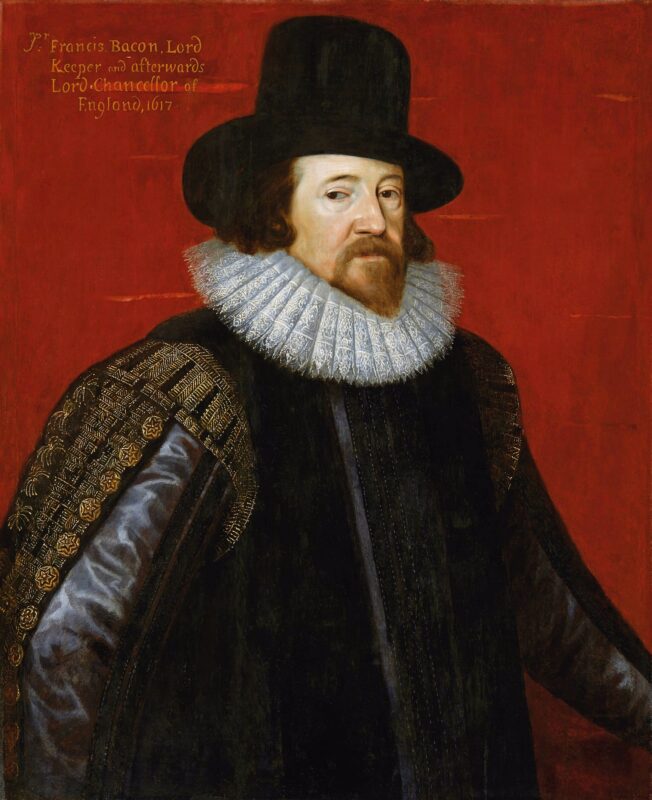
The New Atlantis by Francis Bacon presents a vision of a society shaped by scientific discovery, religious faith, and civic order. Written in the early seventeenth century, the work captures Bacon’s belief that knowledge expands human power and that social institutions must guide that power toward collective flourishing. The narrative describes a group of European sailors who stumble upon the hidden island of Bensalem and encounter a civilization organized around family, piety, and the systematic pursuit of natural philosophy.
A voyage into discovery
The story begins with sailors departing Peru in search of Asia. Adverse winds carry them into an unknown part of the Pacific, where provisions run out and death looms. When they finally sight land, the sailors approach cautiously and discover a city built with quiet order. Officials meet them with courtesy, offering food and medicine while restricting their movements. This encounter establishes the pattern of Bensalemite hospitality: generosity coupled with measured boundaries. The strangers sense that they have reached a society both deeply humane and carefully guarded.
The sacred foundation of Bensalem
Bensalem is Christian, a fact that surprises the sailors who had assumed such a remote land would follow older beliefs. The island’s conversion traces back to a miraculous event twenty years after Christ’s ascension. A luminous pillar rose from the sea, crowned with a glowing cross. When townspeople approached, they found a sealed ark containing scriptures and a letter from the Apostle Bartholomew declaring that salvation had arrived for this people. The texts appeared legible to every inhabitant in his native tongue, a sign of divine providence. This origin story grounds the island’s identity in faith, aligning civic life with sacred authority.
Laws of hospitality and restraint
The sailors learn that Bensalem admits foreign visitors rarely and under strict conditions. The governor of the Strangers’ House explains that newcomers may remain for weeks or months but cannot travel beyond a fixed boundary without permission. Officials monitor them, not to burden but to safeguard public health and preserve order. The policy reflects a law established nearly two millennia earlier by King Solamona, revered as Bensalem’s great legislator. He judged the island self-sufficient and feared disruption from uncontrolled exchange. He therefore closed most channels of trade and contact while instituting humane provisions for shipwrecked travelers. This framework balances openness with secrecy, allowing Bensalem to absorb knowledge selectively.
The Feast of the Family
Social life centers on the household, reinforced by the institution known as the Feast of the Family. Any man who lives to see thirty descendants gathered in one generation may hold the feast at state expense. He assumes the role of Tirsan, the honored father, and presides over ceremonies that include reconciliation of disputes, guidance for marriages, and distribution of resources to needy kin. On the feast day, a herald delivers a royal charter conferring privileges and presents a golden cluster of grapes, symbol of lineage. The Tirsan blesses his children one by one and appoints a Son of the Vine to carry the emblem of family honor. This ritual enshrines continuity, reverence for elders, and the sacredness of procreation.
Marriage and chastity
Bensalemite law cultivates chastity with rigorous precision. The people consider unchastity a violation of self-respect and a threat to the community. Marriage is monogamous, arranged with parental consent, and delayed until at least a month after the couple’s first meeting. To ensure suitability, friends of the prospective bride and groom may inspect them bathing in separate pools, known as Adam and Eve’s pools, to guard against hidden defects. Adultery, prostitution, and promiscuity have no sanctioned place, and the society prizes faithful union. These practices create what observers describe as the most chaste people under heaven, whose friendships are as pure as their marriages.
The role of secrecy and controlled exchange
The governor describes how Bensalem maintains knowledge of the wider world without exposing itself to corruption. Solamona ordained that two ships set out every twelve years, each carrying three Fellows of Salomon’s House. Their mission is to observe the sciences, technologies, and customs of foreign lands and return with books, instruments, and patterns of invention. The state supports them with treasure to purchase what they deem valuable. Only these agents may engage in such voyages. In this way, Bensalem gathers the fruits of global knowledge without dispersing its own secrets or risking moral contagion.
Salomon’s House as the center of knowledge
At the heart of the island stands Salomon’s House, also called the College of the Six Days’ Works. Its mission is to uncover the causes of things and to extend the bounds of human empire. A Father of the institution describes its organization to one of the sailors. The House maintains deep caves for experiments with refrigeration, petrification, and artificial metals. It operates high towers for meteorological study and insolation. It cultivates lakes, pools, and wells for hydrological research, including waters engineered for health and longevity. It houses chambers that simulate meteors, baths that restore the body, and gardens for the breeding of plants and animals.
Experimental methods and anticipated inventions
The Fellows of Salomon’s House specialize in diverse fields. Some collect natural specimens, others conduct experiments, others compile results, and others apply them to practical use. They create artificial minerals, extend the life of plants, and crossbreed species. They design new forms of food and drink, explore fermentation, and perfect medicines. They manipulate air, harness winds, and study sound to produce instruments of greater harmony. They build submarines, flying devices, and means of communication across distance. They study optics to magnify and reduce images, to see microscopic forms, and to project light. They develop engines for motion, energy, and construction. Many of these projects anticipate later scientific achievements, embodying Bacon’s vision of applied knowledge.
The ethical direction of science
The Father emphasizes that the end of Salomon’s House is not speculation but the effecting of works. The institution seeks to increase human mastery over nature while directing outcomes toward health, utility, and social benefit. The Fellows divide into classes: merchants of light who gather knowledge abroad, mystery men who test experiments, compilers who record, interpreters who derive axioms, and benefactors who apply discoveries. The system integrates observation, experiment, theory, and application into a coherent process. The structure models the method Bacon had long advocated, in which science advances step by step through controlled inquiry and yields fruit in the form of inventions and improvements.
Civic order and religious reverence
The island’s civic life reflects the same harmony that governs its families and sciences. Leaders act with restraint, officials refuse bribes, and laws operate with dignity. Religion permeates the society, uniting scientific endeavor with devotion. The people give thanks for discoveries as manifestations of God’s creation. They view the study of nature as an act of worship, revealing the workmanship of the Creator. In this union of faith and knowledge, Bacon envisions a society where science expands human capacity without severing its ethical anchor.
Legacy of the vision
The New Atlantis remains unfinished, breaking off after the Father of Salomon’s House outlines its purposes and instruments. Yet even as a fragment, the work defines Bacon’s intellectual testament. He imagines an island where the pursuit of knowledge aligns with religious duty and civic virtue. He projects a scientific institution that anticipates modern academies and research universities. He asserts that discovery must serve health, prosperity, and moral integrity. The narrative presents not only an adventure but a structural blueprint for a future in which humanity extends its reach through disciplined inquiry guided by faith and order.
A living framework for thought
The work endures because it crystallizes Bacon’s conviction that science is a means of dominion granted by God for human welfare. The sailors’ wonder at Bensalem mirrors the reader’s sense of possibility: a society shaped by deliberate law, sacred tradition, and organized research. What happens when knowledge becomes the true treasure of a nation? Bacon’s answer lies in Salomon’s House, where investigation of causes yields both power and responsibility. The New Atlantis continues to challenge modern readers to consider how scientific progress can be structured within moral and civic frameworks, how institutions can channel discovery into public good, and how faith can guide the expansion of human empire without dissolution of order.