The Curse of Canaan: A Critical Historical and Theological Analysis
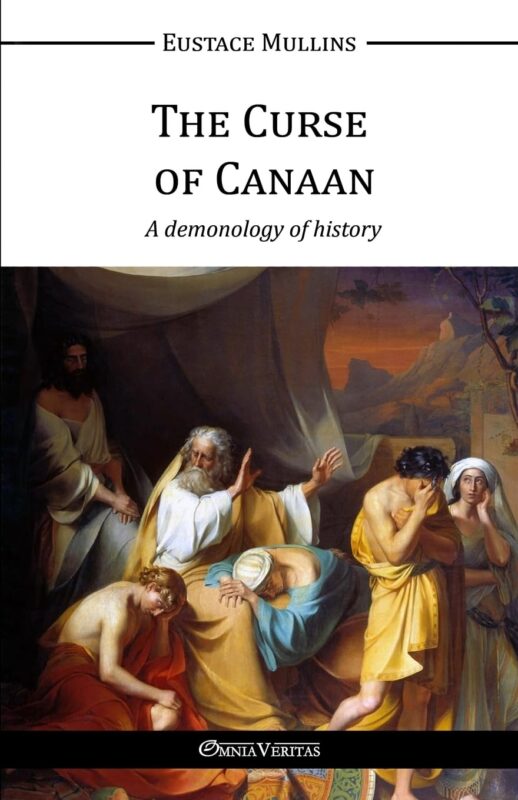
Eustace Mullins’ The Curse of Canaan presents a controversial narrative that attempts to reconstruct world history through a theological lens grounded in biblical texts and apocryphal sources. The book synthesizes genealogy, myth, and sociopolitical development to argue for a coherent historical line that traces ideologies, cultural practices, and power structures back to the ancient Near East, specifically through the lineage of Canaan.
Biblical Foundations and Lineage
The central premise of Mullins’ framework emerges from the Genesis account, particularly the post-Flood episode involving Noah and his sons. Mullins identifies Ham’s transgression—described in Genesis 9:22–25—as the initiating event that leads to Noah cursing Ham’s son Canaan. Mullins interprets this curse as having far-reaching genealogical and cultural consequences, with the Canaanites embodying a legacy of spiritual and moral deviation. He draws upon etymological and historical references to suggest that this lineage shaped subsequent civilizations through syncretic religious practices and socio-political influence.
Cultural and Religious Development in Canaanite Society
The book places strong emphasis on the religious practices of the Canaanites, particularly their rites of fertility, human sacrifice, and worship of deities such as Baal and Ashtoreth. Mullins draws on both biblical condemnations (e.g., Leviticus 18, Deuteronomy 7) and archaeological references (e.g., excavations at Gezer) to illustrate how child sacrifice and ritual sex were integral to the Canaanite cultic system. He frames these rituals as not only theological aberrations but as sociopolitical mechanisms for consolidating elite control through fear, initiation, and secrecy.
Mullins situates these practices within the broader context of ancient Near Eastern religions, comparing them to rites found in Mesopotamia, Egypt, and Phoenicia. He suggests that the transmission of these practices into adjacent cultures was often accompanied by linguistic shifts, architectural adaptation (e.g., temple groves and ziggurats), and changes in political symbolism.
Phoenician Transformation and Maritime Expansion
Following the biblical account, Mullins identifies the Phoenicians as the cultural and economic successors of the Canaanites. After 1200 BCE, historical references to “Canaanites” diminish, replaced by the term “Phoenicians.” Mullins interprets this shift as a deliberate cultural rebranding. He documents how the Phoenicians expanded westward, establishing colonies such as Carthage, and how they leveraged control over key trade commodities—like purple dye and tin—to exert disproportionate influence in Mediterranean geopolitics.
This section of the book connects the Phoenicians' religious syncretism and maritime trade dominance with their ability to disseminate ideas and practices, including temple-based prostitution, across vast distances. Mullins references classical authors like Herodotus and archaeological discoveries to contextualize the Phoenician impact on European pre-modern cultures.
Carthage and Roman Conflict
Mullins dedicates a significant portion of the book to analyzing Carthage, the preeminent Phoenician colony, especially its military engagements with Rome in the Punic Wars. He treats the destruction of Carthage not merely as a geopolitical turning point, but as a symbolic defeat of Canaanite religion and socio-political philosophy by Roman order. Drawing from Roman accounts, he describes Carthaginian religious rites—including child sacrifice to Moloch—as central to their identity and ideology.
In this section, Mullins argues that the total destruction of Carthage, including the salting of its earth by Scipio Aemilianus, marked not only the fall of a city but the temporary suppression of a religious worldview.
From Venice to the Modern Age
After Rome, Mullins suggests that the ideological and economic descendants of the Phoenicians reemerged in Venice during the Middle Ages. He refers to this merchant-aristocratic class as the "Black Nobility," claiming they developed sophisticated banking systems and trade monopolies. Here, the author draws on historical accounts of Venetian involvement in trade, espionage, and ecclesiastical politics, using them to argue that these elites maintained a continuous legacy rooted in ancient Canaanite practices, now secularized and economic rather than explicitly religious.
The evolution of these practices, Mullins claims, produced modern financial institutions, with particular focus on central banks and international lending. He critiques these structures as opaque, elitist, and hierarchical in design—qualities he associates with ancient priesthoods.
Theological and Ideological Inheritance
Mullins argues that secular ideologies of the 18th–20th centuries—specifically Enlightenment liberalism, Marxist socialism, and humanism—represent modern expressions of what he terms “demonological” worldviews. He links revolutionary movements in France, America, and Russia to a symbolic continuation of ancient anti-theistic or occult ideologies.
This thesis is not offered as a political critique in isolation but is framed as a spiritual-historical argument. Mullins sees these ideologies as fulfilling the "Will of Canaan," a Talmudic text he cites that allegedly instructs Canaan’s descendants to “love robbery, love lewdness, hate your masters, and do not speak the truth.” This text functions as a moral code through which Mullins interprets events such as the French Revolution, the rise of Communism, and the spread of global capitalism.
Ethnological and Racial Arguments
The most controversial elements of Mullins’ work concern his racial anthropology. He classifies world populations into Shemitic (descendants of Shem), Hamitic (descendants of Ham), and Japhetic (descendants of Japheth) groups, aligning religious and cultural behaviors with these genealogical lines. Mullins holds that the Shemitic line represents constructive civilization, moral law, and monotheism, while he associates the Hamitic line with ritual violence and spiritual corruption.
These assertions draw from older ethnological frameworks found in 19th-century biblical archaeology, though they are widely rejected by modern anthropology. Mullins attempts to tie racial intermarriage and cultural syncretism with the spread of what he characterizes as destabilizing ideologies and moral decay. He also equates Shem with early Egypt’s civilization, arguing that Shem (under the name Khufu) built the Great Pyramid and established early governance systems.
Symbolism, Language, and Myth
Throughout the book, Mullins reads symbols—such as the “X” of Nimrod or the red thread of Zarah—as indicators of religious and genealogical significance. He interprets holidays (e.g., Christmas as the birthday of Nimrod), corporate symbols (e.g., “Exxon” as invoking occult symbology), and historical legends (e.g., the Scarlet Thread of Judah in British monarchic tradition) as evidence of an encoded historical continuity.
These readings aim to support his argument that symbols preserve power and intention across time, even when explicit theological language disappears. In this model, modern secularism is not a rejection of religion but the result of an inverted theology embedded in modern institutions.
Conclusion: A Theological View of History
Mullins’ overarching claim is that history cannot be understood through material causes alone. For him, theological and genealogical narratives are essential to explaining cultural and political developments. The Curse of Canaan offers a highly deterministic view of history, in which lineage, belief systems, and secret traditions shape the trajectory of nations and civilizations.
While the book is replete with historical references, its methodology relies heavily on mythic integration, typological reading of scripture, and speculative genealogies. Mullins constructs a closed historical loop in which ancient rebellion, modern ideology, and institutional power form a coherent, if controversial, arc.
The result is a provocative synthesis that seeks to restore biblical cosmology as the lens through which human history must be understood, challenging conventional secular historiography and offering a spiritually centered account of cultural evolution.