Cybele and Attis, the Myth and the Cult
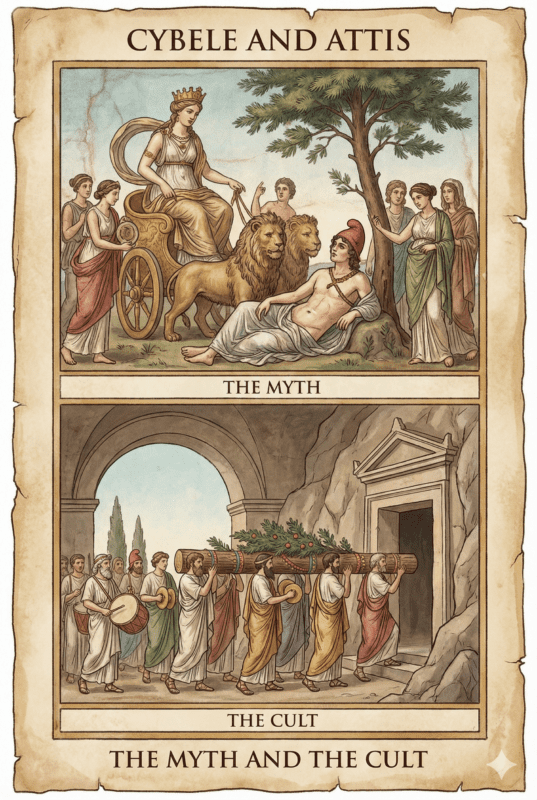
Cybele and Attis the Myth and the Cult by M. J. Vermaseren traces the complete historical, archaeological, and theological development of the Anatolian Mother Goddess and her youthful consort. The study begins with the Neolithic settlements of Çatal Hüyük in Asia Minor and follows the transformation of the Great Mother through Hittite, Phrygian, Greek, and Roman civilizations. Vermaseren reconstructs the cult’s evolution from early terracotta figurines to imperial temples, describing how an agrarian goddess of fertility became a central divine figure in the religious landscape of the Mediterranean world.
Origins in Anatolia
The book opens with the Neolithic horizon of central Anatolia around 6000 BCE. Excavations at Çatal Hüyük reveal terracotta figures of a woman enthroned between leopards, her body enlarged in symbolic fertility. The goddess represents the earth’s productive body, its womb forming the origin and return of all living forms. Mellaart’s discoveries define her earliest artistic type: a seated woman pressing milk from her breasts or emerging from a cave. Vermaseren identifies this as the foundational image of the Earth Mother, later known as Kubaba among the Hittites and Cybele among the Phrygians. These Anatolian peoples worshipped her on mountain summits, within fortresses, and near rocky clefts, perceiving the land’s contours as her physical form. Reliefs from Ephesus, Delphi, and Bogazkoy display her enthroned with lions at her side, an icon of dominion over wilderness and fertility alike.
Kubaba and the Hittite Legacy
During the second millennium BCE, the Hittite Empire adopted Kubaba as queen of Carchemish. Cuneiform tablets from Hattusa record priests of Kubaba and names such as Sili-Kubabat—“Kubaba is my protection.” Rock sanctuaries like Yazılıkaya depict the goddess Hepatu, wife of the Weather God Teshub, standing on a panther’s back, a posture that anticipates Cybele’s lion-flanked throne. Kubaba’s name appears in hieroglyphic Luwian inscriptions accompanied by a pomegranate, emblem of life’s renewal. The stele of Malatya shows her seated on a bull while her consort stands upon a lion. Through these reliefs, Vermaseren traces a continuous Anatolian image of divine sovereignty mediated through animal power and mountainous setting. The later Phrygian adaptation preserved these symbols but localized the goddess in Pessinus and Mount Dindymus, where she assumed the title Matar Kubileya—Mother of the Gods.
Phrygian Transformation
After the collapse of the Hittite Empire around 1200 BCE, Thracian migrants settled in central Anatolia, forming the Phrygian kingdom. King Midas of Gordion, remembered for his “ass’s ears,” honored the Mountain Mother with monumental rock sanctuaries. The Midas Monument at Yazılıkaya, with its geometric facade and central niche for a cult statue, marks the earliest monumental temple of Cybele. Inscriptions such as MIDAI FANAKTEI—“to Midas the ruler”—attest to royal patronage. Reliefs from Arslan Kaya and Büyük Aslanta depict the goddess between lions within a decorated pediment. These Phrygian monuments define her public cult as a civic protector enthroned amid sacred architecture carved directly from the landscape. Music, pipes, and drums accompanied her rites, a legacy visible in later Roman depictions where flautists flank her image.
Meaning of the Name
Vermaseren devotes detailed analysis to the name Kubaba-Cybele, tracing its written forms in Hittite, Lydian, and Greek sources. The Lydian inscription from Sardis, dated before 570 BCE, reads Kuvav(a), linking the goddess to Kubaba. A jar fragment from Locri Epizefiri in southern Italy bears the Greek genitive “of Kybele,” showing the transmission of her cult through Phocaean colonies. The root “Kube” connects to ancient words for “hollow vessel” and “cave,” suggesting her identity as the earth’s inner chamber. In Hellenistic iconography, the goddess appears with a mural crown, a stylized citadel upon her head, representing her fusion with the protective walls of cities.
Cybele in Greek Religion
Greek settlers along the Anatolian coast encountered the Phrygian Mother and integrated her with their own pantheon. She merged with Rhea, Gaia, and Demeter, becoming the Mother of the Gods. In the Homeric Hymns she rides a lion-drawn chariot amid the sound of tambourines and flutes, surrounded by roaring beasts. Her sanctuaries on Mount Ida and in Athens’ Metroon housed images of the enthroned goddess. Greek art presents her with dignified majesty, draped in chiton and himation, her hand resting on a lion’s head. Poets invoked her as Meter Theon, the origin of divine and mortal life. From these coastal cults, her worship spread through the Aegean islands and mainland Greece, maintaining her Asiatic rituals of ecstatic music and processional dance.
Cybele’s Arrival in Rome
The narrative shifts to 204 BCE, when the Sibylline Books advised the Roman Senate to bring the Great Mother from Pessinus to secure victory over Hannibal. King Attalus I of Pergamum delivered her meteoric stone—believed to be her embodiment—to Roman envoys. Upon arrival, the stone was installed on the Palatine Hill, establishing the Metroon of the Magna Mater. Vermaseren describes the Senate’s supervision of the cult and the restriction of priestly duties to Phrygian eunuchs, maintaining the sacred origin of her rites. The goddess became protector of the state, identified with Trojan ancestry through the legend of Aeneas and the Phrygian Mount Ida. Vergil’s Aeneid portrays her as guardian of the Trojan ships and maternal force guiding Rome’s destiny.
Ritual and Priesthood
The Roman cult introduced a structured hierarchy. The Archigallus led the Galli, eunuch priests devoted to ecstatic worship through drumming, cymbals, and dance. During the festival of March, initiates re-enacted the mourning and resurrection of Attis. The Day of Blood (Dies Sanguinis) commemorated his death, followed by ritual lamentation, purification, and the joyful Hilaria celebrating his return. The taurobolium and criobolium—sacrificial baths in the blood of bulls or rams—marked initiations into divine renewal. Vermaseren describes inscriptions that record the ritual as an act of regeneration “in the eternal safety of the Great Mother and Attis.” These rites established the theological foundation for personal salvation within a Roman mystery tradition.
The Myth of Attis
Attis emerges as Cybele’s youthful companion, born of the river Sangarios and the nymph Nana. His beauty captured the goddess’s devotion. When he pledged himself to another, Cybele’s divine frenzy seized him, driving him to self-castration beneath a pine tree. His blood fertilized the earth, and the goddess transformed him into a deity of renewal. This myth encoded the agricultural rhythm of seed, death, and rebirth. In artistic reliefs, Attis appears wearing the Phrygian cap, reclining beside the pine or assisting Cybele’s lions. Under the Roman Empire, Attis gained prominence as a symbol of solar vitality and eternal life, particularly during the Antonine period when the taurobolium spread through the provinces.
Expansion Across the Empire
Cybele’s cult extended from Asia Minor into Egypt, North Africa, Gaul, Spain, and Britain. Archaeological evidence from Ostia, Lugdunum (Lyon), and Londinium reveals Metroa constructed near theaters and riverbanks. Inscriptions record dedications by governors, soldiers, and women of high rank. In Gaul, the goddess received the title Mater Deum Magna Idaea; in Britain, her image adorned altars near Hadrian’s Wall. The provinces developed local variations, yet her essential imagery—throne, lions, and mural crown—remained constant. Vermaseren documents these monuments with maps and photographs, showing the diffusion of her iconography through trade routes and Roman military expansion.
Cybele in Art and Literature
Sculpture, relief, and coinage depict the goddess in varied postures: enthroned between lions, standing with drum and sceptre, or driving a chariot. The reliefs from Sardis and Pergamum combine her with Artemis and the Moon God Men, reflecting regional syncretism. Poets such as Catullus and Lucretius describe her ecstatic processions; Ovid’s Fasti celebrates the Megalensia with vivid detail of the Galli’s rituals. Apuleius, in The Metamorphoses, places her within the universal frame of the Great Mother who reveals herself through many names—Isis, Demeter, Venus, and Cybele—embodying the eternal feminine principle. These literary witnesses preserve the emotional intensity of her worship and its moral focus on renewal through devotion.
Festivals and Temples
The Roman calendar integrated Cybele’s major festivals: the March celebrations of Attis, the April Megalensia, and the December ceremonies of her temple. The Metroon on the Palatine Hill, restored by Augustus, served as both temple and state archive. Other sanctuaries included the Phrygianum on the Vatican Hill and the Hypogaeum near Porta Maggiore. In Ostia, the Campus of the Magna Mater hosted processions and banquets. Vermaseren reconstructs the topography of these sites through inscriptions and architectural remains, connecting them to the broader ritual geography of the empire.
Cybele in the Provinces
Egypt adopted her as companion to Isis; North African dedications pair her with Saturn and Caelestis. In Spain, altars at Tarraco and Emerita Augusta commemorate the taurobolium. In Gaul, the great altar of Lyon preserves a bilingual inscription recording a sacrifice to Cybele and Attis for the emperor’s welfare. Britain yielded statues of the goddess with mural crown, a sign of the cult’s penetration into distant provinces. These findings confirm the administrative reach of her priesthood and the adaptability of her theology to diverse regional pantheons.
Cybele, the Emperors, and Christianity
In the imperial age, emperors from Claudius to Julian the Apostate supported her worship. Claudius reestablished the Galli’s legal status; Antoninus Pius sponsored taurobolic altars; Julian praised her as cosmic mother in his hymns. As Christianity gained influence, Church Fathers criticized her orgiastic rites and eunuch priests. Yet the structure of her mysteries—death, purification, and rebirth—resonated with emerging Christian ritual forms. The image of the mourning goddess who restores life through divine power sustained its symbolic presence into late antiquity.
Continuity of the Earth Goddess
Vermaseren concludes that the Great Mother embodies an unbroken thread of religious consciousness from prehistoric Anatolia to the late Roman Empire. Her cult united mountain sanctuaries, civic temples, and imperial ceremonies through a single theological vision: Earth as the source of life and the vessel of return. The book’s detailed catalog of monuments, inscriptions, and artistic depictions affirms the durability of her image. The lions at her feet, the mural crown on her head, and the meteoric stone at her altar mark a continuum of sacred geography. Cybele and Attis stand as central figures in the Mediterranean’s spiritual history, where fertility, sacrifice, and resurrection form the grammar of divine presence.