The Choice Vine: Mary Magdalene, the Sacred Whore, and the Benjamite Inheritance
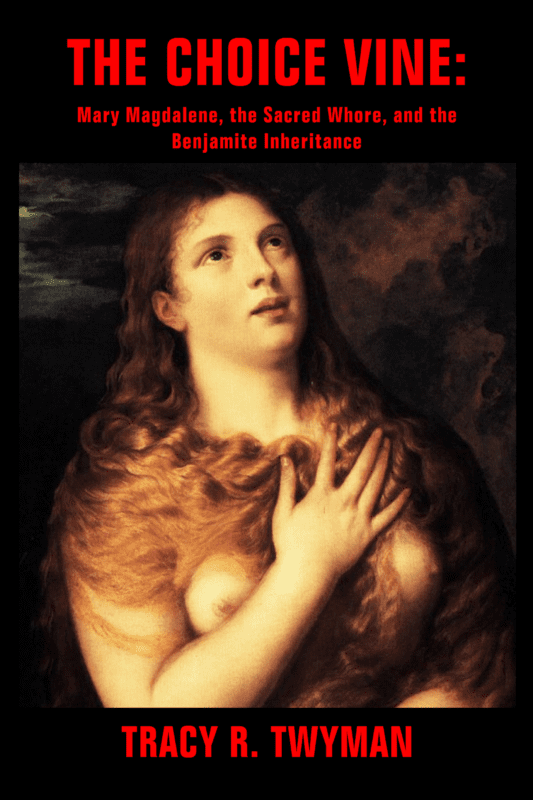
The Choice Vine: Mary Magdalene, the Sacred Whore, and the Benjamite Inheritance by Tracy R. Twyman traces the dynastic, ritual, and tribal dimensions of the marriage between Jesus of Nazareth and Mary Magdalene, drawing on a wide array of biblical, apocryphal, and esoteric sources to reconstruct a political and spiritual genealogy that Roman institutional editors worked to suppress. Originally published in 2003 through Quintessential Publications and Dagobert's Revenge Magazine, the book examines how Magdalene's Benjamite lineage carried specific rights — the right to anoint Israel's king, the right to keep the genealogical records of priests and kings, and the right to "divide the spoil," as Genesis 49:27 phrases it — that made her the indispensable counterpart to a Davidic claimant seeking to reunify the fractured tribes of Israel.
The Dynastic Marriage as Political Strategy
Twyman builds her argument on a foundation laid by Margaret Starbird's The Woman with the Alabaster Jar, which theorized that Jesus married Mary of Bethany — identified by Starbird and Twyman as the same person as Mary Magdalene — in a secret dynastic union. Starbird described this marriage as a political alliance between the tribe of Judah (through Jesus' descent from King David) and the tribe of Benjamin (through Magdalene's descent from King Saul). Twyman extends this analysis by connecting the marriage to the prophecy of Genesis 49:11, where Jacob blesses Judah with the image of binding "his foal unto the vine, and his ass's colt unto the choice vine." She identifies the "choice vine" as the Benjamite royal line, and reads the prophecy as a description of two thrones: one bound to the vine of Judah, and a successor's throne — the foal's — bound to the enhanced "choice vine" that a Judah-Benjamin fusion would produce.
The significance of this union, as Twyman traces it, reaches back through the entire history of Israelite kingship. Saul, the first king anointed by the prophet Samuel, came from the tribe of Benjamin and ruled a united Israel. When David displaced Saul's line, the covenant between the two kings — in which David swore to preserve Saul's descendants (I Samuel 24:17-22) — bound the two royal houses together across generations. After Solomon's death, the kingdom fractured: the ten northern tribes followed the Ephraimite line of Jeroboam, while Benjamin remained loyal to the house of David within the kingdom of Judah. Twyman identifies Jesus' marriage to a Benjamite princess as a strategic move designed to reunite both claims, since the northern tribes had awaited a "Messiah-ben-Joseph" from the line of Ephraim, and would have recognized a king who carried the Benjamite inheritance of Saul as a figure capable of bridging that divide.
The Anointing Ritual and the Role of the Sacred Bride
Twyman devotes substantial attention to the anointing scene described in Matthew 26:6-13, where an unnamed woman pours spikenard over Jesus' head at the house of Simon the Leper in Bethany. Citing Olaf Hage, who identified Simon the Leper as both Magdalene's father and the Sanhedrin member Nicodemus, Twyman interprets Magdalene's anointing of Jesus as an official royal act — a Benjamite prerogative exercised by a woman authorized by tribal custom to designate Israel's king. Starbird reinforced this reading by situating the anointing within an ancient tradition where a royal bride conferred kingship on her consort through the marriage rite itself.
Twyman positions this ceremony within a broader framework of hierogamy — the sacred marriage ritual practiced across Sumerian, Babylonian, Egyptian, and Judaic traditions. She draws on Nicholas de Vere's The Dragon Legacy, which described Jesus' movement as a Greco-Roman-Judaic mystery cult where Magdalene served as "Grail maiden" and sacred priestess. De Vere's analysis situated the anointing within a Tantric and Qabalistic ritual context, connecting the spikenard ceremony to the "Starfire" rite — a non-penetrative ritual involving the consumption of sacral fluids believed to contain pineal secretions concentrated in members of the "Grail bloodline."
The timing of the anointing mattered: in the ancient pattern of hierogamy, the sacred wedding preceded the ritual death of the king. Twyman links this directly to the Gospel narrative, where Judas' betrayal follows immediately after the Bethany anointing in Matthew's account. Jesus himself stated that Magdalene anointed him for his burial, making her a ritual participant in his sacrifice. De Vere interpreted this as a symbolic ceremony, arguing that Magdalene went to the tomb to commune with the "Ka of Jesus in the Underworld" according to the protocol of her priestly station.
The Benjamite War and the Daughters of Shiloh
A large portion of the book analyzes the catastrophic war between the tribe of Benjamin and the other eleven Israelite tribes, narrated in Judges 19-21. Twyman examines the "outrage at Gibeah," where "sons of Belial" among the Benjamites gang-raped the concubine of a Levite priest, provoking the other tribes to near-annihilate the Benjamites in retaliation. She connects this narrative structurally to the story of Lot in Sodom (Genesis 19), where townspeople besieged Lot's house seeking to sexually assault angelic visitors, and identifies a recurring pattern: a divine or semi-divine being whose presence provokes uncontrollable sexual desire, followed by mass destruction, followed by the preservation of a remnant population.
After the war, with three hundred Benjamite men surviving and the other tribes having sworn an oath at Mizpeh to withhold their daughters from Benjamite marriages, the remaining Benjamites married four hundred virgins from Jabesh-gilead and additional "daughters of Shiloh" captured during a vineyard fertility festival. Twyman identifies this episode as the origin of the Benjamite custom of matrilineal inheritance — a tradition that allowed Benjamite women to transmit tribal identity and property when the patrilineal line had been functionally severed. This custom, she argues, explains how Magdalene carried the Benjamite royal inheritance centuries later, and why the tribe's identity persisted despite its apparent absorption into the kingdom of Judah.
The Nephilim Bloodline and the Benjamite Inheritance
Twyman incorporates the theory — drawn partly from multiorgasmic.com and partly from the Book of Enoch — that the Benjamites carried Nephilim ancestry. She notes that Genesis describes the conception of each of Jacob's sons except Benjamin, and that Jacob received visitations from Watchers (angels) in the months preceding Benjamin's birth. On the night coinciding with Benjamin's likely conception, Jacob wrestled an angel on one side of the river while Rachel remained alone on the other side. Rachel named the child "Benoni" ("Child of Travail") and died in childbirth; Jacob renamed him "Benjamin." The name itself, Twyman observes, resembles "Bene-ha-Elohim" — the term translated as "sons of God" in Genesis 6, the passage describing angel-human interbreeding that precipitated the Flood. Benjamin's firstborn son was named "Rapha," linking the Benjamite line to the Rephaim — the biblical term for Nephilim-human hybrid offspring.
King Saul's physical characteristics — standing a head taller than other Israelites, possessing a beauty that women found irresistible — align with this proposed lineage. Twyman reads the Benjamite association with the "sons of Belial" and with Canaanite worship practices, including the golden calf ritual described in Exodus, as expressions of a covenantal relationship between the tribe and the deities represented by their angelic ancestors.
The Merovingian Connection and the Grail Bloodline
Twyman traces the Benjamite diaspora through the Holy Blood, Holy Grail thesis and the Priory of Sion's Secret Dossiers, which placed exiled Benjamites in Arcadia on the Greek Peloponnese. The royal house of Arcadia later intermarried with families that produced the Merovingian dynasty of France — the bloodline that esoteric tradition identifies as the continuation of Jesus and Magdalene's descendants. The Secret Dossiers described the Merovingian lineage as the result of "vine-grafting," and Twyman reads this as a direct reference to the fusion of the Judah and Benjamin royal lines through Jesus and Magdalene. She cites Starbird's claim that the word "Merovingian" means "vine of Mary."
Michael Bradley's Holy Grail Across the Atlantic connected the Benjamites to the Phoenicians of Tyre and Sidon — the "sons of Belial" with whom the Benjamites had allied — and Holy Blood, Holy Grail linked the Benjamite clan of Bela to the god Belial, suggesting that the Benjamites may have considered Belial an ancestral deity. Robert Graves identified the Danaus myth, recording the arrival of "colonists from Palestine" in the Peloponnese, as a Benjamite migration narrative, with King Belus representing Baal or Belial.
The Sacred Whore and the Suppression of the Bloodline
Twyman's concluding argument identifies the term "whore" — as applied to Magdalene by later Church tradition — as a compound label encoding multiple transgressions within Hebrew law. A woman who had been divorced, who practiced the worship of foreign gods, who served as a priestess in rituals involving sacred sexuality, or who descended from a tribe associated with such practices would have carried the designation. The Hebrew scriptures repeatedly equated the worship of foreign gods with "whoring," and Twyman reads Magdalene's traditional reputation as a compressed expression of the Benjamite tribe's entire theological and political history.
James Freeman Clarke's The Legend of Thomas Didymus proposed that Magdalene had previously been married to Herod, and that John the Baptist objected to Herod's subsequent marriage to Herodias on the grounds of this prior union. If Magdalene carried the status of a divorced woman, her marriage to Jesus would have been seen as bringing a generational curse upon the royal line — a "forbidden union" that the rabbinical establishment and, later, Jesus' own disciples may have declined to acknowledge.
Twyman concludes that the Church suppressed the marriage and maligned Magdalene to prevent recognition of a bloodline that held legitimate claims to the throne of Israel, carried covenants with deities outside the Yahwist tradition, and perpetuated a matrilineal inheritance custom that placed women at the center of dynastic succession. The Grail, as Twyman frames it, was simultaneously sacred and cursed — and the Merovingian bloodline carried both attributes in its veins.