America’s Strategy in World Politics: The United States and the Balance of Power
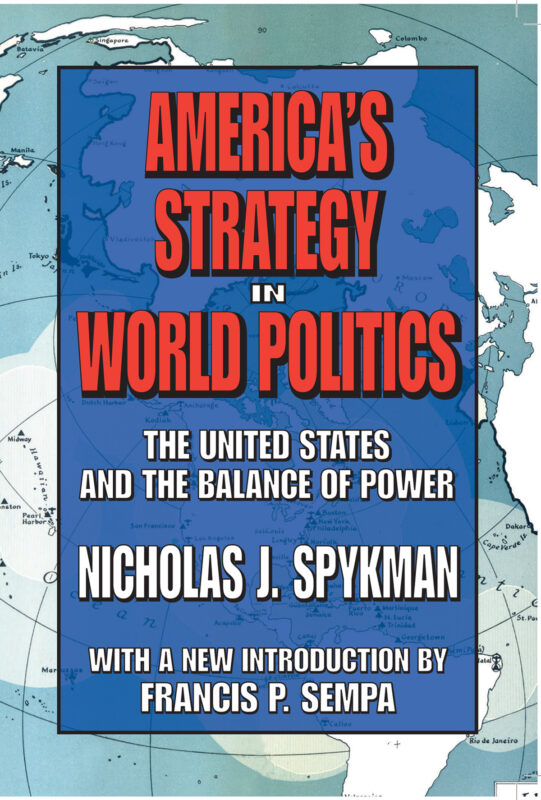
America’s Strategy in World Politics: The United States and the Balance of Power by Nicholas Spykman investigates how the intersection of geography, power, and policy shapes the fate of nations. The author asserts that the geographic position of the United States confers advantages, but only so far as leaders recognize its demands and act on its imperatives. Spykman crafts a framework that links geographic facts to security strategy, using the lessons of history to guide American engagement in world affairs.
The Geopolitical Foundation
Geography exerts enduring influence on the structure of international politics. Spykman defines the physical world in terms of continents, islands, and oceans, tracing historical centers of power from the ancient Middle East to the Atlantic basin. The United States, positioned between the Atlantic and Pacific, occupies a unique location with direct access to both major world oceans. This dual frontage creates structural advantages in trade, communication, and defense. Yet location does not guarantee safety. Spykman shows that states which rely on geographic isolation ignore the permeability of borders in a technological age. Railways, aircraft, and modern navies compress space, exposing even distant powers to external threats.
He identifies three types of states: landlocked, island, and those with both land and sea frontiers. The United States, with weak land neighbors and two vast coastlines, fits the latter category, but enjoys “island” security in the Western Hemisphere. Spykman demonstrates that control of communications—by sea or land—determines the range and efficacy of national power. He examines historical cases where empires rose and fell according to their ability to project force across natural barriers.
Power Politics and the Structure of Survival
The struggle for power defines the global order. Spykman insists that states, lacking any central authority above them, act to preserve territorial integrity and political independence. The pursuit of power becomes the core objective, for survival in an anarchic system depends on relative strength. He lists elements of power—territory, population, resources, economic development, political stability, national spirit, military capacity, and the strength of adversaries. Leaders, he argues, must focus on practical calculations rather than abstract ideals. Morality enters foreign policy only to the degree it supports or does not obstruct the power imperative.
Spykman grounds his analysis in the constant flux of international relations. He draws on the analogy of a magnetic field, where great powers function as poles whose relative strengths direct the lines of force. Shifts in power—whether through expansion, technological change, or alliances—reconfigure the field. He illustrates this with historical examples: river valley civilizations seeking outlets to the sea, land empires striving for warm-water ports, and maritime states expanding to adjacent coasts. These patterns drive cycles of war and peace, which Spykman presents as inherent in the state system rather than aberrations.
The Balance of Power and American Strategy
A stable balance of power creates the most reliable environment for state security. Spykman places the maintenance of equilibrium in Europe and Asia at the center of American grand strategy. He explains that the United States, protected by oceans but bound to global trade and security, cannot isolate itself from Eurasian developments. The collapse of the European or Asian balance threatens to tip the scales against American interests, exposing the Western Hemisphere to indirect influence or direct aggression. He contends that “hemisphere defense” alone leaves the United States vulnerable, for advances in military technology erase the protective function of distance.
The book surveys the evolution of American policy from the Monroe Doctrine, through the phases of continental expansion, to the debates over intervention and isolation in the world wars. Spykman reveals how isolationist sentiment, rooted in the desire to escape European power struggles, repeatedly yields to the logic of engagement when continental or overseas balances collapse. He points to critical moments—French and British challenges to U.S. dominance in the hemisphere, German ambitions in both world wars, Japanese expansion in the Pacific—when American leaders confront the limits of isolation.
The Western Hemisphere: Power and Integration
Spykman analyzes the Western Hemisphere as a theater of American influence. He explores how U.S. power extends from the control of North America through dominance over the Caribbean and Central America to involvement in South American affairs. He scrutinizes the challenges posed by European colonial interests, German and Japanese designs on Latin America, and the persistent task of mobilizing hemispheric resources for common defense.
The author probes efforts at political and economic integration, such as the Pan American movement and inter-American trade agreements. He discusses obstacles—rivalries with regional powers like Argentina, the diversity of interests among Latin American states, and the limited reach of American influence. Spykman demonstrates that unity within the hemisphere depends on more than declarations of solidarity; it requires the alignment of interests, economic cooperation, and credible security commitments.
Europe and the Transatlantic Balance
Europe serves as the traditional cockpit of world politics. Spykman dissects its geography: the continent’s landmass, peninsulas, and proximity to the heartland of Eurasia. He traces the succession of powers—Hapsburgs, France under Louis XIV, Napoleonic France, Wilhelmine and Nazi Germany—that sought to dominate the continent and thereby project power outward. He explains Britain’s historical strategy as an offshore balancer, forming alliances to prevent continental hegemony.
In this context, the United States becomes the transatlantic counterpart to Britain. Spykman demonstrates how American intervention in both world wars reflects the structural requirement to prevent a hostile power from consolidating Europe. He explores the dynamics of coalition-building, the shifting roles of Britain, France, and Russia, and the dangers posed by the “political collapse of Europe” in the early twentieth century. He assesses German and Soviet geopolitical visions, warning that the control of European and Middle Eastern resources creates the foundation for intercontinental power struggles.
Asia and the Transpacific Zone
The Pacific basin emerges as a parallel arena of contest. Spykman details the American advance into the Pacific through annexations and the Spanish-American War, leading to interests in Hawaii, the Philippines, Guam, and China. He analyzes Japan’s ascent, its moves into Manchuria and Southeast Asia, and its challenge to American and British supremacy in the Pacific. He describes the failure of notes and protests to curb Japanese expansion, leading to economic sanctions and the attack on Pearl Harbor.
Spykman emphasizes the strategic logic connecting Asian and American security. He warns that the loss of access to Asian markets and resources would cripple American power, and that the formation of a Japanese sphere would reverberate across the Pacific and threaten the Western Hemisphere. He examines the challenges of defending far-flung possessions and projecting force over the vast Pacific expanse. The interplay between sea power and continental strength structures the dynamics of rivalry and alliance.
The Rimland and the Structure of Eurasian Power
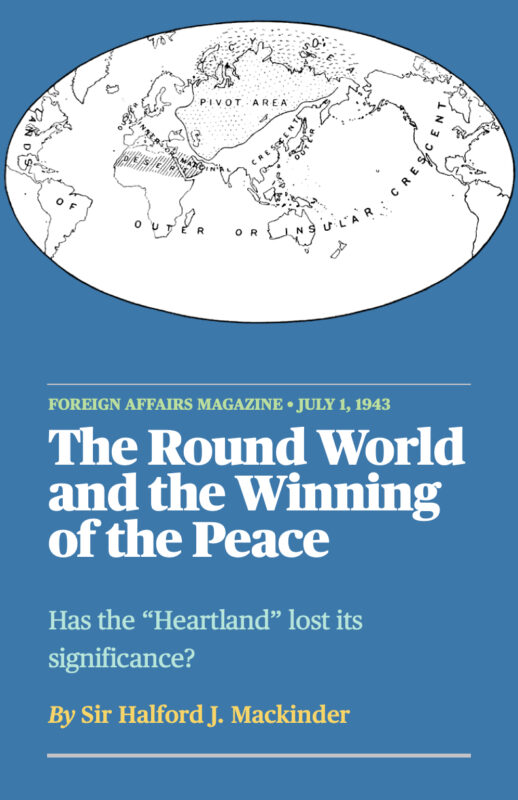
Spykman builds on the work of British geographer Halford Mackinder but redefines the core theater of world politics. He identifies the “rimland”—the coastal regions encircling Eurasia, including Western Europe, the Middle East, and East Asia—as the decisive zone for global power. He demonstrates that this region, combining industrial and manpower resources, offers both land and sea power advantages. He tracks the emergence of aspiring hegemons from the rimland, citing Napoleonic France, Germany, and Japan as cases where attempts to dominate the rimland triggered global coalitions and wars.
He asserts that the security of the United States depends on preventing the consolidation of the rimland under a single power. Control of the rimland leads to domination of Eurasia, which in turn shapes the destinies of other continents. Spykman articulates the implications for postwar planning: the necessity of sustaining a plural power structure in Eurasia, supporting allies and coalitions, and maintaining access to key strategic regions.
Strategy for War and Peace
Spykman develops a concept of grand strategy that integrates military, political, and economic dimensions. He argues that American leaders must design policies that respond to the permanent realities of geography and power, balancing the demands of war and peace. He criticizes faith in collective security schemes that ignore structural constraints, urging instead a practical focus on alliances, balances, and the distribution of force.
The book assesses the mobilization of resources, both within the hemisphere and in alliance with others. Spykman details the struggle for strategic materials, the significance of economic integration, and the patterns of military cooperation. He examines the vulnerability of supply lines, the challenges of maintaining technological superiority, and the risks of overextending commitments.
The Postwar World and Lasting Lessons
As the war concludes, Spykman foresees a new configuration of power centers. He predicts the emergence of China, India, the Soviet Union, and the United States as dominant actors. He cautions against dismantling German and Japanese power entirely, arguing that new vacuums invite instability and that American interests demand enduring engagement in both Europe and Asia. He warns that the end of war signals only a transition in the power struggle, not its termination.
The book’s analysis resonates beyond its immediate historical context. Spykman’s framework influenced Cold War strategies, particularly the doctrine of containment. His insights underpin debates on U.S. alliances, intervention, and the logic of forward engagement in the twenty-first century. The argument returns repeatedly to a central question: How does a state secure its future in a world structured by competing powers and shifting balances?
Spykman’s clarity stems from his conviction that geography and power, rather than sentiment or historical habit, dictate the range of viable policy. The narrative tracks the convergence of historical events, technological change, and structural imperatives. The logic of the book flows from the specific—maps, resources, rivalries—to the general, culminating in the assertion that the United States must organize its foreign policy around the enduring demands of the balance of power.
America’s Strategy in World Politics: The United States and the Balance of Power stands as a definitive treatise on the intersection of geography and statecraft. Spykman compels readers to recognize that the structure of the world imposes constraints and opportunities, and that states prosper when they act with clear-eyed purpose within those bounds. The book’s synthesis of historical narrative, geopolitical theory, and strategic prescription gives it a central place in the canon of international relations, shaping how generations of policymakers and scholars understand the perennial tasks of security and engagement.