Who We Are: America’s Fight for Universal Progress, from Franklin to Kennedy: Volume I – 1750s to 1850s
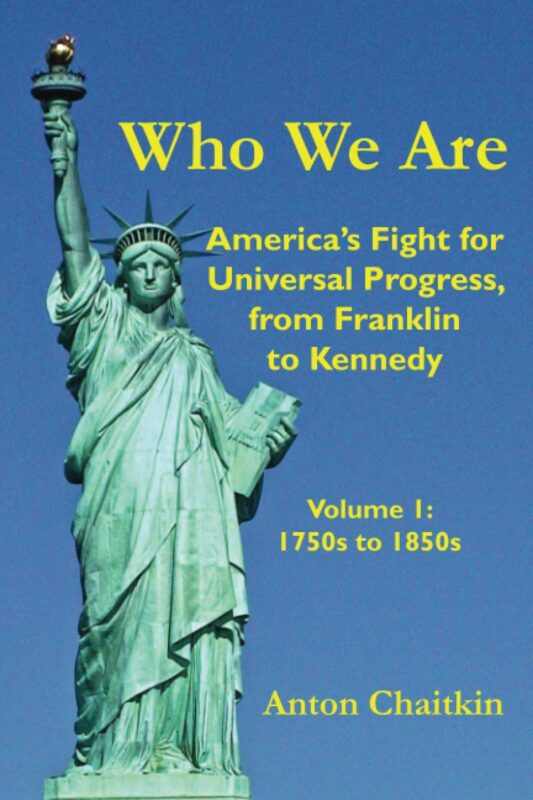
Who We Are: America's Fight for Universal Progress, from Franklin to Kennedy by Anton Chaitkin recovers a buried historical tradition that defines the United States as a nation founded to uplift humanity through science, infrastructure, and republican principles. Chaitkin traces this mission from the mid-18th century to the mid-19th century, focusing on the lives and work of those who initiated the industrial transformation of both America and Europe.
The American Republic as an Engine of Human Development
The founding purpose of the United States arose from the intention to deploy national power for technological progress. Leaders like Benjamin Franklin, George Washington, and Alexander Hamilton envisioned a republic organized to multiply human productivity. They pursued national development through public investment, scientific advancement, and international alliances structured around mutual benefit.
Franklin’s scientific vision shaped a network of collaborators in Britain and France. These reformers, many operating in secret under the shadow of imperial repression, pioneered the industrial innovations that launched modern economies. Their activities laid the groundwork for canals, mechanized manufacturing, and the use of steam power as a strategic resource. Franklin’s American Philosophical Society formed a prototype for political-scientific organization, coordinating transatlantic operations with long-term objectives.
The Franklin Circle and the Industrial Transformation of England
In 1757, Franklin arrived in England and began working with a circle of scientists, inventors, and reformers. This network included Matthew Boulton, James Watt, Josiah Wedgwood, John Wilkinson, Erasmus Darwin, and Joseph Priestley. Their collective work birthed the world’s first industrialized city in Manchester and developed the first commercially viable steam engine.
The Bridgewater Canal, organized by John Gilbert and financed by the Duke of Bridgewater, created a model of regional transformation through infrastructure. Their coalition structured financial mechanisms, engineering practices, and political lobbying to overcome feudal inefficiencies. These initiatives launched England’s canal network and enabled mass iron and coal production, catalyzing rapid urban growth and manufacturing.
Steam Power as a Planned Technological Breakthrough
Steam engine development emerged not from isolated inventions, but from coordinated scientific inquiry and engineering design. Franklin initiated William Small into this mission and placed him alongside Boulton to lead the new Soho works. Together with Watt, they solved core technical challenges—such as efficient condensation and cylinder boring—that made steam power scalable. John Wilkinson’s ironworks provided the tools and materials, while Soho became the first modern manufacturing facility.
This was a deliberate campaign. Small’s leadership, Boulton’s industrial ambition, and Watt’s engineering discipline turned theoretical knowledge into production systems. The integration of statecraft, physics, and metallurgy delivered systemic change. The team’s work enabled mechanized power in textiles, mining, and transportation, reshaping labor, capital, and commerce.
International Strategy and American-French Cooperation
Franklin’s political intelligence extended into wartime logistics and foreign policy. Through collaboration with Beaumarchais, the French playwright and arms supplier, he directed the creation of French artillery foundries based on Wilkinson technology. These factories produced cannons that supported Washington’s victory at Yorktown.
The French industrial sites at Indret and Le Creusot, designed and managed by the Wilkinson family, symbolized the spread of American industrial methodology into continental Europe. These projects emerged through covert diplomacy and technical exchange, formalizing the alignment of American and French republican ambitions against the British Empire.
Science as Moral Action: Priestley and the Republican Ideal
Joseph Priestley’s role exemplifies the connection between science and civic mission. Under Franklin’s mentorship, he transitioned from education into chemistry, discovering oxygen and laying the foundations for modern biology and environmental science. Priestley understood his work as service to humanity, advancing public health, agriculture, and technological literacy.
His political views mirrored his scientific ethos. Priestley opposed tyranny and ecclesiastical oppression, championed dissenting academies, and exposed the ideological structure of the British ruling class. His persecution and eventual exile to America illustrated the stakes of aligning science with republican liberty.
From Political Economy to National Industrial Strategy
Chaitkin dissects the philosophical basis of national development. Hamilton’s financial system did not derive from market forces but from conscious economic architecture. The national bank, tariffs, and internal improvements policy provided the instruments to direct capital toward national goals. American industrialization in the 1820s and 1830s followed this blueprint.
Henry Clay, John Quincy Adams, and Matthew Carey refined this tradition. They argued that national sovereignty depends on productive capacity, and that infrastructure multiplies economic agency. Their advocacy for public works, education, and a manufacturing base positioned the United States to become a global leader in science and engineering.
Counterforces: The Rise of Imperial Economics and Historical Distortion
The book identifies an enduring counterproject. The British imperial elite—centered in the City of London, operating through financial monopolies and colonial exploitation—sought to contain or reverse industrial development outside their control. Through the East India Company, opium trade, and suppression of manufacturing in the colonies, they enforced a system of enforced underdevelopment.
Chaitkin exposes how free trade ideology, presented by Adam Smith and later by Marxist theorists, obscured the intentional strategies behind industrial progress. These narratives attribute technological revolutions to market spontaneity or class struggle, omitting the conscious planning of republican leaders. This distortion serves oligarchic interests by denying agency to nation-states and peoples.
The American System and the Legacy of Progress
By mid-19th century, the American System had matured. West Point-trained engineers built railroads, canals, and bridges across the country. Public credit fueled universities, laboratories, and agriculture. The Reading Railroad, the Pennsylvania Canal, and the founding of the Smithsonian Institution exemplified state-sponsored uplift.
Philadelphia became a center of innovation, where foundries, banks, and publishers worked in tandem to distribute tools, knowledge, and ideas. This ecosystem generated the conditions for later achievements, including the industrial expansion of the late 19th century and the scientific infrastructure of the New Deal and NASA.
The Struggle Over Historical Memory
The post-1960s collapse of American industrial policy coincided with the erasure of this tradition. Chaitkin argues that the murders of John F. Kennedy, Robert Kennedy, and Martin Luther King, alongside the Vietnam War and the rise of globalism, terminated the republic’s mission. Historical revisionism then concealed the record of national success, replacing it with myths of inevitable decline and permanent inequality.
The educational system now treats nationalism as reactionary, industrial growth as destructive, and technological mastery as hubris. Chaitkin challenges these premises by reconstructing the historical record. He shows how progress results from design, how liberty depends on capacity, and how republican institutions create the platform for dignity.
Renewing the American Mission
The book closes with a call to reclaim the founding purpose. Progress is not an abstraction but a concrete strategy requiring leadership, engineering, and cultural confidence. The principles that once organized American development—sovereignty, productivity, education, and infrastructure—can again serve as the architecture of global uplift.
Who We Are presents a usable history. Chaitkin recovers the institutional memory of America’s builders, articulates their principles, and outlines their operations. This is a story of cause and effect, of vision turned into policy, of republic against empire. It is a record of what works.