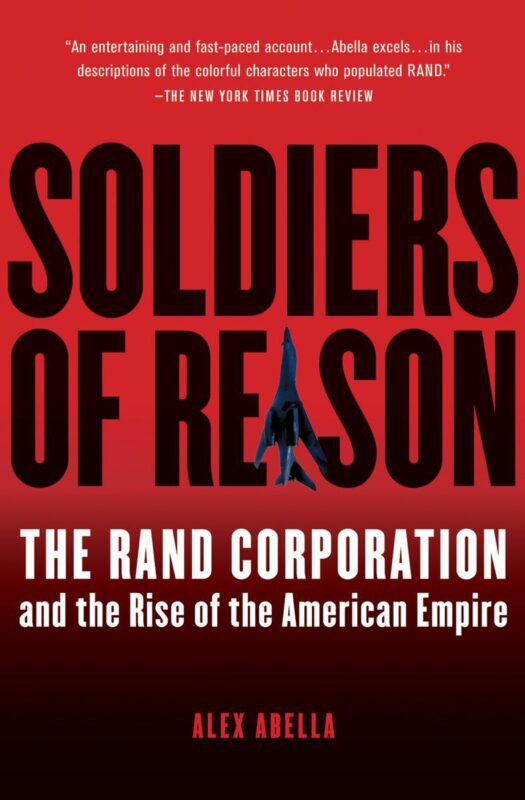
Soldiers of Reason: The RAND Corporation and the Rise of the American Empire by Alex Abella exposes the origins, evolution, and enduring influence of the RAND Corporation on American policy, global strategy, and modern technological life. Abella asserts RAND’s primacy in shaping postwar military doctrine, systems thinking, and the rationalist frameworks that define policy across decades.
The Genesis of RAND: Power, Science, and Military Ambition
RAND emerges from the crucible of post-World War II anxieties. General Henry “Hap” Arnold, recognizing the dispersal of America’s wartime scientific talent, determines to concentrate intellectual capital within a single advisory center. Arnold partners with Franklin Collbohm, a Douglas Aircraft executive, and General Curtis LeMay, a strategist with relentless vision. The Air Force directs funds and focus into Project RAND, tasking it with one clear imperative: deliver scientific innovation to support American dominance in air warfare. These founders embed a culture that fuses the rigor of operational research, born in the fires of World War II, with the autonomy of academic inquiry. The organization’s first assignment, a study on the feasibility of orbiting satellites, signals the scope of its ambition and presages its eventual reach into space technology and the internet.
Operational Research and Systems Analysis: The Engine of Policy
RAND’s early breakthroughs arise from the adaptation of operational research to military and strategic planning. British wartime scientists had shown how to quantify and optimize warfare using mathematics, probability, and logistics. RAND institutionalizes this logic within American defense policy, turning problems of bombing, missile development, and nuclear deterrence into quantifiable systems. Under John Williams, a mathematician with grand designs, RAND hires polymaths and Nobel laureates, such as John von Neumann, who introduces game theory and formalizes rational decision-making. RAND pioneers “systems analysis,” an approach that frames complex challenges as variables within interconnected structures. This method transforms not only military planning, but also the logic of governance, economics, and even healthcare. Policy becomes the art of maximizing efficiency through rational evaluation of choices, costs, and outcomes.
Nuclear Strategy and the Cold War Mindset
The specter of the Soviet Union drives RAND’s research toward nuclear weapons, deterrence, and game-theoretical models of conflict. Analysts such as Bernard Brodie, Paul Nitze, and Nathan Leites generate foundational doctrines: deterrence depends on credible threat, second-strike capability, and the measured calculation of risk. RAND’s advocacy for missile and satellite programs steers Pentagon priorities and catalyzes the arms race. Documents like NSC-68, heavily influenced by RAND’s approach, prompt massive increases in U.S. defense spending and fortify the logic of permanent military preparedness. The calculus of potential destruction—measured in megatons, delivery times, and survivability—shapes American and global security for generations.
The Reach of Rational Choice: Economics, Social Policy, and the Matrix of Governance
RAND’s influence radiates beyond bombs and battlefields. Rational choice theory, introduced and championed by RAND economists, asserts that self-interested action—quantified and analyzed—underpins human decision-making. This theory infiltrates government, redefining the relationship between citizen and state. Healthcare reforms, welfare models, and education policy bend toward efficiency, cost-sharing, and the quantification of public good. The concept of co-payments in insurance emerges from a decade-long RAND health experiment, demonstrating the group’s impact on everyday life. Packet switching, the innovation that makes the internet possible, springs from RAND’s quest for survivable communications in nuclear war. RAND’s frameworks become the invisible code beneath Western society’s consumerist matrix.
Integrating the Human Factor: The Struggle with Social Science
RAND’s founders recognize the limitations of pure mathematics when confronting the complexity of human behavior. They recruit social scientists and convene seminal conferences—drawing figures such as Ruth Benedict, Bernard Brodie, and Hans Speier—seeking to graft the insights of psychology, sociology, and anthropology onto their analytical models. The organization forms dual headquarters, splitting its social science operations between Santa Monica and Washington, D.C. Despite its intellectual ambition, RAND finds human unpredictability difficult to reconcile with its numbers-driven systems. Analysts debate how to model morale, enemy intentions, and group dynamics, sometimes reducing the “human factor” to variables within decision trees. The effort produces path-breaking studies in propaganda, attitude measurement, and policy analysis, yet the tension between quantification and complexity persists.
Technocracy Ascendant: RAND’s Model for Modern Power
RAND engineers a transformation in American governance: expertise and technical analysis displace partisanship and traditional deliberation. RAND’s nonprofit structure, funded through government contracts and philanthropic foundations like Ford, allows the think tank to pursue projects with academic freedom and practical consequence. Its analysts draft policy blueprints, conduct classified war games, and design simulations that later shape urban planning, traffic management, and even counterinsurgency strategy. RAND’s culture prizes debate, innovation, and internal competition—working papers circulate for fierce critique, and so-called “murder boards” dissect ideas in rigorous group sessions. The organization cultivates a sense of intellectual superiority among its staff, recruiting top graduates, mathematicians, and social scientists, many with wartime intelligence backgrounds.
Vietnam, Social Engineering, and the Limits of Rationality
RAND’s analytic prowess draws it deep into the heart of U.S. involvement in Vietnam. The think tank’s models of counterinsurgency, population control, and bombing effectiveness attempt to provide scientific solutions to an intractable conflict. The logic of cost-benefit and systems analysis, powerful in engineering and nuclear strategy, confronts the unpredictability of guerilla warfare and political insurgency. The Pentagon Papers, which expose internal government doubts about the war, originate from RAND-sponsored research and analysts. RAND’s approach to urban planning and domestic policy echoes the same rationalist logic: cities become laboratories, citizens variables within optimization models, and government an engineer of outcomes. The pursuit of efficiency—divorced from politics and ethics—exposes new tensions in the American experiment.
RAND’s Enduring Legacy: Influence, Innovation, and Controversy
RAND’s ideas and alumni shape U.S. policy from the Cold War to the present. Alumni like Paul Baran, a pioneer of the internet, and military strategists who design the “Revolution in Military Affairs,” carry the RAND logic into the private sector, academia, and the Pentagon. RAND’s research in terrorism, initiated long before the attacks of September 11, informs both theory and practice in homeland security. The think tank’s involvement in Iraq, debates over missile defense, and advocacy for network-centric warfare demonstrate its lasting capacity to direct policy at the highest levels.
RAND’s signature—reason unbound, the pursuit of solutions through abstract modeling and technocratic governance—saturates the infrastructure of the West. Healthcare, warfare, economic policy, and even debates over artificial intelligence echo the structures first articulated in RAND’s meeting rooms and memoranda. Yet the organization’s insistence on rationality also leaves open questions about ethics, humanity, and the unforeseen consequences of a world run by experts. Abella posits RAND’s rational choice theory as the invisible architecture of the modern West, the code animating a civilization defined by numbers, models, and managed risk.
The Hidden World Revealed: Why RAND Matters
How does a single organization leave such a vast imprint on technology, governance, and global order? RAND’s secret lies in its method—transforming uncertainty into structure, ambiguity into calculation, and threat into opportunity for mastery. By championing systems thinking and rational analysis, RAND engineers the intellectual environment in which military, political, and economic power converge. RAND’s proximity to government, combined with its academic style and philanthropic support, grants it unparalleled access to decision-makers and resources. Its analysts—selected for brilliance, trained to question, and empowered to innovate—deliver ideas that become doctrine, policy, and, ultimately, reality.
Abella contends that understanding RAND is essential for anyone who seeks to grasp the mechanisms of American power and the logic that propels the modern world. The organization’s story intersects with every major policy shift, technological leap, and strategic doctrine of the postwar era. Its legacy—visible in the internet, in global security doctrines, in the language of policy analysis—demands recognition and critical scrutiny. RAND’s story is the story of the American century told through the logic of the mind, the calculus of strategy, and the ambition to control the uncertain future.
Future Trajectories: The RAND Logic in a New Era
What challenges will the rationalist vision confront in a world defined by asymmetrical threats, information warfare, and social upheaval? RAND’s methods continue to evolve, integrating data science, behavioral economics, and advanced modeling. As policymakers confront climate change, pandemics, and geopolitical realignment, the demand for RAND’s style of expertise intensifies. Yet the book’s narrative invites inquiry: can systems analysis fully account for the unpredictability of human society, the persistence of values, or the demands of democracy? RAND’s history offers both inspiration and caution—a reminder that solutions shaped by intellect alone can change the course of history, but cannot escape the dilemmas of ethics, agency, and the enduring complexity of human life.