Cinna and His Times; a Critical and Interpretative Study of Roman History During the Period 87-84 B.C.
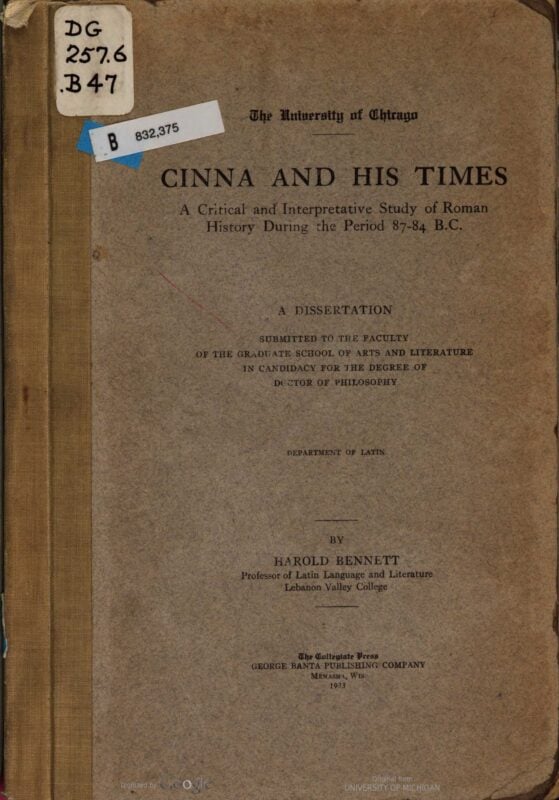
Cinna and His Times by Harold Bennett reconstructs the four years between 87 and 84 B.C., when Lucius Cornelius Cinna directed the Roman Republic through crisis and transition. The study, grounded in the primary sources of Appian, Plutarch, Velleius Paterculus, Livy, and Cassius Dio, interprets the Cinnan regime as a bridge between senatorial oligarchy and emergent autocracy. Bennett presents a close analysis of the civil war following Sulla’s departure for the East, the reorganization of civic power, and the constitutional structure that briefly sustained Rome before Sulla’s return.
The Collapse of the Post-Social War Order
The Social War had altered the composition of the Roman state. Italian allies received citizenship through the Julian and Plautio-Papirian laws but were confined to ten voting tribes. Their marginalization created unrest across Italy and opened the political field to ambitious consuls. Cinna entered public life during this tension, having served under Cn. Pompeius Strabo in the northern campaigns of 89 B.C. His military experience and senatorial background prepared him for the consulship of 87 B.C., which he won alongside Cn. Octavius. Bennett emphasizes the complexity of this election: Plutarch’s account suggests that Sulla himself endorsed Cinna to maintain temporary calm before departing for the Mithridatic War. The gesture placed a latent revolutionary in the highest office under an oath of loyalty that he soon disregarded.
The Return of the Italian Question
As consul, Cinna advanced the renewal of the Sulpician legislation, which proposed distributing the new Italian citizens across the thirty-five tribes. He aimed to transform partial enfranchisement into full civic integration. The senate resisted. Octavius opposed the motion, and violence broke out in the Forum. Octavius’s forces drove the Italians from the city; Cinna fled, accompanied by several sympathetic tribunes. The senate expelled him from office and stripped his citizenship, citing his attempt to incite slave insurrection. L. Cornelius Merula, the flamen Dialis, filled the vacant consulship. Cinna’s expulsion created a precedent: the deposition of a consul without trial through senatorial decree. The event redefined the limits of constitutional legitimacy and revealed the instability of republican procedure under stress.
Raising Armies and Building Alliances
Cinna reorganized his base in the Campanian region. At Nola he persuaded the legion left by Sulla under Appius Claudius to defect, claiming to defend constitutional order against illegal deposition. His speech combined personal grievance and civic appeal, invoking the oath between consul and citizen. The soldiers swore allegiance and joined his cause. Cinna’s recruitment spread through the southern towns—Capua, Nola, and Beneventum—drawing volunteers and funds from Italian communities that still demanded full integration. His forces swelled to several legions, a field army capable of confronting the capital. The senate prepared defenses, recalling Strabo and fortifying Rome’s walls. Strabo’s position remained ambiguous. Commanding veterans from the northern campaigns, he stationed himself at the Colline Gate and waited, negotiating with both factions for advantage.
The Return of Marius
At this juncture Gaius Marius reappeared from exile in Africa. His return altered the strategic balance. Accompanied by freed slaves and a small force of Numidian cavalry, he landed at Telamon in Etruria, assembled forty ships, and began recruiting. He joined Cinna after negotiations through intermediaries, among them M. Junius Brutus. Sertorius advised Cinna against alliance, yet Cinna saw in Marius a commander whose experience and name could rally the disenfranchised. Bennett characterizes the alliance as transactional: Cinna gained military strength; Marius gained restoration and opportunity for vengeance. Cinna appointed him to proconsular command. Together they organized four armies under Marius, Cinna, Sertorius, and Cn. Papirius Carbo.
The Siege of Rome
The campaign of 87 B.C., often called the Bellum Octavianum, followed a structured plan. Marius advanced from the coast, Cinna and Carbo encamped on the Vatican plain opposite the city, and Sertorius controlled the upper Tiber. They built bridges to cut supply lines and surrounded Rome by land and river. Strabo, entrenched at the Colline Gate, watched both sides. His inaction preserved Cinna’s momentum. When Marius seized Ostia through the treachery of Valerius, he severed Rome’s grain route and starved the population. Appian reports the sack of the port and the plundering of its warehouses. Fighting erupted near the Janiculum, where Marius crossed from the south while Cinna assaulted from the opposite bank. The defenders under Octavius resisted until exhaustion forced negotiation. Envoys met on the Appian Way; Rome capitulated. Cinna and Marius entered the city as consuls recognized by force.
Purge and Political Control
The victory initiated a purge that later writers described as a massacre. Bennett interrogates these accounts, arguing that the executions targeted specific senatorial leaders rather than broad classes. The council of death, presided over by Marius, ordered the killing of Cn. Octavius, Q. Catulus, L. Julius Caesar, and others associated with Sulla’s legislation. Cinna’s role, according to Bennett’s synthesis, was administrative rather than vindictive. He attempted to limit mob violence and restore civil order after the killings subsided. Marius, aged and ill, died shortly after his seventh consulship began in 86 B.C., leaving Cinna the dominant figure in Rome.
Cinna’s Regime and Legislative Actions
With power consolidated, Cinna conducted annual elections that returned him and his allies to office. The regime governed through formal legality while exercising unrestricted authority. Bennett interprets this dual structure as a deliberate strategy: Cinna preserved republican forms to legitimize revolutionary control. The Lex Valeria de aere alieno solvendo provided debt relief by mandating payment at one-quarter of the nominal value. Creditors denounced it as turpissima, yet the law stabilized urban unrest by reducing insolvency. Another reform, issued by M. Marius Gratidianus, adjusted currency exchange rates and reestablished public confidence in coinage. Together these measures reflect an attempt to manage economic disarray after years of war and confiscation.
The Administration of Justice and Provincial Affairs
Cinna’s government maintained tribunician functions and expanded the census rolls to include newly enfranchised Italians. The censorship of Philippus and Perperna sought to reconcile citizens and allies under unified registration. In foreign policy Cinna dispatched L. Valerius Flaccus eastward to confront Mithridates and counterbalance Sulla’s campaign. Flaccus’s expedition disintegrated when his legate C. Flavius Fimbria mutinied, murdered him at Byzantium, and seized command. Fimbria’s advance through Asia culminated in the sack of Ilium, an act that discredited the Roman presence in the East. The Cinnan government, unable to reassert control, recalled the remnants of the force. The episode revealed the fragility of authority beyond Italy and the erosion of discipline within the legions.
The Structure of Power and Political Theory
Bennett examines the constitutional implications of Cinna’s rule. The senate continued to meet, laws were enacted through the comitia, and magistracies functioned in name. Yet initiative resided exclusively with Cinna and his circle. This centralization without formal dictatorship marked a critical stage in the evolution of Roman governance. Cinna did not claim divine sanction or royal prerogative; he ruled through the inertia of institutions unable to oppose him. His authority derived from the army, his legitimacy from the pretense of legality. The fusion of these elements produced a political organism that foreshadowed later autocratic forms while retaining republican vocabulary.
Economic and Social Dimensions
The financial distress of the early 80s B.C. shaped much of Cinna’s policy. War expenses drained the treasury. Coin debasement and confiscations eroded public trust. The Lex Valeria’s partial cancellation of debt reflected both moral and fiscal calculation. Bennett tracks the response of different social strata: urban plebs welcomed relief, senatorial creditors protested, and provincial administrators faced chaos in remittance systems. The regime’s measures on grain supply and coinage created temporary stability but lacked administrative depth. Gratidianus’s reform, praised for its immediate effect, relied on compulsion rather than institutional finance. Cinna’s failure to create enduring mechanisms illustrates the limits of improvisation under continuous military pressure.
The Final Year and Death of Cinna
By 85 B.C., Sulla had secured victory in the East and prepared to return. Cinna, anticipating confrontation, assembled forces at Ancona and Brundisium. Mutiny erupted among the recruits, provoked by fear of renewed civil war. Attempting to restore order, Cinna confronted the troops and was stoned to death. His body, denied public burial, marked the violent end of the Cinnan regime. Leadership passed briefly to Carbo, who could not sustain cohesion. The republic drifted toward Sulla’s second march on Rome and the establishment of dictatorship.
Cinna’s Historical Position
Bennett situates Cinna within the continuum of Roman constitutional development. He defines Cinna’s regime as transitional—a government born of electoral legality yet sustained by military coercion. The administration respected forms while altering substance, maintaining the appearance of the consulship as it accumulated executive permanence. Cinna’s political imagination lacked constructive design; he governed through expedients rather than systemic reform. Yet his tenure transformed the republic by demonstrating that command of legions could substitute for senatorial mandate. The concept of a perpetual consulship, renewed through compliant elections, became a precedent for future concentration of power.
The Character of Sources and Method of Analysis
The dissertation dissects discrepancies among the ancient historians. Appian’s narrative of sweeping massacres, Plutarch’s moralized portraits, and Livy’s senatorial epitome present conflicting motives and scales of violence. Bennett reconstructs probable sequences by cross-referencing military logistics and civic decrees. His interpretive method identifies political function rather than rhetorical coloring. The result produces a portrait of Cinna as a politician with strategic acumen and limited ideological vision. The study distinguishes personal ambition from structural necessity: Cinna acted as the system’s executor rather than its destroyer.
Legacy and Interpretation
Cinna’s years in power redefined Roman expectation of executive continuity. The republic discovered that legality could coexist with coercion when ritual procedures masked violence with ceremony. The annual renewal of the consulship turned into a mechanism of permanence. The regime’s symbolic respect for law created a vocabulary of legitimacy later adopted by Sulla’s dictatorship and Caesar’s consulships. Cinna’s actions exposed the elasticity of Roman constitutional forms—their ability to sustain authority without consent once armed force guaranteed compliance.
Bennett’s Scholarly Contribution
Harold Bennett’s analysis rescues the Cinnan period from the shadow of Marius and Sulla. His reconstruction of the civil war traces the interplay between military command, civic status, and legislative authority. The argument unfolds through primary-text interpretation rather than speculation. The book’s value lies in its precision: dates, laws, decrees, and troop movements appear with philological rigor. Bennett frames Cinna’s policies as responses to defined conditions—economic strain, political exclusion, and administrative vacuum—rather than as products of ideology. The result is a historically grounded study that maps the mechanics of revolution within a republican framework.
The Evolution of Republican Authority
The years 87 to 84 B.C. form a compact cycle of revolution, governance, and collapse. They reveal how authority migrated from civic consensus to military enforcement. Cinna’s rise demonstrates how institutional vacancies invite armed arbitration. His administration proves that once soldiers replace voters as arbiters of legitimacy, constitutional structure converts into ceremonial façade. The transformation under Cinna did not end with his death; it set the precedent that Rome would follow for the next half century. Through the synthesis of evidence and interpretation, Bennett exposes the logic by which republican forms evolve into instruments of singular command.