Super Imperialism. The Economic Strategy of American Empire. Third Edition
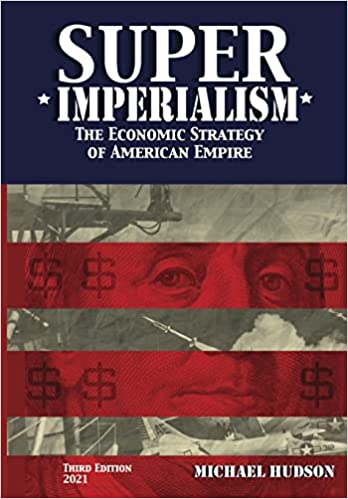
Super Imperialism: The Economic Strategy of American Empire by Michael Hudson redefines the architecture of global finance through an unflinching analysis of U.S. monetary policy and its geopolitical leverage. Hudson charts the evolution of a uniquely American model of global dominance—one that bypasses traditional colonial tactics in favor of financial mechanisms grounded in public debt, institutional hegemony, and controlled currency flows.
How America Reshaped Global Capital Through Intergovernmental Debt
Hudson opens by tracking the roots of U.S. global dominance to the aftermath of World War I. The U.S. leveraged inter-Allied debt arrangements to impose a creditor hierarchy that subordinated former European powers. These debts did not just reflect fiscal claims—they became tools for reshaping trade balances, tariff structures, and domestic policy compliance in debtor nations. The structure of these debts redirected surplus flows and channeled them into the U.S. economy, locking allies into cycles of dependency.
The creation of this system hinged on strategic decisions that isolated Germany economically while tying Britain and France to a repayment logic that impaired their postwar recovery. The U.S. enforced debt repayment while refusing reciprocal trade concessions, weaponizing its creditor position to dismantle competing empires under the guise of economic order. The Versailles Treaty and the subsequent Dawes and Young Plans formalized this financial containment, embedding U.S. oversight in European recovery.
Monetary Dominance Without Production Parity
Hudson argues that U.S. dominance operates through an inversion of classical economic expectations. Traditional empires extracted raw materials and labor from colonies. The U.S. reversed this logic by compelling surplus nations to absorb American liabilities through the purchase of Treasury securities. Surplus dollars never exited the system—they recirculated to fund U.S. military expansion, industrial protectionism, and domestic deficits.
This mechanism operates through the IMF and World Bank. These institutions do not serve as neutral arbiters of global development but enforce a framework in which credit is extended conditionally to preserve dollar supremacy. Aid is tied to structural adjustments that suppress local self-sufficiency. Currency stability becomes conditional on policy submission. Loans serve less as developmental tools and more as levers for enforcing market access, commodity exports, and financial deregulation.
The Dollar Standard as a Global Taxation System
The 1971 closure of the gold window severed the final link between U.S. currency and any external standard of value. Nixon's decision to end dollar convertibility into gold did not merely adjust the balance of payments—it transformed the dollar into an instrument of extraction. As nations continued to accumulate dollar reserves, they lost the ability to discipline U.S. fiscal behavior. They financed U.S. budgetary and military expansions without compensation, accountability, or reciprocal benefits.
Treasury bills replaced gold as the anchor of global reserves. Foreign central banks, unable to diversify without risking exchange shocks, reinforced the dollar’s position by necessity. The U.S. economy expanded its deficits in tandem with global demand for safe dollar-denominated assets. These deficits were not signs of weakness—they were the conduits of imperial reach. Nations financing America’s liabilities underwrote a system from which they could not exit without triggering destabilization.
Imperialism Through Institutional Engineering
Hudson exposes how institutional architecture magnifies this imperial footprint. The IMF’s enforcement of austerity in debtor nations preserves capital mobility and repayment schedules, often at the cost of domestic investment and real wages. The World Bank directs developmental pathways toward export-focused strategies that align with U.S. market needs. GATT and WTO frameworks prioritize U.S. agricultural and technological interests, embedding legal structures that limit national economic agency.
These institutions do not promote open trade as an abstract good—they promote a specific configuration of trade that sustains U.S. surpluses in strategic sectors and suppresses industrial competition from the Global South. Aid becomes a disguised form of capital repatriation. Loan conditions function as political discipline. Global monetary flows are structured to maintain asymmetries in production, innovation, and capital accumulation.
Military Spending as a Core Mechanism of Deficit Management
Hudson identifies military expenditure as the primary driver of postwar U.S. deficits. This spending is not a fiscal drag but a structural pillar of global dollar flows. Bases, procurements, and defense contracts abroad generate overseas payments that accumulate as reserves in host nations. These reserves cycle back into U.S. financial markets through Treasury purchases, reinforcing the dollar’s hegemony.
Military Keynesianism becomes a geopolitical strategy. The U.S. maintains strategic presence while transferring the financial burden to creditor nations. Defense outlays create a flow of dollars abroad. Foreign central banks absorb these dollars to maintain exchange stability. The circularity of this flow—military spending, reserve accumulation, reinvestment—solidifies U.S. control over global liquidity without producing tradeable goods.
The Role of Policy Deception in Masking Extraction
Hudson demonstrates that transparency in balance-of-payments accounting has been deliberately eroded. U.S. government reports obscure the fiscal benefits of foreign aid and military spending. Aid packages are structured to return dollars to American contractors. Military expenditures are recorded as costs without acknowledging their contribution to financial inflows. The true structure of U.S. surplus extraction is hidden beneath layers of bureaucratic reclassification.
This concealment is not accidental. The façade of benevolent aid maintains diplomatic cover for coercive economic practices. Policymakers benefit from public misapprehensions about deficit implications and aid altruism. The narrative of American generosity veils a regime in which surplus extraction is built into the architecture of international finance.
Structural Impacts on Global Development and Sovereignty
The consequences of this system are not theoretical—they materialize in constrained development trajectories, stalled industrialization, and political fragmentation across the Global South. Nations that resist U.S. policy prescriptions face capital flight, sanctions, and exclusion from credit markets. Attempts at monetary independence provoke punitive responses. Efforts to build regional trade blocs are undermined through legal, financial, or military pressure.
Even advanced economies find themselves constrained. Japan and Germany, despite export surpluses, accumulate dollar reserves they cannot effectively deploy. The Eurozone, bound by fiscal rules that inhibit deficit financing, lacks the monetary autonomy to rival the dollar’s reach. Sovereignty becomes conditional on compliance with an external monetary logic.
The Strategic Logic of Free Market Rhetoric
Hudson argues that American calls for free markets serve as cover for structurally asymmetric policies. Free trade is invoked when it advances U.S. exports. Deregulation is promoted where it facilitates U.S. capital access. When these principles threaten domestic industries or geopolitical priorities, protectionist measures are imposed without hesitation.
This instrumental approach to liberalization is not a contradiction—it is a deliberate strategy. Ideology functions as a negotiating weapon, not a binding principle. Trade agreements codify favorable terms while preserving unilateral flexibility. Financial liberalization opens foreign economies to U.S. investors while shielding domestic markets through institutional control.
De-Dollarization and the Fracturing of Monetary Hegemony
Hudson sees the emerging efforts toward de-dollarization as systemic reactions to prolonged financial subordination. Russia, China, and regional blocs across Asia and Latin America pursue alternative payment systems, bilateral currency swaps, and gold accumulation. These moves reflect a strategic shift toward monetary autonomy, not merely reactionary defiance.
The U.S. responds with financial sanctions, trade restrictions, and institutional exclusion. These responses, while temporarily effective, accelerate the fragmentation of the dollar system. The more aggressively the U.S. enforces its monetary terms, the more urgently competitors seek insulation. Structural dependence is giving way to multipolar experimentation.
The Post-2021 Outlook for Monetary Imperialism
Hudson closes by observing the system’s deepening contradictions. Austerity abroad subsidizes expansion at home. Military outlays generate financial inflows. Debtor logic enables creditor behavior. The very mechanisms that sustain U.S. power produce instability in global finance and development. This system extracts rather than stabilizes, imposes rather than coordinates.
Super Imperialism does not describe a stable order—it describes a temporary advantage institutionalized through policy, force, and narrative. Its continuation requires compliance, opacity, and financial entrapment. Its challenge requires coordination, transparency, and systemic alternatives. The stakes are not ideological—they are structural.

About the Book
https://youtu.be/m0ze5HGIQQw