The Phoenician Origin of Britons Scots and Anglo Saxons
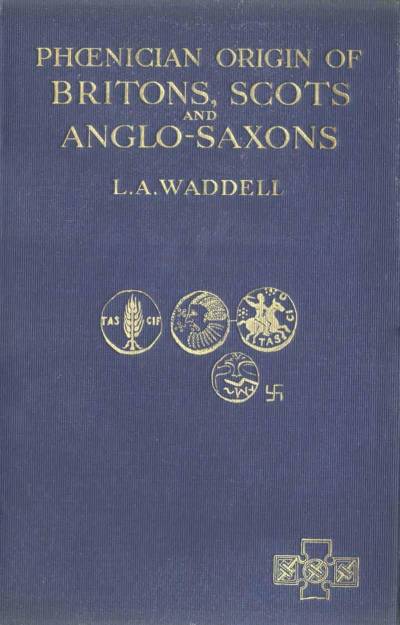
The Phoenician Origin of Britons, Scots and Anglo-Saxons by Lawrence Austine Waddell traces British civilization to successive migrations of Phoenician seafarers whom he identifies with the Sumerians, Hittites, Catti, Goths and Aryans. Published in 1924, the book combines inscriptions, pre-Roman British coins, place names, chronicles, religious symbols, stone monuments and comparative linguistics to construct a continuous history that begins in the ancient Near East and reaches Britain through Mediterranean trade and colonization. Waddell centers his argument on the Newton Stone in Aberdeenshire, whose inscriptions he reads as a bilingual dedication by a Phoenician ruler who called himself a Briton and Scot.
The Phoenicians as Aryan Civilization-Bearers
Waddell identifies the Phoenicians as an Aryan people who carried Sumerian and Hittite civilization through Asia Minor, Syria, the Mediterranean and northwestern Europe. He connects their tribal names through a broad series of forms: Khatti, Catti, Guti, Goth, Gad, Cassi, Ceti, Xat and Scot. These names, he argues, record branches of one seafaring and mercantile population whose members developed writing, agriculture, metalworking, navigation, organized religion and urban government.
The book links Phoenician expansion with the ancient tin, copper, bronze and amber trades. Britain attracted Phoenician merchants because Cornwall and the Cassiterides supplied tin, an essential ingredient in bronze. Gades, the Phoenician settlement associated with modern Cádiz, served as a western station along the maritime route from the Levant to Britain. Waddell therefore treats Britain as an active territory within an ancient commercial network whose routes connected Cilicia, Cyprus, Crete, Iberia, Gaul, Cornwall, Ireland and Scotland.
This historical framework also supports his linguistic thesis. Waddell derives English, Scottish, Irish, Gaelic, Cymric, Gothic and Anglo-Saxon forms from an Aryan Phoenician language whose deeper roots reach Sumerian and Hittite. He extends the same ancestry to the alphabet, Gothic runes and the Ogam script. Through recurring correspondences in sound, spelling and meaning, he argues that Britain preserved archaic linguistic forms carried westward by Phoenician settlers.
The Newton Stone and Its Two Inscriptions
The Newton Stone stands in the Don Valley near Mount Bennachie in Aberdeenshire. Its principal inscription contains forty-eight characters arranged in six lines around a central swastika. A second inscription runs along the stone’s border in Ogam characters. Earlier scholars proposed Pictish, Gaelic, Hebrew, Greek, Latin, Coptic, Palmyrene and Anglo-Saxon readings. Lord Southesk, Sir William Ramsay, Whitley Stokes, John Rhys, Dr. Bannerman and William Diack produced conflicting transcriptions, and Ogam specialist Richard Rolt Brash declined to translate the border inscription.
Waddell approaches the central text through Cilician, Cyprian, Iberian, Indian Pali and Gothic runic scripts. He reads the characters from left to right and classifies the writing as Aryan Phoenician. He then groups the crowded Ogam strokes according to the names and titles found in the main text. The two versions, in his reading, reproduce the same dedication with minor differences caused by the restricted Ogam alphabet and the available space.
His translation declares that a sun-cross had risen to Bil or Bel, the god of solar fire. The dedicator identifies himself through a sequence of ethnic, dynastic and geographic titles: Kassi, Kast, Siluyr, Khilani, Phoenician, Ikar of Cilicia and Prwt or Prat. Waddell interprets Prat as a form of Barat or Brihat, which he equates with Briton. He dates the inscriptions to approximately 400 BC through the letter forms and treats the central swastika as the monument’s defining religious emblem.
Ikar of Cilicia and Part-olon, King of the Scots
The Newton Stone’s personal names provide Waddell with a bridge into the British and Irish chronicles. He connects Prat or Prwt with Part-olon, the traditional king who led settlers from the Mediterranean through Spain to Ireland. He further equates the inscription’s Gy-aolownie or Gi-oln title with Geleoin and Gleoin in Irish records, Uchlani in Ptolemy, Uallaun in Roman forms and Wallon in Cymric names.
This sequence links Part-olon with Cassi-Uallaunus, also written Cassivellaunus or Cad-Wallon, and with the Cat-uallauna ruling clan. Waddell reinforces the association through inscriptions from South Shields, Yarrow and Caerleon. At South Shields, a Syrian named Barates commemorated his wife from the Cat-uallauna clan. Waddell reads this monument as evidence that Syrian Phoenician Barats and British ruling families shared ethnic titles across centuries.
Irish tradition places Part-olon’s landing at Scene in Kenmare Bay and describes his arrival with men and women from Spain. Geoffrey of Monmouth places him in the reign of Gurgiunt, around 407 BC. Waddell identifies Gades as the Spanish station in the migration and Tarsus in Cilicia as Part-olon’s eastern homeland. He then locates the king’s later presence in Aberdeenshire through the Newton inscription and nearby names such as Wartle, Bourtie, Bartle, Barthol Chapel, Clyan’s Dam and Cluny. He also derives the Pictish royal title Brude from Prat, Prwt and Brut.
The First Inhabitants of Ireland and Britain
Part-olon’s arrival leads Waddell into the earlier population history preserved in Irish sources such as the Books of Ballymote, Lecan and Leinster. These records identify Cesair as the female leader of the first migration into Ireland. Waddell associates her with matriarchal society, mother-right and the Stone Age population that preceded Aryan settlers.
He calls this population the Van, Wan, Ban, Fen, Fene or Fein people and connects them with place names including Bantry Bay, Bandon, Banteer, Bannow, the River Bann, the Boyne and Finn-abair. The Van appear in his account as a small, dark, matrilineal population associated with serpent worship, subterranean dwellings and the “dwarf” traditions of Ireland and northern Britain. He places the Picts within this population and interprets their painted bodies, matrilineal succession and stone habitations as survivals from the Van cultural system.
Waddell also redefines the Celts. He identifies the properly named Celts or Kelts with the Khaldis of Van and connects the Culdees with the same ethnic and religious inheritance. In his structure, “Pict” and “Celt” refer to distinct layers and titles within Britain’s pre-Aryan population, whose members later adopted the speech and institutions of their Phoenician rulers.
Brutus the Trojan and the Naming of Britain
The second major migration narrative concerns Brutus the Trojan, whom Waddell places in Britain around 1103 BC. Drawing from Geoffrey of Monmouth, Nennius and related king lists, he follows Brutus from the Mediterranean through North Africa, Iberia, Gaul and Totnes. Brutus travels with Trojan followers and joins Duke Corineus, whose people occupy a Phoenician station near Gades.
After reaching Albion, Brutus divides the land, establishes laws and gives Britain its national name. Corineus receives Cornwall; Brutus’s sons Locrin, Kamber and Albanact receive Logria, Cambria and Albania. Brutus also founds New Troy, or Tri-Novantum, on the Thames. Waddell identifies this city with London and interprets Caer-Lud or Lud-Dun as a later form attached to King Lud.
The name Britain receives a separate linguistic treatment. Waddell derives Briton from Barat or Brihat, a Phoenician and eastern Aryan tribal title. He explains Britain as Barat-ana, “Land of the Barats,” comparing the territorial suffix with Rajputana, Gondwana, Cataonia, Susiana and Airyana. Britannia consequently emerges as the tutelary female figure of the seafaring Barats, complete with martial and maritime emblems inherited from Phoenician religious art.
Stone Circles, Cup Marks and Solar Observation
The book interprets Britain’s stone circles as Phoenician solar observatories. Waddell connects their distribution with megalithic trade routes and identifies the Mor-ite Brito-Phoenicians as their builders. Through sighting stones and alignments, communities observed the sun, regulated seasonal rites and maintained agricultural calendars. His discussion includes the Keswick stone circle, Avebury, Stonehenge and monuments near the Newton Stone.
Cup marks carved into rocks and standing stones form another script in Waddell’s reconstruction. He compares British examples with marks on Hittite and Sumerian seals, Trojan spindle whorls and Phoenician amulets. Numerical arrangements, circles, crosses, spirals and grouped depressions function as invocations to divine beings. These readings connect British monuments with Ia or Yah, Jove, Indara, Maia and the three Fates or Sibyls. Waddell also traces English numeral names and signs through this system of Sumerian sacred notation.
Bel-Fire, the Sun Cross and British Emblems
Phoenician solar religion supplies the organizing principle for Waddell’s treatment of British ritual. Bel-fire ceremonies, sunwise movement, horseshoes, solar wheels, swastikas, spirals and cross forms express devotion to a Father God symbolized by the sun. The deazil, or clockwise ceremonial direction, follows the sun’s apparent course, and seasonal fires preserve rites associated with Bel.
The equal-armed sun cross appears on Sumerian, Hittite, Trojan, Phoenician and pre-Roman British objects. Waddell derives the Celtic wheel cross, Scottish Fiery Cross, St. George’s red cross and several forms within the Union Jack from this religious sign. He treats the cross as a symbol of divine victory, life, resurrection and solar power that Phoenician settlers brought to Britain centuries before Christianity.
St. Andrew, Indara and the Saltire
Waddell identifies St. Andrew with the Hittite-Sumerian Father God Indara, the Vedic Indra and the Gothic Eindri or Thor. The diagonal saltire represents Indara’s protecting axe or hammer. Ancient seals show the X-shaped emblem with goats, solar figures and scenes of combat against the dragon of darkness. British monuments and coins repeat the same forms, which Waddell reads as evidence for Indara’s worship in Britain before the Christian period.
The name INARA appears on a pre-Roman British coin alongside crosses and a solar horse. Waddell connects the unicorn and Cymric goat with Indara’s sacred goat, whose image also serves as a rebus for Goth. The crosses of St. Andrew, St. Patrick and St. George consequently preserve connected elements of the Phoenician solar cult within British and Scandinavian national insignia.
Tascio, Tashub and Michael the Archangel
Pre-Roman British coins bearing the names Tascio, Tasc and Dias lead Waddell to the Hittite deity Tashub and the Sumerian Tas. He identifies this figure as the son and messenger of the Father God, the protector of grain and the creator of wheat and barley. Coins display Tascio with ears of corn, crosses, wings and solar emblems.
Waddell extends the identification to Dionysos, the Gothic god Ty, the Vedic Daxa and Michael the Archangel. Phoenician inscriptions use forms such as Dashap-Mikal, and Cilician coins contain the name Miklu. British survivals include St. Michael’s Mount, wells dedicated to Michael in the Don Valley, the Michaelmas harvest festival, the Michaelmas goose and the St. Michael’s bannock of the Scottish islands. These customs preserve, within Waddell’s chronology, the agricultural cult of the Phoenician corn spirit.
Coins, Chronicles and the British Historical Sequence
Waddell treats British coins as compressed historical records. Names such as Catti, Cassi, Tascio, Inara and Ricon connect rulers with Phoenician clans and divinities. Crosses, horses, grain, crescents, spirals and pellet arrangements identify their religious affiliations. The coins also support the royal lists preserved by Geoffrey of Monmouth and other chroniclers, extending the sequence from Brutus through Cassivellaunus, Cunobelin and Caractacus.
Through this convergence of inscriptions, royal titles, coins, monuments, place names and chronicles, Waddell constructs a history in which Phoenician migrations shaped Britain’s language, political institutions, maritime enterprise, agriculture, metallurgy, religion and national symbols. His final chapters describe modern Britons as descendants of repeated population mixtures in which an Aryan Phoenician ruling element joined Pictish, Celtic and later Germanic populations. The book closes by tracing Britain’s commercial reach, political character and seafaring culture to the civilization that the Barats, Catti and related Phoenician clans carried from the ancient Near East to Albion.