Trilaterals Over Washington: Volumes I & II
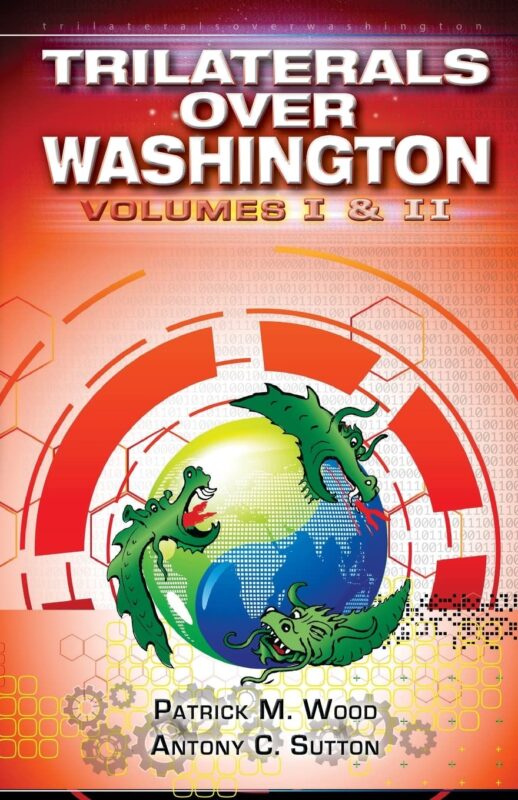
Trilaterals Over Washington by Antony C. Sutton and Patrick M. Wood exposes the strategic integration of global finance, multinational corporations, and political elites through the Trilateral Commission. Conceived by David Rockefeller and shaped ideologically by Zbigniew Brzezinski, the Commission launched in 1973 with a singular ambition: to engineer political and economic alignment among North America, Europe, and Japan, forming a unified power axis under the guise of international cooperation.
The Rise of a Managed Global Order
Brzezinski’s Technetronic Era provides the philosophical scaffolding. He outlines four stages of human development: religious faith, nationalism, Marxism, and a final global technocracy. This culminating era prioritizes rational humanism and supra-national planning. Within this framework, the Commission functions not as a diplomatic facilitator but as a task force implementing post-national governance. Its goal is systemic transformation. Political institutions must adapt or dissolve. National sovereignty becomes a friction point obstructing planetary management.
David Rockefeller operationalized this theory. Through the Chase Manhattan Bank and Rockefeller Foundation networks, he recruited elites across corporate, political, and academic spheres. Brzezinski, meanwhile, identified future leadership assets—most notably, a little-known Georgia governor named Jimmy Carter. Brzezinski trained Carter in global policy, economics, and technocratic strategy. Upon election, Carter staffed key posts with Commission members. The architecture of the U.S. executive branch aligned with Trilateral priorities before the administration began.
Control Through Institutional Capture
Power did not aggregate by chance. The Trilateral Commission embedded members across core government structures. By the time Carter assumed office in 1977, over one-third of U.S. Trilateral members held executive positions. These included the Secretaries of State, Defense, Treasury, and National Security Advisor. The National Security Council, Council on International Economic Policy, and numerous ambassadorships followed suit. Authority consolidated. The White House, its agencies, and international policy apparatus tilted decisively toward the Commission's global governance framework.
In Congress, the pattern replicated. Trilateralists occupied key leadership roles across Senate and House committees. The ideological consistency among them reflected the Commission’s philosophical core: democracy must yield to managerial efficiency. Huntington, Watanuki, and Crozier’s The Crisis of Democracy, commissioned by the Trilateralists, argued that public participation threatens governance. Societies require depoliticization, central authority, and reduced media independence. The report defines the mission: restrict democratic volatility, elevate expert rule, and expand administrative state power.
Economics as the Primary Lever
Multinational corporations and international banks provide structural muscle. Chase Manhattan, Citicorp, IBM, Exxon, and other financial giants shaped Commission policy while benefiting from its execution. These firms extended beyond national boundaries in strategy and allegiance. They responded to global coordination, not domestic loyalty. Their CEOs, often Trilateral members, influenced trade policy, regulatory structures, and foreign relations. Through banking interlocks and boardroom convergence, financial entities like Chase Manhattan achieved dominance not only in commerce but in governance.
The economic influence radiated through foundations and think tanks. The Brookings Institution, Carnegie Endowment, Aspen Institute, and Rand Corporation produced policy blueprints. Academic personnel from Harvard, Columbia, MIT, and Georgetown transferred from research to office. They framed public narratives and managed elite training. Ideas flowed from classroom to cabinet. The academic structure did not merely study policy—it authored and implemented it.
Shaping the Media Environment
Control over narrative emerged as an essential component. Media executives from Time, CBS, the New York Times, and the Chicago Sun-Times belonged to the Commission or served its financial sponsors. Editors such as Hedley Donovan directed content framing around presidential campaigns, emphasizing outsider images while concealing elite coordination. Coverage of Carter in 1976, for instance, stressed his distance from Washington while omitting his deep involvement with Trilateral strategies. Such messaging enabled elite ascent without public resistance.
Ownership patterns further consolidated influence. Trilateral-affiliated individuals held board positions across major media groups. These included Henry Schacht at CBS, Sol Linowitz at Time, Harold Brown at Times-Mirror, and Peter G. Peterson across educational and publishing platforms. This web of indirect editorial control shaped not only headlines but the permissible bounds of political discourse. Investigations into elite integration rarely surfaced. When they did, they faced professional and institutional deterrents.
Trade Union Integration
Labor leaders also joined the Commission. Union heads from the Steelworkers, Auto Workers, and Communication Workers participated in policy formation. The merger of organized labor and multinational capital marked a strategic alignment. By embedding within both capital and labor, the Commission neutralized opposition from traditional economic adversaries. Labor support for globalist trade policy, foreign aid, and regulatory expansion functioned as institutional endorsement, not resistance.
This alignment mimicked the structure of corporate socialism. The Commission coordinated capital, labor, media, and governance under centralized frameworks. Public rhetoric emphasized cooperation. The operational structure enforced hierarchy. Decisions flowed from elite consensus to administrative implementation. Political debate shrank. Economic direction calcified. Citizens became subjects of a system that bypassed electoral accountability.
Structural Blueprint of Control
The Commission's organization resembled a pyramid. At its apex stood a financial aristocracy—principally the Rockefeller network—commanding international banking assets. Below it sat the Executive Committee, a select group including Henry Kissinger, William Scranton, Robert Ingersoll, and Brookings directors. The broader membership populated government, media, academia, and industry. These tiers did not represent independent actors but stages in a command structure. Orders moved downward. Compliance moved upward.
The Commission concentrated on nine core nations in the U.S., Europe, and Japan. These accounted for 80 percent of global economic output. The strategic plan sought dominance over the remaining 20 percent through coordinated economic, diplomatic, and military engagement. American multinational corporations provided intelligence, funding, and implementation channels. They operated across borders, managed legal arbitrage, and influenced foreign regulatory design. Political autonomy eroded as economic dependence increased.
Ideological Consistency
Across every sphere—executive, legislative, media, academic, corporate—the message converged. The world required a new order. Sovereignty obstructed progress. Public accountability impeded speed. Decision-making must transfer from representative institutions to elite administrators. In Brzezinski’s model, the nation-state gave way to managed interdependence. Legal frameworks, trade regimes, environmental protocols, and financial systems would operate globally. Domestic consent would diminish. The legitimacy of decisions would rest in expert design, not democratic approval.
The Commission's literature emphasized equity and justice. Its actions prioritized coordination and consolidation. Strategic language softened public reception. Structural change advanced regardless of consent. Through think tanks and op-eds, the Trilateralists praised interdependence while preparing institutional mergers. Sovereign nations adapted their laws to supranational standards. Treaties incorporated private governance. Central banks synchronized monetary policy. The architecture of independence dissolved.
The Final Phase of Administrative Centralization
By 1980, the Commission had completed its executive integration. The next phase targeted constitutional structures. Brzezinski recommended an incremental approach to reform. Direct amendments might provoke resistance. Gradual erosion, however, would succeed. Blurring distinctions between public and private institutions would create operational overlap. Once indistinguishable, authority could shift without formal debate.
Programs like the Panama Canal Treaty, SALT negotiations, and economic normalization with communist states advanced under this logic. They redefined American interest through the prism of global interdependence. Strategic partnerships formed not from cultural affinity but from production complementarities and managerial convergence. Trilateral goals aligned with Soviet and Chinese modernization efforts. Aid and technology flowed outward. Public understanding remained superficial.
Who Benefits and How
The Commission’s architecture delivers results to its designers. Rockefeller influence directs financial leverage. Media partners shape perception. Policy architects structure incentive systems. Corporations benefit from stable, predictable global environments. Their profits depend on regulatory alignment, legal protection, and subsidized risk. Governments enforce order. Citizens fund the process.
Trilateralism operates through convergence. Institutions act in synchronized rhythms. Decisions reflect shared premises. Change appears organic because dissent has no structured platform. Without structural alternatives, centralization proceeds unopposed. Public voice fragments. Administrative power concentrates. Global integration becomes irreversible.
The authors document this transformation with specificity. Their claim rests on patterns of appointments, funding trails, ideological texts, and institutional links. They present the Commission as a structural actor, not a conspiratorial shadow. Its power emerges from formal positions, visible affiliations, and documented strategies. Its effectiveness comes from coordination. The authors assert that understanding this machinery is the prerequisite for reclaiming democratic agency. They argue that awareness alone, without organization, will remain inadequate.