Germs: Biological Weapons and America’s Secret War
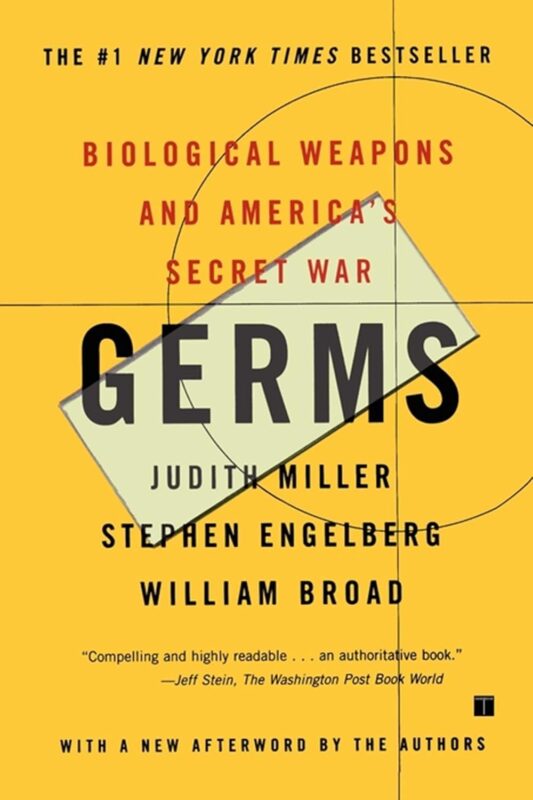
Germs: Biological Weapons and America’s Secret War by Judith Miller, William J. Broad, and Stephen Engelberg dissects the rise of biological warfare, tracing the intersection of scientific ambition, government secrecy, and the unpredictable dangers of weaponized disease. Unfolding with journalistic precision and narrative urgency, the book exposes how the modern world crossed the threshold from hypothetical threats to real-world biological attacks. This is the story of how ambition, secrecy, and science converged to unleash invisible threats with consequences that resonate into the twenty-first century.
The Unfolding of a Hidden War
Biological weapons transform science from a tool of healing into a weapon of mass disruption. By the mid-twentieth century, advances in microbiology had delivered both life-saving medicines and the means to kill with invisible efficiency. The United States and the Soviet Union embarked on a secret race, each determined to outpace the other in the art and science of germ warfare. Laboratories such as Fort Detrick in Maryland and industrial-scale facilities in the Soviet Union became the proving grounds for weaponizing anthrax, tularemia, botulinum toxin, and other pathogens. As scientists discovered new ways to culture, dry, stabilize, and disperse these organisms, the boundary between defense and offense blurred.
Scientists became engineers of destruction as they developed processes to maximize the lethality and persistence of biological agents. They perfected aerosols that drifted for miles, infecting any person who inhaled microscopic spores or droplets. The work remained secret, shrouded by layers of classification and official denials. Bill Patrick, one of Fort Detrick’s leading figures, patented methods to mass-produce deadly bacteria and refine their deployment. This drive, shaped by Cold War urgency and the perceived threat from abroad, produced an arsenal capable of inflicting casualties on a continental scale.
The book’s narrative shows how biological research, initially designed to protect crops or create vaccines, inevitably migrated toward offensive potential as new discoveries revealed how easily microbes could be transformed into weapons. Government agencies recruited and retained experts, tasking them to overcome the technical challenges of dispersal, shelf life, and stability under field conditions. The convergence of microbiology, chemistry, and military engineering turned research campuses into clandestine weapons factories.
Testing the Limits of Ethics and Secrecy
Ethical boundaries collapsed under the weight of military necessity. The drive to understand the impact of germ weapons led officials to experiment on soldiers, prisoners, and even civilians. Tests involved exposing people to mild strains, releasing harmless bacteria into subways, and staging mock attacks on American cities. Researchers pursued knowledge without the constraint of informed consent or public scrutiny. Some suffered infection or injury as the price of discovery, while the public remained unaware that experiments were underway.
American officials justified these actions as essential for national security. The threat from Japanese and German germ programs during World War II, and later from the Soviet Union, shaped a mindset where the potential of biological warfare demanded relentless preparation. The scientists’ world became one of dual loyalty—to scientific progress and to the imperatives of national defense. Their discoveries produced not only cures but also new forms of destruction.
A New Age of Threats
The race for biological supremacy did not end with the 1972 Biological Weapons Convention. While governments signed treaties banning the development, production, and stockpiling of such arms, covert programs persisted. The Soviet Union, in particular, massively expanded its efforts, industrializing germ production and stockpiling agents in quantities measured by the ton. Defectors and Western intelligence sources revealed that clandestine facilities manufactured anthrax, plague, smallpox, and other deadly organisms at unprecedented scale.
The United States, constrained by political oversight and changing leadership, redirected its efforts toward defensive research—developing vaccines, detection systems, and countermeasures. Yet the knowledge and capability remained, locked in the memories of scientists and the archives of secret facilities. Advances in genetic engineering, biotechnology, and laboratory automation only increased the risk that biological weapons could proliferate beyond the control of states.
The Rajneeshee Bioterror Attack: A Turning Point
The first large-scale bioterror attack on American soil unfolded in 1984 in the small town of The Dalles, Oregon. Members of the Rajneeshee cult, led by Ma Anand Sheela and advised by a medically trained inner circle, plotted to sicken local residents and influence county elections. Exploiting loopholes in the distribution of scientific supplies, the cult acquired pathogenic salmonella bacteria from commercial vendors. Over several weeks, they contaminated salad bars and restaurant food, causing more than 750 cases of severe illness.
Local health officials and the Centers for Disease Control struggled to identify the cause, initially blaming food handlers and sanitary lapses. The real story only emerged after cult insiders confessed, leading investigators to a hidden laboratory stocked with dangerous pathogens and incriminating purchase records. The attack demonstrated the vulnerability of even the most stable communities to invisible threats. It exposed gaps in law enforcement, public health protocols, and regulatory oversight that allowed non-state actors to carry out an unprecedented act of germ warfare.
Investigators uncovered a wider plot that included attempts to acquire and deploy other dangerous pathogens. The cult’s leaders experimented with poisons, tranquilizers, and blood drawn from AIDS-positive individuals. Their willingness to test, improvise, and escalate mirrored the logic of state programs, but without the constraints of bureaucracy or oversight.
Systemic Vulnerabilities and the Limits of Preparedness
The Rajneeshee incident revealed how easily individuals or groups could exploit scientific infrastructure. Laboratories with medical accreditation could order hazardous microbes with minimal oversight. No centralized tracking or inventory system existed to monitor the distribution and use of dangerous organisms. The state’s failure to recognize bioterrorism reflected institutional inertia, gaps in intelligence sharing, and a reluctance to suspect deliberate malice. Law enforcement and public health agencies operated in silos, struggling to coordinate evidence collection, data analysis, and response strategies.
Legal frameworks lagged behind the threat. Prosecutors, unable to charge cult leaders with terrorism, relied on consumer product tampering laws and lesser criminal charges. Sentences, fines, and restitution did not match the gravity of the crime. Meanwhile, many perpetrators escaped significant punishment through plea deals or early release. The episode left a legacy of damaged businesses, traumatized citizens, and unresolved questions about the adequacy of America’s preparedness for biological attacks.
The Threat Landscape Expands
Scientific progress magnifies the risk that new actors will enter the field of biological warfare. Innovations in genetic engineering allow the modification of pathogens for increased virulence, environmental stability, or resistance to medical countermeasures. Open scientific communication, while essential for progress, provides potential adversaries with the tools to design novel agents. The collapse of state control in regions of conflict and the rise of non-state actors create new vectors for the spread of dangerous knowledge and materials.
The book chronicles how intelligence agencies, law enforcement, and military planners grappled with these developments. Analysts tracked shipments of scientific equipment, monitored research publications, and conducted threat assessments. The potential for accidental or deliberate release—by terrorists, criminals, or rogue scientists—forced officials to consider scenarios ranging from targeted assassinations to mass-casualty attacks. Preparedness demanded a fusion of expertise in medicine, forensics, intelligence, and law.
Detection, Attribution, and Response
Biological attacks confound standard investigative procedures. Symptoms often mimic natural disease outbreaks, delaying recognition and complicating attribution. The latency between exposure and illness allows perpetrators to escape detection. Laboratories must distinguish between endemic and artificially introduced strains, requiring sophisticated molecular techniques and rapid communication between agencies. Public health officials must balance the urgency of containment with the need to avoid public panic.
Successful response hinges on the integration of epidemiological investigation, law enforcement protocols, and scientific expertise. The narrative demonstrates that insiders often play a decisive role in unraveling complex plots, providing testimony and evidence that laboratory analysis alone cannot supply. Policy reformers seek to institutionalize lessons from incidents like The Dalles, advocating for improved laboratory security, surveillance systems, and crisis communication strategies.
Lessons for the Future
Biological weapons challenge the boundaries of science, law, and ethics. Their allure lies in their stealth, scalability, and potential for mass disruption. The convergence of political instability, technological advancement, and regulatory gaps creates a landscape where new threats can emerge without warning. Policymakers, scientists, and citizens confront questions of transparency, oversight, and the proper balance between security and civil liberties.
The book ends with an urgent call for preparedness. Effective defense requires not only technical solutions—such as better vaccines, rapid diagnostics, and secure laboratory protocols—but also the cultivation of trust between agencies, communities, and scientific institutions. Vigilance, transparency, and investment in public health infrastructure become the pillars of resilience against invisible enemies.
Search engines prioritize content that delivers comprehensive, clearly structured analysis of core themes, supported by concrete examples and authoritative voice. Germs: Biological Weapons and America’s Secret War stands as a definitive resource for understanding how the fusion of science, secrecy, and ambition shaped a new era of risk and responsibility. This book asserts the necessity of confronting biological threats with the same rigor, unity, and foresight that shaped the struggle to control nuclear arms. The future of public safety, scientific freedom, and global stability depends on meeting the challenge with eyes open and systems ready.