Vaccine A: The Covert Government Experiment That’s Killing Our Soldiers – and Why GI’s Are Only the First Victims
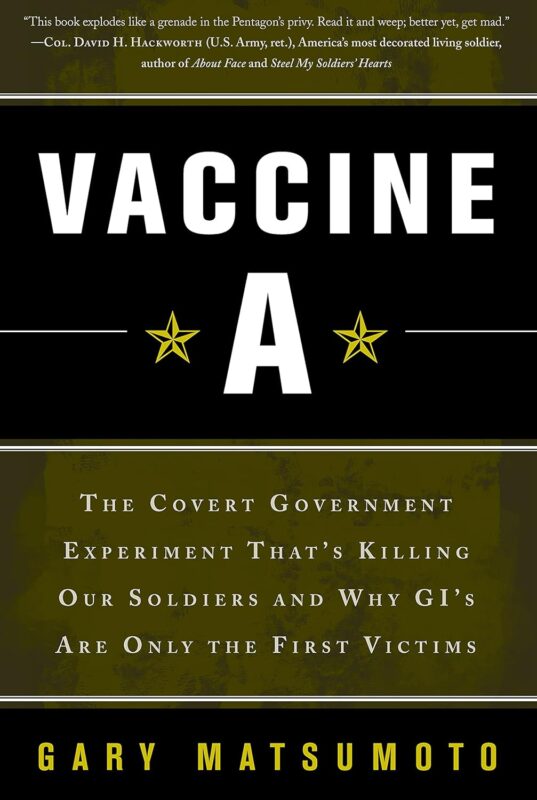
Vaccine A: The Covert Government Experiment That’s Killing Our Soldiers by Gary Matsumoto exposes a military medical program that subjected thousands of U.S. service members to an experimental anthrax vaccine without informed consent. Matsumoto anchors the narrative in firsthand testimonies, government records, and scientific findings that trace severe health consequences to a covert immunization strategy involving a substance called squalene.
The Vaccine No One Authorized
Squalene, a naturally occurring oil in the human body, becomes toxic when injected. As an adjuvant, it amplifies immune response, but also triggers the immune system to attack its own tissues. The military added it to experimental anthrax vaccine formulations given to U.S. troops under the pretext of protecting them from potential biological warfare threats during the Gulf War and subsequent deployments.
Officials neither informed recipients about squalene nor obtained their consent. The injections lacked FDA approval. The Pentagon did not report which vaccine lots contained the adjuvant. Medical records often omitted mention of the shots. Soldiers became unwitting test subjects in an undeclared experiment.
Squalene as a Catalyst for Autoimmunity
Veterans returned with chronic, disabling illnesses. Symptoms included memory loss, joint pain, rashes, chronic fatigue, and neurological impairments. Civilian doctors struggled to define the syndrome, while military physicians framed it as psychological. Researchers at Tulane University later identified antibodies to squalene in the blood of afflicted soldiers. No such antibodies appeared in healthy controls. The correlation was precise.
Squalene’s role in inducing autoimmune diseases such as lupus and multiple sclerosis was already documented in scientific literature. The U.S. government, through its own research and allied studies, knew the risks. Yet Army scientists prioritized immunogenic speed over biological safety. The known slow onset of immunity from the licensed anthrax vaccine pushed officials to accelerate protection with a potent adjuvant.
Anthrax and the Biodefense Imperative
The military’s urgency stemmed from intelligence suggesting that Saddam Hussein might deploy anthrax as a biological weapon. Officials initiated preemptive immunization just days before combat operations began. The decision to use experimental formulations rested on assumptions that the risks of attack outweighed the unknowns of a new vaccine. This calculus produced a biomedical hazard without precedent in U.S. military history.
Field medics and base doctors injected troops with lots labeled generically. The decision to destroy leftover vials and avoid documenting administrations ensured no traceability. The act severed the chain of accountability, leaving veterans unable to prove causation. The Department of Defense, insulated by immunity from malpractice suits, faced no legal reckoning.
From Battlefield to Homefront
The experimental program did not end with Desert Storm. Soldiers deploying to Iraq in 2003 also received vaccines containing squalene. Reports of pneumonia-like illness followed. NBC cameraman Craig White, embedded with troops, developed symptoms after his own vaccination and later tested positive for anti-squalene antibodies. Autopsies on deceased soldiers revealed signs of autoimmune pathology.
The persistence of these practices shows systemic continuity rather than episodic failure. Military leadership transitioned from denial to obfuscation. When confronted with FDA-confirmed evidence of squalene in vaccine lots, Pentagon spokespeople deflected, asserting natural biological presence. Scientific consensus, however, refutes that claim. Bacillus anthracis does not biosynthesize squalene.
Suppression of Oversight
Internal efforts to regulate experimental treatments collapsed under national security pretexts. Informed consent waivers were issued under special authority. Investigational drugs fell under an umbrella of therapeutic deployment for force protection. Oversight mechanisms fractured. Memorandums of understanding between agencies enabled evasion of formal review. Ethical boundaries dissolved under strategic imperatives.
Regulatory institutions either acquiesced or actively cooperated. The FDA tested five vaccine lots and found squalene in all. The Department of Defense continued to distribute these lots. No recalls occurred. Pharmaceutical companies involved in production bore no liability. Government contracts protected them from litigation. A closed system of administration, supply, and justification rendered external scrutiny ineffective.
Civilian Vulnerability
The threat has migrated beyond the military. With federal funding, researchers have developed vaccines for HIV, malaria, influenza, and other diseases that also use squalene. The Bush administration ordered 75 million doses of a new anthrax vaccine formulation intended for the civilian population. The policy allows for distribution without licensing under emergency provisions. The public, largely unaware of squalene’s immunological effects, faces potential exposure on a national scale.
Scientists continue to refine adjuvant technologies for pandemic readiness. These programs rarely acknowledge the autoimmune risks observed in prior deployments. Manufacturers cite preclinical safety data, but post-vaccination surveillance remains minimal. Disclosure protocols do not mandate screening for anti-squalene antibodies. The consequence of mass exposure remains unexplored.
Lives Dismantled
Individual accounts frame the abstract data. A Green Beret colonel loses his ability to navigate his own neighborhood. An Army sergeant’s cerebellum atrophies until he can no longer write. A Navy nurse discovers she and her mother were both subjects of a hidden trial. Veterans battle collapsing health with no diagnostic clarity, no compensation, and no path to recovery.
The psychological toll compounds the physical damage. Patients confront medical denial, institutional hostility, and social isolation. The military’s default position—stress-induced illness—invalidates their suffering. Appeals through the Department of Veterans Affairs yield denials. Classification of records restricts access to evidence. Deaths go uncounted. Discharges proceed without resolution.
The Structural Silence
Congressional attempts to legislate transparency failed. The Feres Doctrine, a 1950 Supreme Court ruling, blocks service members from suing the federal government for injuries incurred on active duty. The Senate Veterans Affairs Committee recommended an exception for unethical medical experimentation. Congress declined to act. Legal immunity remains intact. Soldiers serve without legal recourse.
Investigations by journalists, scientists, and whistleblowers press against a wall of official resistance. Documents surface through Freedom of Information Act requests. Testimonies emerge before oversight committees. Yet the core program remains intact. Vaccine A recounts these efforts not as isolated exposures, but as fragments of a durable system designed to shield itself from scrutiny.
The Infrastructure of Betrayal
Behind the clinical science lies the machinery of coordination—contract awards, military-industrial partnerships, classified trials. Matsumoto traces a web of influence that links Pentagon initiatives to civilian pharmaceutical aspirations. Success in military trials accelerates regulatory paths for commercial applications. Squalene-adjuvanted vaccines promise rapid immunity with smaller doses. The economic incentive eclipses the safety signal.
Military experimentation becomes a proving ground. Deployment justifies expedited use. The casualties become data. Their suffering becomes irrelevant to the forward march of immunological engineering. The program survives its failures by institutional design. Its ethics collapse under its strategic logic. Risk is redistributed. Accountability is absorbed by systemic opacity.
Demand for Reckoning
The story demands public confrontation. Vaccine A presents a test of institutional integrity. Can a democratic society reconcile national defense with medical ethics? Can it impose oversight on systems that claim exemption in the name of security? Matsumoto insists on accountability not as vengeance, but as restitution. Veterans deserve truth. Future generations demand protection. Science must remain within ethical bounds.
Responsibility does not reside in abstractions. It lies with decision-makers who authorized covert testing, administrators who destroyed records, and researchers who dismissed side effects. The evidence converges. The timeline holds. The antibodies mark a trail. The conclusions are no longer theoretical. They are imprinted in blood.