The Gene Machine: The Race to Decipher the Secrets of the Ribosome
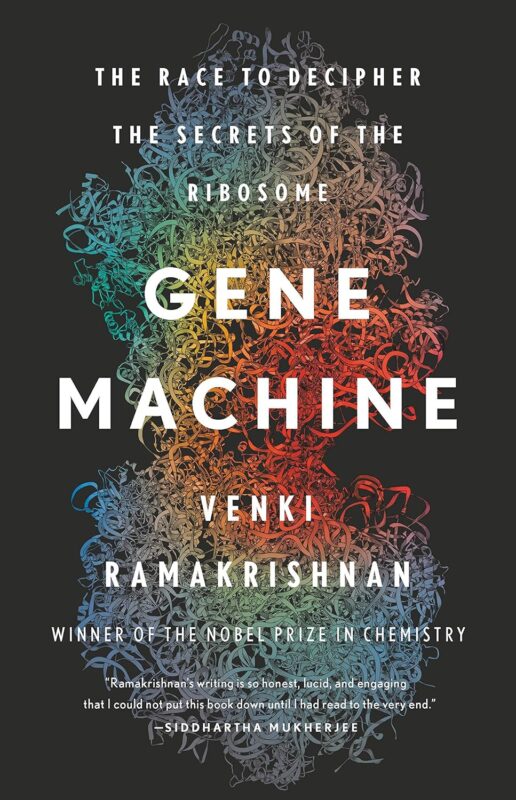
The Gene Machine by Venki Ramakrishnan traces the relentless pursuit to decode the molecular machine central to life: the ribosome. This is the machine that translates genetic code into functional proteins. Ramakrishnan, a physicist-turned-structural-biologist, delivers a firsthand narrative of his immersion in molecular biology and the decades-long race that led to a Nobel Prize. His journey reveals how structural biology, personal ambition, and collaborative tension converged on one of biology’s most formidable challenges.
Crossing Disciplines to Uncover Life’s Machinery
Venki Ramakrishnan began his scientific life in theoretical physics, driven by admiration for figures like Richard Feynman. Trained in India, he landed in the U.S. to pursue graduate studies but soon found himself disillusioned with the abstract detachment of theoretical work. The shift toward biology emerged not from institutional encouragement but personal curiosity and the desire for tangible relevance. His transition into biology marked a full intellectual and professional reset.
The ribosome captivated him with its scale and complexity. As the site where genetic instructions become proteins, it orchestrates the most fundamental process of cellular life. Yet its internal structure remained opaque. Ramakrishnan, still learning biology’s tools, committed to this daunting target, joining the Yale lab of Peter Moore and adopting neutron scattering as a way to triangulate the ribosome’s layout. It was slow and often unrewarding. Yet the resolve to keep going shaped the backbone of the book.
The Invention of Scientific Vision
Seeing is a scientific act. To see the ribosome, researchers had to make it visible. That meant crystallography. Molecular biology had long been data-rich and insight-poor when it came to large molecular structures. But X-ray crystallography created a way to generate atomic maps from crystalline samples. Crystallography demanded both technical precision and luck. It required coaxing fragile molecules into regular lattices and firing X-rays to produce diffraction patterns. From those patterns came electron density maps. From maps, three-dimensional models.
The book tracks the evolution of these techniques, from early misunderstandings about the nature of X-rays to Lawrence Bragg’s formulation of the structural principles that underpinned molecular imaging. Crystallographers learned to decode these maps layer by layer, solving the phase problem with ingenuity and persistence. Ramakrishnan doesn’t narrate from afar. He was there, handling crystals, analyzing data, making decisions that shaped what the world would eventually see.
The Race to the Ribosome
Scientific discovery operates in competitive ecosystems. The ribosome was no exception. Multiple teams pursued its structure, often without full awareness of each other’s timelines or methods. Ada Yonath began working on ribosomal crystals in the 1980s, often dismissed as pursuing a fantasy. Tom Steitz at Yale pursued large subunit structures with equal intensity. Ramakrishnan focused on the small subunit, essential for decoding genetic messages.
The competition sharpened strategies. Timelines accelerated. Labs rushed to publish first, fearing that rivals might submit structures within days or hours. Structural breakthroughs came with quantum leaps in resolution. One paper could shift perception, funding, and career trajectory. Ramakrishnan’s team succeeded in solving the 30S subunit of the bacterial ribosome, showing precisely how mRNA and tRNA interacted. This structural insight offered new views into how antibiotics targeted bacterial machinery.
Crystallography as Cultural Battlefield
Crystallography does not exist in isolation. It functions inside institutions, among hierarchies, with credit and prestige closely guarded. Ramakrishnan confronts the peculiar culture of science, where collaboration often masks competition, and where reward systems prioritize individual names despite team-driven outputs. The Nobel Prize, with its three-person limit, excluded several pivotal contributors. This structural limitation reflects deeper issues in how science is acknowledged.
The book does not hide Ramakrishnan’s personal stakes. He struggled for jobs, faced rejection, and often worked with limited resources. His move from Brookhaven to Utah and eventually to the MRC Laboratory of Molecular Biology in Cambridge placed him at the heart of molecular science. The work consumed years, driven by belief in structural clarity as the foundation of functional understanding.
Decoding Life’s Assembly Line
The ribosome translates RNA codons into amino acid sequences, building proteins with precise order. The small subunit ensures correct decoding; the large subunit links amino acids. Each step depends on molecular interactions, governed by shape, charge, and position. Crystallographic data revealed these interactions in action, turning speculation into geometry.
By mapping tRNA movement through the ribosome, Ramakrishnan’s team clarified how ribosomes maintain fidelity. Codons matched anticodons through induced fit. Structural shifts verified correct pairing and triggered chemical transitions. These moments, invisible to traditional biochemistry, became observable. The machinery of life could now be described in atomic terms.
Antibiotics and the Power of Structure
Understanding the ribosome has pharmaceutical consequences. Many antibiotics work by binding to bacterial ribosomes and halting protein synthesis. Structural insights made these interactions legible. The location, orientation, and mechanism of antibiotic binding became targets for new drug design. Resistance mechanisms could also be visualized. Mutations in ribosomal RNA altered antibiotic binding sites. These structural revelations turned microbiological problems into molecular puzzles.
Ramakrishnan’s work enabled structure-guided antibiotic development. Drug resistance demanded structural agility. His research provided blueprints for molecules that could evade bacterial defense mechanisms. Structure offered a direct path to therapeutic innovation.
Scientific Character in the Context of Discovery
Gene Machine presents science as a human enterprise. Progress emerged from flawed people in flawed systems. Ramakrishnan recounts rivalries, miscommunications, and the emotional strain of research life. Scientists maneuvered through uncertain funding, lab politics, and ambiguous results. The path from data to insight required perseverance and the capacity to tolerate extended ambiguity.
Moments of doubt shaped the narrative as much as breakthroughs. Failures in crystal formation, misassignments of molecular positions, and delayed publications punctuated the story. Yet the ability to persist, to reassess models and reattempt experiments, turned setbacks into stages of refinement.
The Structure Behind the Structure
Scientific structures do not exist without supporting frameworks. Ramakrishnan benefited from institutional infrastructures—the MRC’s commitment to structural biology, Yale’s dual-lab collaboration, and the availability of synchrotrons and cryogenic technologies. But he also navigated their limits. Funding cycles, hiring decisions, and journal hierarchies all imposed constraints.
His personal decisions—to switch disciplines, to uproot his family, to gamble professional security on risky projects—reflect the broader context in which discovery unfolds. These decisions were not made from comfort. They emerged from necessity, vision, and the awareness that some truths require disproportionate commitment.
A Legacy Built from the Invisible
The ribosome now stands as one of biology’s most comprehensively understood machines. Its structure anchors modern molecular biology. Ramakrishnan’s contribution reshaped how the world sees translation, both as a process and as a concept. The images of tRNAs moving through the ribosome, codons aligning with anticodons, and peptides emerging in sequence define contemporary views of life at the molecular level.
Gene Machine is more than a memoir. It is a document of transformation—of molecules into maps, of ideas into structures, of persistence into recognition. By capturing the intersection of vision and execution, Ramakrishnan has created a landmark in the literature of scientific discovery.