Six-Legged Soldiers: Using Insects as Weapons of War
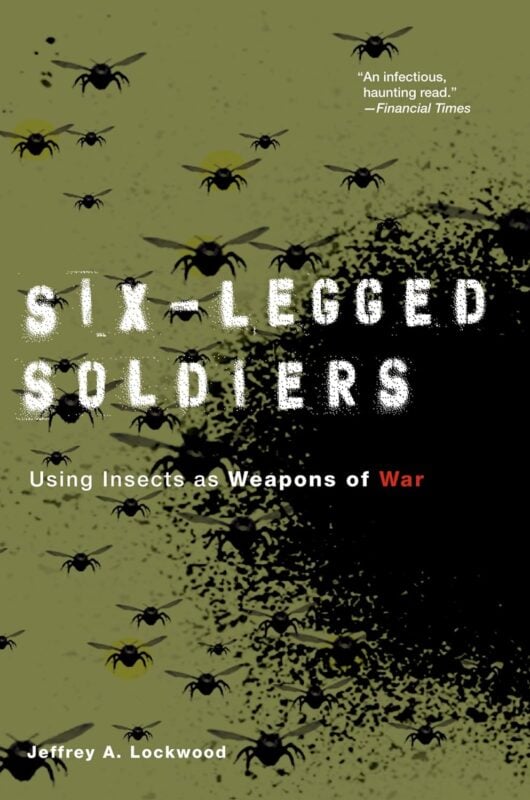
Six-Legged Soldiers: Using Insects as Weapons of War by Jeffrey A. Lockwood charts the entomological dimensions of warfare across human history, mapping the deployment of insects for aggression, surveillance, and devastation. From ancient tactics involving hives of bees to the engineered vectors of twentieth-century biowarfare programs, Lockwood uncovers the complex interplay between biology, strategy, and power.
Insects as Instruments of Attack
Lockwood traces the earliest instances of insect weaponization to prehistoric sieges and biblical plagues. Tribal communities discovered that nests of bees or wasps, hurled into enemy fortifications, could rout defenders and inflict chaos without risking direct confrontation. Egyptian hieroglyphs, Mesopotamian clay tablets, and the biblical Book of Exodus preserve descriptions of insect-induced suffering deployed with strategic intent. These accounts reveal a longstanding awareness of insects’ capacity to terrify, injure, and dislodge entrenched opponents.
Ancient texts from cultures spanning Mesoamerica to Mesopotamia document methods for directing stinging insects toward enemy formations. The Tiv of Nigeria constructed bee cannons. Mayans embedded stinging insects into effigies. Middle Eastern cities stockpiled clay pots teeming with ants or hornets. Tactical innovation harnessed entomological behavior—aggression, territoriality, and swarming—to shape early battlefield outcomes.
Disease as a Deliberate Contagion
Insects served not only as weapons of pain but as vectors of disease. The Mongol siege of Kaffa in 1346 likely initiated Europe’s Black Death by catapulting plague-infested corpses into the city, unleashing flea-borne Yersinia pestis. Lockwood identifies this act as the earliest fusion of military and microbial vectors. Centuries later, Napoleon's failed campaigns in the Middle East and Russia succumbed not to enemy fire but to outbreaks of typhus and plague transmitted by lice and fleas.
Military tacticians in World War I and II studied these patterns and initiated programs to transform entomology into a strategic discipline. Japan’s Unit 731 exemplified this shift. Under General Ishii Shiro, researchers bred vast quantities of plague-infected fleas, cholera-laced flies, and anthrax-bearing lice. Field tests over Chinese villages produced casualties exceeding those caused by conventional munitions. These operations formed a prototype for modern biowarfare.
Entomological Engineering and the Cold War
The Cold War redefined the biological capabilities of insects. American researchers at Fort Detrick developed systems to disseminate uninfected mosquitoes over U.S. cities in secret tests, tracking their spread and potential as vectors. These experiments confirmed the feasibility of covert biological attacks. North Korean and Chinese accusations during the Korean War alleged that U.S. forces deployed infected insects. Though Washington denied these claims, Lockwood contextualizes the charges within a broader ecosystem of disinformation and clandestine experimentation.
Cuban allegations in the 1960s and 70s reignited scrutiny. Fidel Castro blamed U.S. operations for infestations that damaged crops and public health. Thrips palmi, the Mediterranean fruit fly, and African swine fever outbreaks coincided with geopolitical tensions. Whether these events were acts of sabotage or ecological coincidences, Lockwood insists on their analytical value. They illustrate how entomological warfare operates as both material threat and political theater.
Agricultural Devastation and Economic War
Beyond human targets, insects have been deployed to annihilate food systems. Agricultural bioterrorism weaponizes species that destroy crops, erode economic stability, and provoke social disorder. Lockwood recounts plans during World War II to bomb Britain with Colorado potato beetles. Although Germany denied carrying out the plan, postwar infestations intensified suspicions.
In the 1980s and 90s, radical environmentalists in California threatened to release Mediterranean fruit flies to halt pesticide spraying. Their threat spotlighted the vulnerability of industrial agriculture to small-scale biological sabotage. With potential losses exceeding $13 billion, officials treated the incident as a credible national security concern.
Insects such as the glassy-winged sharpshooter and Asian longhorned beetle demonstrate how accidental or deliberate introductions can cripple ecosystems. Lockwood cites estimates that invasive pests cost the U.S. economy over $100 billion annually. Entomological warfare exploits precisely this weakness—low visibility, rapid reproduction, and high destructiveness.
Psychological Operations and Tactical Fear
Fear magnifies the effects of entomological weapons. Panic triggered by suspected insect attacks can paralyze cities and provoke disproportionate responses. Lockwood dramatizes a hypothetical scenario: a terrorist releases fleas infected with plague into the New York subway. Even limited casualties would spark massive psychological disruption.
Historical episodes reinforce this potential. Rumors of bee attacks in Vietnam, wasp traps set by Vietcong, and scorpion-laced traps in tunnels reflect how even simple insect threats elicit terror. Ancient armies used these tactics to flush enemies from bunkers. Modern guerillas and counterinsurgents adapt them for jungle warfare.
Lockwood shows how perception often determines the success of an entomological strike. If a population believes insects carry disease or poison—even in the absence of actual infection—the psychological damage can equal or exceed physiological harm.
Technological Futures: Cyborgs and Gene Hacks
Emerging technologies multiply the strategic potential of insects. Scientists now design insect-machine hybrids. Cockroaches equipped with microchips navigate surveillance missions. Robotic ants perform reconnaissance in environments inaccessible to human soldiers. Dragonfly drones collect battlefield data.
Synthetic biology opens more ominous possibilities. Genetic engineering could alter mosquitoes to transmit tailored diseases. A modified virus embedded in an insect vector could target specific populations. The convergence of biotechnology and robotics collapses the boundary between biology and weapons engineering.
Lockwood warns that these developments exceed the capacity of existing regulatory frameworks. National borders offer no protection against species engineered for dispersal. A single organism, carefully designed, could destabilize economies, decimate populations, or provoke war.
Institutional Secrecy and Public Risk
Governments shield entomological programs behind layers of secrecy. Lockwood details how American, Soviet, Japanese, and other military branches concealed biological projects. Classification limits accountability. Propaganda distorts narratives. Public health officials often learn of outbreaks too late to trace origins or contain damage.
Democratic societies rely on transparency to prevent misuse. Lockwood advocates for public literacy in entomological risks. He describes past government failures to defend agriculture and public health from pest incursions. The transition of inspection duties to the Department of Homeland Security, for example, weakened early detection and response.
Knowledge empowers citizens to demand preparedness. The technical information in Lockwood’s book—far from being a “how to” guide for terrorists—aims to provoke informed vigilance. He argues that deterrence depends on public awareness, scientific investment, and ethical governance.
The Ethics of Insect Warfare
Lockwood calls into question the morality of using living creatures as tools of war. Insects operate as unconsenting agents of destruction. Their biological autonomy is overridden by human engineering. This raises ethical concerns akin to those posed by animal experimentation and synthetic life.
Moreover, the indiscriminate nature of insect dispersal challenges just war theory. Civilians cannot be reliably spared. Ecosystems suffer collateral damage. Diseases unleashed through vectors may escape control and mutate unpredictably.
Lockwood urges policymakers to consider these consequences. Ethical lines become blurred when the delivery system is alive, when its attack is invisible, and when its effects emerge over weeks or months. Biowarfare treaties must expand to address entomological applications explicitly.
A Legacy of Innovation and Brutality
Insects have served as allies in humanity’s oldest conflicts. They amplify force, extend reach, and generate fear. From siege warfare in ancient cities to Cold War biological stockpiles, insects reflect the dual nature of human ingenuity—creative and destructive.
Lockwood situates entomological warfare within the broader history of human violence. His narrative gathers momentum from ancient myth and scientific precision. He assembles evidence across eras, geographies, and disciplines. His central assertion echoes across the book: wherever war touches the earth, insects follow.
The evolution of entomological weapons mirrors the evolution of war itself. Strategy, biology, psychology, and ethics converge. The stakes now extend beyond battlefields to cities, farms, and genetic blueprints. Six-legged soldiers stand ready—not by their will, but by ours.

https://youtu.be/qAFZw20kxhk?si=GCq97mdfUDjLux1u