SJWs Always Lie: Taking Down the Thought Police
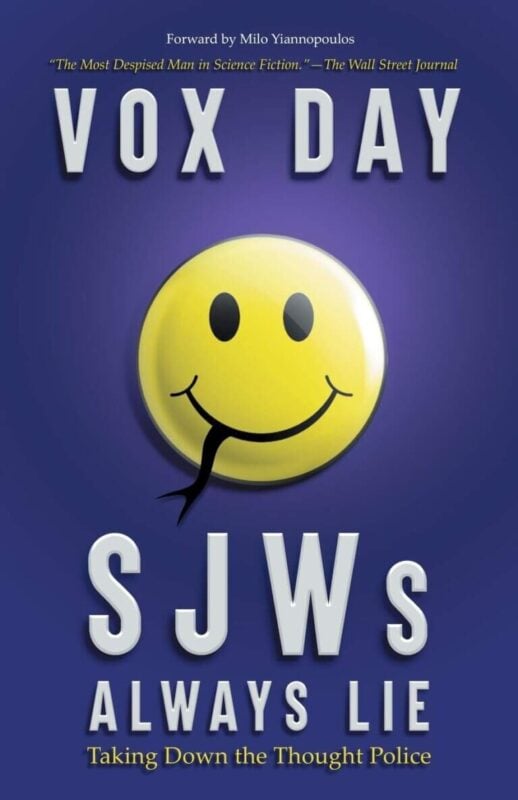
SJWs Always Lie: Taking Down the Thought Police by Vox Day launches a full-frontal intellectual and strategic attack against what the author defines as a pervasive and destructive force within modern culture: the social justice warrior (SJW). Using his own experience and case studies across corporate, academic, and digital environments, Vox Day outlines a methodical profile of SJW behavior, their ideological roots, and a concrete guide to resisting their influence.
The SJW Archetype
Social justice warriors, as Vox Day defines them, operate as ideological enforcers who prioritize narrative conformity over objective truth. They apply pressure through personal attacks, coordinated campaigns, and institutional leverage to silence dissent and reshape discourse. This enforcement stems from an ideological conviction that justice arises through enforced equality, diversity, and progressive conformity. Their behavior follows recognizable patterns: moral posturing, public denunciation, and systematic disqualification of opposition.
This is not merely about disagreement or activism. SJWs, in the author's analysis, deploy coordinated personal attacks, often initiated from social networks and consolidated within institutional bureaucracies such as HR departments, editorial boards, or organizational leadership structures. Their goal is to neutralize perceived threats to their ideological dominance—not through reasoned debate, but by reputational destruction and ostracism.
Three Laws of SJW Behavior
The core of the book establishes three behavioral laws that define how SJWs engage with opponents and shape their tactics. These are not proposed as abstractions or tendencies. Vox Day presents them as categorical assertions grounded in repeated behavioral observation.
First: SJWs lie. They manufacture narratives, distort intent, and omit key context to frame adversaries as morally repugnant. Second: SJWs double down. When challenged, they intensify their accusations and escalate rhetoric rather than retract or reconsider. Third: SJWs project. They attribute their own tactics, motivations, and psychological patterns to others, accusing their targets of the very misdeeds they themselves commit.
The author supports these laws through documented examples, most notably from the science fiction publishing industry, the gaming world, and high-profile media incidents. He argues that understanding these behavioral constants allows targets to anticipate attacks and neutralize their impact through exposure, resistance, and counter-attack.
Case Study: SFWA and the Thought Police
Vox Day’s expulsion from the Science Fiction and Fantasy Writers of America (SFWA) serves as a central narrative spine. His candidacy for SFWA president prompted backlash, not over policy but over ideological nonconformity. He describes a coordinated effort to disqualify him based on past writings and alleged offenses unrelated to his professional qualifications.
Despite procedural irregularities, including actions potentially in violation of the organization's bylaws, the expulsion advanced. The message was clear: dissent from the ideological consensus invited total organizational erasure. This episode illustrates the broader trend he outlines—ideological conformity enforced through procedural and reputational mechanisms.
GamerGate and the War for Narrative Control
The #GamerGate controversy functions as another crucial battleground. Vox Day interprets it as a populist revolt against the convergence of gaming journalism and ideological gatekeeping. For him, GamerGate represented a rebellion by creators and fans who recognized the imposition of a narrative orthodoxy under the guise of diversity and ethics.
The author credits this movement with crystallizing widespread recognition of SJW tactics: shaming, deplatforming, coordinated media pressure, and strategic misrepresentation. In response, GamerGate participants developed counterstrategies: documentation, decentralized resistance, independent platforms, and public ridicule of media inconsistencies.
Narrative vs. Reality
Vox Day defines “the Narrative” as a malleable, ideologically charged construct designed to reshape public perception regardless of factual consistency. It is propagated by those who control media, education, and corporate messaging, and it demands alignment from every participant within a converged institution. The Narrative shifts as needed to accommodate current ideological objectives, often contradicting previous positions without acknowledgment.
He asserts that facts, logic, and consistency are irrelevant to SJWs as long as the Narrative survives. Challenges to the Narrative provoke personal retaliation rather than reasoned response. Therefore, combating the Narrative requires exposing its contradictions and refusing to participate in its premises.
Institutional Convergence
Convergence describes the infiltration and transformation of apolitical institutions into ideological instruments. According to Vox Day, institutions—once focused on merit, output, or service—are hijacked by ideologues who prioritize conformity to SJW values. This shift begins with language, expands through policy, and culminates in hiring and leadership decisions governed by ideological loyalty rather than performance.
He observes convergence in academia, media, publishing, corporate HR departments, and even churches. Once convergence advances past a tipping point, productivity declines, internal dissent disappears, and the organization becomes vulnerable to disruption or collapse.
Surviving and Countering SJW Attacks
Vox Day outlines tactical advice for individuals targeted by SJWs. First, do not apologize. Apologies function not as conflict resolution but as admissions of ideological guilt. Second, document every interaction. SJWs rely on distortion and erasure; documentation neutralizes their claims. Third, expose contradictions in the Narrative. Use their own shifting standards and selective outrage to reveal inconsistency.
The goal is not merely defense but disruption. Ridicule exposes the absurdity of ideological overreach. Independent platforms bypass institutional gatekeeping. Coordinated counter-attacks invert the pressure dynamic. Resistance, in this model, builds resilience and gradually erodes the legitimacy of ideological enforcement.
Cultural Schism and the Rise of Parallel Institutions
The book concludes with a call for separation rather than reclamation. Institutions captured by ideological convergence cannot be reformed from within. The solution lies in building parallel systems—publishers, media, schools, churches, and businesses—that reject ideological policing and operate on principles of merit, transparency, and independent thought.
These institutions do not exist as refuges but as competitive alternatives. They operate with autonomy, attract the disillusioned, and establish their own standards. Over time, Vox Day predicts, the failure of converged institutions will accelerate the migration toward these new structures, reshaping cultural authority through divergence rather than confrontation.
Why the Book Resonates
SJWs Always Lie speaks to individuals who have witnessed institutional transformation without consent or debate. It provides a framework for interpreting public events, recognizing strategic behavior, and understanding the dynamics behind seemingly spontaneous controversies. The book does not claim neutrality. It offers a blueprint for conflict engagement where neutrality results in vulnerability.
For readers questioning sudden shifts in workplace policies, academic priorities, or online discourse norms, the book names and dissects those changes. It aligns anecdotal experience with systemic analysis, suggesting that the strange is not random but intentional and organized. This insight gives readers tools for resistance and for constructing resilient counter-narratives.
What drives the zealous enforcement of ideological boundaries? Who decides which words constitute offense, and which identities carry moral authority? These questions shape not only public debate but career trajectories, friendships, and the design of institutions. Vox Day’s book proposes answers with the force of assertion and the urgency of experience.
By exposing patterns, naming laws, and proposing countermeasures, SJWs Always Lie functions as both diagnosis and strategy manual. It reads as a declaration of autonomy in a culture increasingly governed by moral conformity. In that, it offers its readers a compass, a shield, and a call to action.