The Classical Trivium: The Place of Thomas Nashe in the Learning of His Time
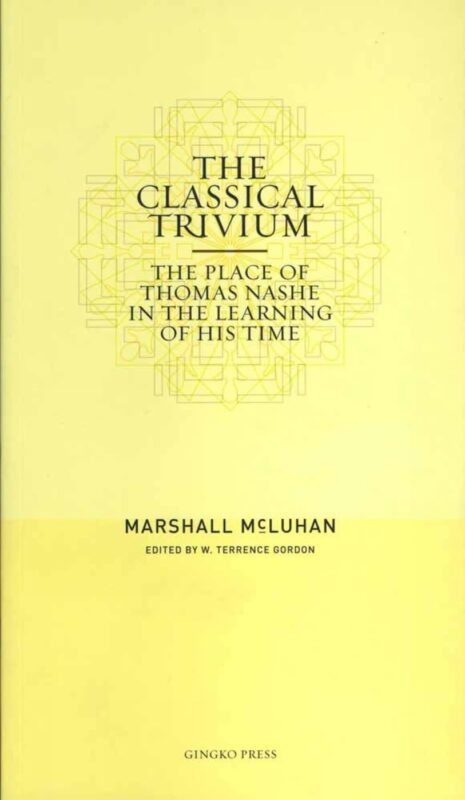
Marshall McLuhan's The Classical Trivium: The Place of Thomas Nashe in the Learning of His Time situates the Elizabethan pamphleteer within the dense web of humanist education, rhetorical tradition, and theological conflict that shaped Renaissance intellectual life.
The Rebirth of Grammar as Method
McLuhan begins with the foundational claim that grammar, dialectic, and rhetoric—together the trivium—once organized the entire structure of Western knowledge. He does not define grammar as syntactical rule but as the interpretive framework through which all texts and phenomena acquire meaning. In this form, grammar extends into theology, physics, and poetic form. The trivium is not an academic formality; it generates epistemological authority. Its reassertion in the Renaissance was a return to interpretive mastery over both sacred texts and the natural world.
The decline of this integrated framework marks McLuhan’s point of departure. He traces its fragmentation through the rise of dialectic in the twelfth century and the displacement of grammatical method by mathematical abstraction in the seventeenth. The sixteenth century stands as a liminal phase—a brief restoration of the grammarian’s authority amid the theological and political crises of Reformation Europe.
Rhetoric and the Education of Perception
Nashe’s writing expresses this transitional tension. McLuhan identifies Nashe as a rhetorician whose method draws from the patristic tradition—a lineage that grounds textual exegesis in grammar and elevates eloquence to an ethical and epistemological practice. The rhetorical features of Nashe’s style—allegory, hyperbole, metaphor—are not aesthetic flourishes but tools of discovery and persuasion. These figures do not ornament truth; they reveal it.
McLuhan dissects the components of classical rhetoric as they appear in Nashe’s prose. Inventio, dispositio, memoria, elocutio, and pronunciatio compose a method of engagement, shaping how an educated reader constructs meaning. Nashe uses these tools with tactical precision. His satire embeds theological critique. His narrative play destabilizes Ramist logic. His exuberant language resists the codification of thought.
The Anti-Ramist Position
Nashe’s resistance finds its clearest opponent in Gabriel Harvey. McLuhan interprets their conflict not as a personal feud but as a visible expression of a larger epistemological war. Harvey’s alignment with Ramus positions him within the scholastic tradition of dialectic, which privileges clarity, method, and demonstrable proof. Nashe counters with the patristic defense of grammar and rhetoric. He does not refute logic. He undermines its claim to finality.
This confrontation embeds Nashe within a movement that includes Erasmus, More, and Rabelais—figures who restore the grammar-based theological and interpretive methods of early Christian thought. The stakes are methodological: how to read Scripture, how to interpret nature, how to construct civic identity. Nashe answers through language that multiplies perspective, foregrounds irony, and demands interpretive participation.
Thomas Nashe as Educational Blueprint
McLuhan’s study is not a biography or literary analysis in the traditional sense. He positions Nashe as a test case for a larger pedagogical vision. The trivium, restored to prominence, offers a model for education that cultivates critical engagement, moral discernment, and linguistic creativity. McLuhan does not idealize Renaissance humanism. He extracts its operational structure to propose a counter-model to the scientific abstraction that dominates modern culture.
The implications for education are profound. Grammar teaches symbolic recognition. Dialectic trains evaluative judgment. Rhetoric compels ethical commitment. Together, they produce a learner equipped not merely to receive knowledge, but to generate it in relation to historical, cultural, and linguistic context.
Historical Continuity of the Trivium
McLuhan establishes a long arc of influence that connects ancient grammar to Christian allegory and Renaissance humanism. From the Stoics to Augustine, from Hugh of St. Victor to Bonaventure, from Erasmus to Nashe, the trivium evolves yet retains structural coherence. Grammar, especially, appears as the metaphysical and methodological foundation of all interpretive acts. It informs scriptural exegesis, guides poetic composition, and anchors the reading of nature.
The privileging of dialectic during the scholastic period and its systematization by Ramus fracture this continuity. Yet the rhetorical response of the humanists does not merely reject dialectic. It absorbs it. Erasmus critiques method while offering a grammar of spiritual reading. Nashe performs polemic while manifesting rhetorical method. This continuity defines the intellectual lineage that McLuhan retrieves.
Language as the Medium of Revelation
Central to McLuhan’s argument is the theological dimension of language. He frames grammar not as a secular technique but as a mode of revelation. The Logos does not only signify divine reason; it configures the symbolic structure of reality. Language mediates between the visible and the invisible, between matter and meaning. This conception underlies both patristic theology and Renaissance semiotics.
Nashe’s theological satire, read through this lens, emerges as exegetical practice. His linguistic play is not ornamental but revelatory. It disrupts surface meaning to expose spiritual conflict. The figures of speech he deploys are acts of theological interpretation. McLuhan’s own interpretive practice mirrors this, as he reads Nashe with a sensitivity to symbolic density and cultural resonance.
Reviving Grammatica in a Fragmented Culture
McLuhan ultimately offers a cultural critique. He diagnoses the fragmentation of the trivium as a root cause of intellectual and social disintegration in the modern world. The isolation of disciplines, the elevation of quantitative reasoning, the collapse of rhetorical education—these are symptoms of an educational system unmoored from interpretive tradition.
His solution is not nostalgia. He proposes a reintegration of grammar, dialectic, and rhetoric within a modern context. This reintegration requires a redefinition of education as a process of symbolic mastery and ethical formation. The trivium does not prescribe content. It structures engagement. It cultivates the faculties necessary to navigate complexity, ambiguity, and historical change.
Nashe as Structural Agent
In this framework, Nashe’s role intensifies. He is not an isolated stylist or historical curiosity. He embodies a methodological alternative. His prose does not merely illustrate the trivium; it enacts it. His controversies materialize pedagogical debates. His style activates cognitive participation. McLuhan reads Nashe as a dynamic agent within a structural tradition—one that remains viable when restored as educational foundation.
This view demands a reader who does more than decode. It calls for interpretive agency. The trivium, as McLuhan restores it, trains this agency. It forms the habits of perception and judgment necessary for cultural literacy. Nashe’s works become a field of application, a pedagogical mirror through which the reader confronts the tensions of knowledge, power, and expression.
A Program for Intellectual Renewal
The Classical Trivium: The Place of Thomas Nashe in the Learning of His Time builds more than a literary argument. It constructs an intellectual program. McLuhan proposes a system for cultural renewal grounded in ancient method, refined through Christian humanism, and exemplified in Renaissance literature. He does not abstract from history. He enters its patterns, its polemics, its texts.
He interprets the educational crises of his own century through the methodological disputes of the sixteenth. His response is constructive. He offers a grammar of perception, a rhetoric of engagement, a dialectic of critique. This is not a return. It is a realignment. It locates the trivium not in past content but in present need.
The book closes with a model of reading that is interpretive, participatory, and transformative. It urges the reader to recognize symbolic structure, to trace historical continuity, to engage linguistic form as ethical encounter. In doing so, it reasserts the trivium as the architecture of human understanding.