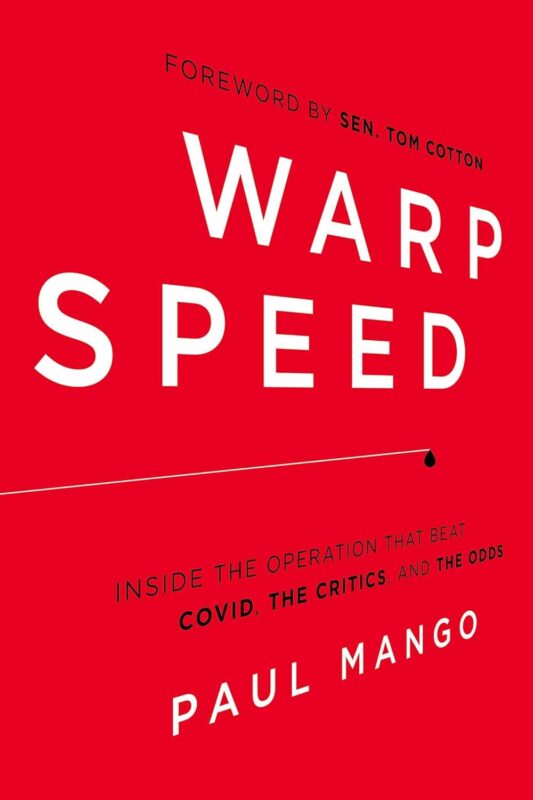
Warp Speed: Inside the Operation That Beat COVID, the Critics, and the Odds
Operation Warp Speed, the high-stakes vaccine initiative chronicled in Warp Speed by Paul Mango, emerged from a moment of unprecedented urgency inside the U.S. Department of Health and Human Services (HHS). When CDC Director Robert Redfield alerted Secretary Alex Azar on January 3, 2020, that “we have a problem in China,” a sequence of rapid decisions unfolded to counteract the looming pandemic. From early containment attempts to a national pivot toward mitigation and hospitalization management, the Trump administration’s actions culminated in a decision to develop, manufacture, and distribute COVID-19 vaccines in record time.
The Strategic Genesis of Operation Warp Speed
Azar understood that traditional pathways for vaccine development could not meet the timeline demanded by the virus’s spread. He mobilized existing federal structures, activated private sector support, and eliminated bureaucratic bottlenecks. The team’s early realization—that the virus spread asymptomatically and affected individuals asymmetrically—drove the strategic imperative for vaccination over natural immunity. This insight formed the operational nucleus of what would become Operation Warp Speed.
In late March 2020, an uncoordinated $450 million investment in Johnson & Johnson’s vaccine candidate catalyzed Azar’s push for centralized oversight. He convened a small leadership group, drawing from within and outside government, to architect a vaccine initiative capable of completing in months what typically required years.
Building a Mission-Driven Team
President Donald Trump functioned as the executive sponsor, empowering the initiative through financial guarantees and private sector engagement. HHS Secretary Azar directed the architecture. Dr. Moncef Slaoui, a vaccine expert with a track record of success at GlaxoSmithKline, led scientific development. General Gustave Perna, a logistics leader from the Department of Defense, handled distribution. Carlo de Notaristefani, with deep manufacturing expertise, managed vaccine production scale-up. Dr. Peter Marks streamlined regulatory approvals. The team maintained a shared mission focus, suppressing ego in favor of execution.
Their operational structure bypassed normal federal hierarchies. Decisions occurred within a tight-knit board that reported directly to the president. They used a venture-capital-style portfolio model, investing in six vaccine candidates across three technological platforms to hedge risks and accelerate outcomes.
Engineering Speed Through Parallel Execution
The operation’s speed arose not from shortcuts but from concurrent execution. Manufacturing plants were constructed or upgraded while clinical trials were still underway. Syringe and vial production scaled in tandem with vaccine development. Partnerships with CVS, Walgreens, McKesson, FedEx, and UPS created a distribution infrastructure ready for immediate deployment upon emergency use authorization.
Each task depended on precise interdependencies. Clinical trials enrolled over 100,000 participants across dozens of sites. Manufacturing capacity, initially nonexistent, expanded through government-financed upgrades. Supply chain bottlenecks for specialized equipment like fill-finish lines and cold storage units were resolved through strategic contracts and Defense Production Act orders. The government bore the financial risk, allowing companies to invest without hesitation.
Confronting Bureaucratic and Political Resistance
Operational challenges extended beyond science and logistics. Bureaucratic turf wars threatened cohesion. Dr. Deborah Birx pushed for a narrow technological focus that would have excluded mRNA candidates, two of which ultimately succeeded. CDC leadership resisted using private sector distribution partners, favoring traditional public health channels. Tensions with Pfizer surfaced due to its limited transparency and missed delivery targets.
External skepticism magnified internal pressure. Media commentators and public health experts dismissed the project’s timeline. Predictions stretched vaccine delivery into 2022 or later. Some critics suggested political motives rather than scientific feasibility. Yet by December 2020, both Pfizer-BioNTech and Moderna had received FDA emergency use authorizations, delivering doses nationwide before year’s end.
Securing Results Amid Disinformation and Doubt
Operation Warp Speed’s achievements triggered political backlash. President-elect Joe Biden and Vice President-elect Kamala Harris cast doubt on vaccine safety during the campaign, only to receive the vaccines shortly after authorization. Their transition team avoided in-person briefings with the Warp Speed leadership, later claiming no handover plan existed. Media narratives shifted from doubt to omission, with little recognition of the initiative’s structural rigor.
By April 2021, vaccines were available to any American adult who wanted one. Efficacy rates exceeded 94%. According to a National Institutes of Health study, the vaccines saved approximately 140,000 lives in their first six months. Economists estimated the accelerated timeline preserved $1.8 trillion in U.S. economic activity. These outcomes traced directly to Warp Speed’s planning, investment, and execution.
Defining the Five Pillars of Success
Operation Warp Speed depended on five interlocking principles. First, it prioritized mRNA platforms based on a decade of prior research. This choice allowed vaccine design to conclude within days of receiving the virus’s genetic sequence. Second, the team executed in parallel—developing, manufacturing, and distributing simultaneously. Third, it adopted a venture investment model, backing multiple candidates to mitigate technical failure. Fourth, it constructed a decision-making body empowered to act without bureaucratic delay. Fifth, it implemented a leadership model that privileged expertise over title, emphasized collaboration, and outsourced functions to the private sector whenever feasible.
These principles enabled the team to bypass typical constraints. Regulatory agencies like the FDA restructured internal workflows to evaluate trial data continuously. Vaccine trials enrolled larger cohorts than usual, with extended observation periods to ensure safety. Distribution plans scaled dynamically in response to demand and jurisdictional variance.
Manufacturing and Distribution Infrastructure
Before 2020, the United States lacked sufficient infrastructure for mass vaccine production. Operation Warp Speed addressed this by partnering with contract manufacturers, building new facilities, and importing essential equipment. The initiative coordinated the acquisition of billions of needles, syringes, and vials, assembling administration kits for state and local deployment.
Software tools like Palantir’s Tiberius system enabled data-driven distribution planning, identifying optimal delivery sites and adjusting volumes in real time. McKesson managed warehousing. UPS and FedEx integrated tracking and cold-chain solutions, ensuring that vaccines reached every county within days of authorization.
A Blueprint for Future Emergency Response
Warp Speed’s model—intense coordination between government and private enterprise, empowered by direct executive oversight—offers a framework for future public health emergencies. It proved that large-scale biomedical challenges could be met with speed, safety, and scale when incentives align and execution dominates process.
The book highlights the structural foundation necessary to meet these challenges. It did not rely on exceptional luck or isolated genius. It fused institutional knowledge, private sector ingenuity, and federal leadership into a single operational entity. This synthesis, rather than any single innovation, produced the record-breaking results.
Legacy and Lessons
Operation Warp Speed demonstrates how leadership, when focused and unrelenting, can alter the trajectory of global crises. Paul Mango’s narrative captures this convergence in granular detail, showing how each decision, each alliance, and each line of effort linked together into a cohesive whole. It traces how clarity of mission, delegation of authority, and precise execution delivered millions of doses in less than a year.
The structure held under scrutiny. It withstood political volatility, media skepticism, and internal conflict. It achieved its objective. Warp Speed did not predict the virus’s emergence, but it created the conditions to confront it head-on. It turned insight into initiative and strategy into survival.