Covert Wars and Breakaway Civilizations: The Secret Space Program, Celestial Psyops and Hidden Conflicts
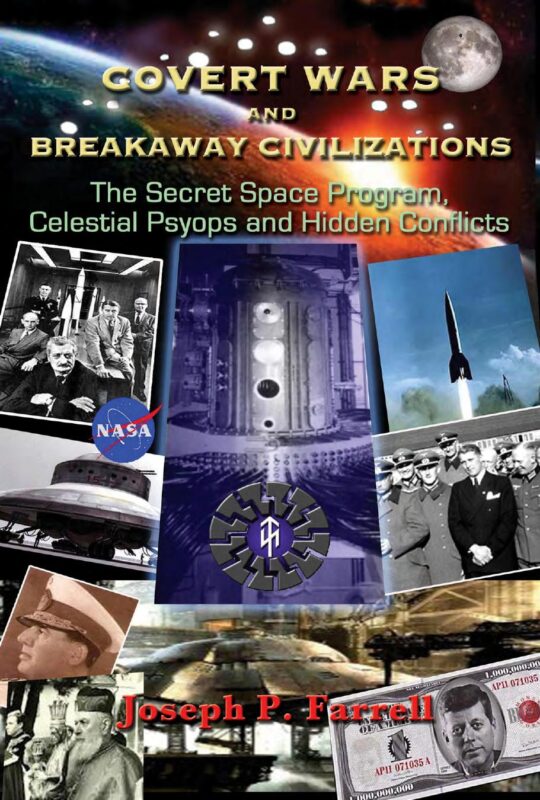
Covert Wars and Breakaway Civilizations by Joseph P. Farrell investigates the hidden architecture of power that emerged from the crucible of World War II, focusing on the formation of secret networks, vast clandestine finance, covert warfare, and advanced technology. Farrell traces the inception of a “breakaway civilization,” a term describing an elite infrastructure that harnessed state resources and illicit activities to pursue dominance beyond public oversight. As the war ended, the convergence of Nazi, American, and Japanese elites produced a durable, multinational structure whose goals, methods, and financial machinery set the template for decades of shadow governance, black projects, and secret space initiatives.
The Birth of a Breakaway Civilization
World War II produced more than a military and geopolitical transformation. It forged relationships that incubated the culture, technology, and financial strategies of an enduring covert apparatus. Allied and Axis intelligence services, industrialists, and financial oligarchs negotiated and aligned through secret pacts and asset transfers, using the chaos of defeat and victory to embed networks that persisted into the Cold War. Farrell identifies Operation Paperclip as one axis of this evolution: the transfer of Nazi scientists, engineers, and their associated technologies into American and British programs expanded the technical reach of the new order. Simultaneously, covert agreements facilitated the laundering of Nazi assets through Western banks, with the aim of establishing both a hidden financial reservoir and a means of ongoing leverage. These networks did not dissolve at war’s end—they institutionalized, generating the conditions for continuous covert operations, financial manipulation, and technological acceleration.
Covert Finance: Counterfeiting, Looting, and Global Fraud
The machinery of a breakaway civilization requires independent, off-the-books financing. Farrell details the mechanisms by which covert elites secured and expanded their financial power. He cites Nazi Germany’s Operation Bernhard, an industrial-scale counterfeiting operation targeting British currency, as a template for postwar illicit finance. When the war ended, the looting of Europe by Nazis and the systematic pillage of Asia by Imperial Japan (notably through operations like Yamashita’s Gold) supplied further reservoirs of bullion, art, and other hard assets. American agencies, leveraging the instability of the postwar environment, assimilated these assets into a new system of covert finance.
The narrative reveals that postwar intelligence, corporate, and criminal syndicates sustained hidden operations through a combination of black budgets, bearer bonds scandals, and securities fraud. Elite banking institutions, operating in concert with intelligence agencies, enabled the creation of fraudulent instruments and offshore vehicles to move and multiply funds. This finance system grew to a scale rivaling public budgets, underwriting technological black projects, covert military actions, and global influence operations.
The Strategic Imperative: Technology, Space, and Full Spectrum Dominance
From its inception, the breakaway civilization faced dual imperatives: contain and surpass the Soviet bloc, and confront the mystery—and potential threat—posed by unidentified flying objects (UFOs). Farrell demonstrates that the intersection of terrestrial geopolitics and extraterrestrial phenomena catalyzed unprecedented technological acceleration. The U.S. and its allies, driven by Cold War anxieties and the shock of atomic weapons, prioritized the creation of reconnaissance platforms, spy satellites, and deep space probes. These technologies served both strategic intelligence needs and the imperative to monitor and, if possible, match the capabilities displayed by UFOs observed near military and nuclear installations.
The emergence of advanced aerospace programs—often concealed within corporate and military-industrial structures—expanded the operational reach of the covert order. Black projects flourished. The intelligence and defense bureaucracies institutionalized secrecy, forging a culture in which plausible deniability, perception management, and technological supremacy became inseparable from strategic planning.
Weaponization of Nature: Earthquakes, Weather, and Psychological Operations
As the technological base of the breakaway civilization grew, its architects explored weaponizing natural forces to achieve strategic objectives without attribution. Farrell reviews evidence for projects aimed at controlling weather patterns, steering hurricanes, and generating earthquakes—tools capable of mass destruction while preserving the ability to disclaim responsibility. The doctrine of full spectrum dominance guided research into both geophysical and psychological warfare. Technologies were developed to alter brain function, erase memories, and manipulate populations, all within the framework of plausible deniability. The integration of these tools into military and intelligence planning transformed the landscape of covert war.
Factional Structure and Internal Instability
The breakaway civilization, Farrell argues, does not operate as a monolith. Its architecture consists of intersecting factions with distinct but overlapping interests: financial oligarchs, intelligence and covert operations elites, international fascist remnants, Japanese aristocratic and criminal networks, and military-industrial technocrats. These groups collaborate and compete, sometimes merging for shared objectives, at other times splintering over turf and strategic vision.
The financial component, anchored by Western central and prime banks, interfaces with the public world while maintaining black channels for covert transactions. Intelligence and military agencies direct operations, leveraging clandestine funding for influence and innovation. Criminal syndicates, both Western and Asian, provide logistical muscle and facilitate the flow of illicit assets. Corporate research and aerospace conglomerates execute black projects, shielded by secrecy and protected by national security prerogatives.
This polycentric, segmented structure resembles a multinational mafia, with capos negotiating power and territory, and alliances shifting in response to internal and external threats. The real power, however, resides with those who control technological innovation, as mastery over advanced systems can recalibrate the balance of influence within the network.
Deep Events and the Engineering of Perception
Farrell identifies “deep events”—assassinations, financial scandals, false flag operations, and persistent cover-ups—as both fingerprints and products of the breakaway civilization. These events, systematically managed through deception, suppression, and media manipulation, shape public reality and maintain the operational autonomy of the covert order. Perception management becomes as strategic as technological superiority. The culture of plausible deniability, institutionalized through directives like NSC 10/2, enables covert operators to wage war, manipulate economies, and orchestrate psychological operations with near-total impunity.
The UFO Phenomenon: Catalyst and Pretext
The book places the UFO phenomenon at the center of the breakaway civilization’s logic. Reports of unidentified craft near nuclear facilities and military installations drove the intelligence and defense communities to treat UFOs as both a potential threat and an opportunity for technological advancement. The imperative to understand, emulate, or defend against non-terrestrial technology justified black budgets, secret research, and global surveillance infrastructure. As UFO activity remained persistent, the breakaway civilization institutionalized a “containment and engagement” paradigm, applying Cold War doctrines of rollback and dominance to this new domain. This focus on UFOs fed the development of advanced weaponry and reinforced the imperative for secrecy and control.
Covert Wars: Global Reach and Methods
The operational reach of the breakaway civilization extends across conventional and unconventional domains. Farrell chronicles covert wars waged through proxies, psychological operations, economic sabotage, and direct action—both on Earth and, by implication, beyond. Operations range from postwar manipulation of elections (such as the Italian election of 1948, funded by Axis assets) to the management of terrorism, narco-trafficking, and the orchestration of “deep events” that recalibrate the balance of power or enable strategic shifts. The apparatus thrives on instability, exploiting crises to expand its autonomy, absorb resources, and shape future conflicts.
The Persistence of Corruption and the Challenge to Democracy
The system Farrell describes does not merely exploit existing corruption; it generates and sustains a culture in which secrecy, financial fraud, and the manipulation of legal and political processes become structural features. The existence of an enormous, hidden system of finance creates incentives for participants to perpetuate and defend the breakaway civilization, regardless of external threats or public policy. This structural dynamic erodes democratic governance, as decision-making migrates from elected representatives to unaccountable networks of intelligence, finance, and corporate power.
Future Horizons: Technology, Power, and Human Destiny
Farrell’s investigation points to a future shaped by the convergence of hidden finance, advanced technology, and autonomous power networks. The breakaway civilization, by capturing the engines of innovation and sequestering resources, positions itself as an emergent global actor with capabilities beyond the reach of public institutions. The boundaries between state and non-state, terrestrial and extraterrestrial, legal and illegal, blur within this framework. As technology accelerates and the imperatives of dominance persist, the structural tensions within the network—competing factions, divergent goals, and the inherent instability of covert finance—foreshadow both internal conflict and ongoing expansion of covert influence.
The observable pattern reveals a durable, evolving order that shapes global events from behind the veil, driven by imperatives that transcend conventional politics or national boundaries. Farrell’s synthesis compels readers to ask: what possibilities emerge as covert power, advanced technology, and untraceable finance converge within a self-sustaining breakaway civilization? The answer defines the stakes for the future of governance, knowledge, and freedom.