The Power of Ritual in Prehistory: Secret Societies and the Origins of Social Complexity
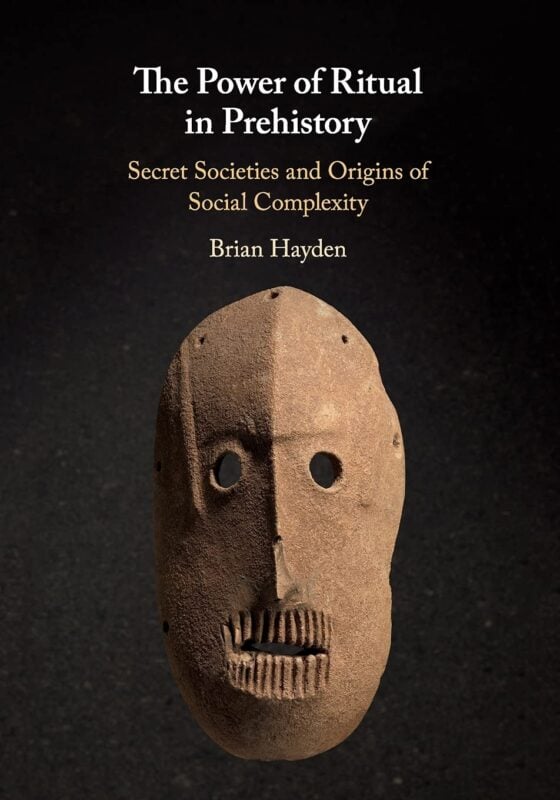
The Power of Ritual in Prehistory: Secret Societies and the Origins of Social Complexity by Brian Hayden examines how hidden networks of ritual specialists shaped the earliest systems of political authority and economic hierarchy. Drawing on archaeological evidence from the Americas, Africa, and Oceania, Hayden demonstrates that secret societies operated as engines of social transformation. They organized rituals, controlled surplus wealth, and monopolized access to supernatural knowledge. Through these mechanisms, they institutionalized power and created the foundations for chiefdoms, states, and organized religions.
The Archaeologist Behind the Theory
Brian Hayden, Professor Emeritus at Simon Fraser University and a Fellow of the Royal Society of Canada, brings decades of fieldwork and comparative research to this study. His excavations in British Columbia, Mesoamerica, and Southeast Asia inform a model of cultural evolution driven by aggrandizers—individuals who used ritual performance to gain influence. He situates secret societies at the core of this process, arguing that their leaders harnessed spectacle, fear, and supernatural claims to secure material and political dominance.
Ritual as the Architecture of Power
Ritual, in Hayden’s analysis, was not a communal act of devotion but a strategic performance that restructured society. Initiates entered through ordeals that tested loyalty and capacity for obedience. Fees, gifts, and offerings created economic dependencies. Leaders staged dramatic ceremonies in specialized structures illuminated by firelight and masked display. The illusion of spirit possession and resurrection transformed human control into divine mandate. Archaeological parallels appear in the specialized architecture of the Northwest Coast’s Hamatsa lodges, the subterranean kivas of the American Southwest, and the monumental sanctuaries of Göbekli Tepe in southeastern Turkey.
The Secret as Knowledge and Weapon
The essence of a secret society was not concealment of membership but control over esoteric information. Hayden defines these organizations as ranked sodalities with exclusive initiation paths and guarded doctrines. Knowledge functioned as a resource. Only upper ranks learned the inner cosmology and the operational techniques that claimed to command spirits, weather, and fertility. Possession of this knowledge conferred prestige and practical authority. In many societies, such as the Mende Poro in Sierra Leone or the Suque in Vanuatu, ritual secrets authorized taxation, judicial control, and access to surplus production.
Archaeological Signatures of Hidden Power
Hayden identifies a pattern of material traces that reveal the presence of secret societies in prehistory. Secluded ritual buildings, carved masks, cannibal imagery, and restricted ceremonial spaces mark their activity. At Keatley Creek in British Columbia, small peripheral structures located outside residential clusters suggest exclusive initiation chambers. In Melanesia, men’s houses filled with skulls and ancestral effigies served as centers of ritual authority. Comparable features at Chavín de Huántar in Peru and Göbekli Tepe in Anatolia indicate that these dynamics extended into the earliest monumental complexes. The repetition of architectural secrecy, restricted access, and symbolic terror across continents implies a structural relationship between ritual power and social complexity.
The Political Ecology of Inequality
The book positions secret societies within a framework Hayden calls political ecology—a study of how surplus resources enable domination. When communities began producing more than subsistence required, certain individuals exploited the excess through ritual systems. Secret societies demanded tribute and initiation payments, transforming spiritual obligation into economic hierarchy. The distribution of wealth mirrored access to ritual ranks. Those who could afford advancement gained authority over those who could not. Ritual thus became both the language and the machinery of inequality.
From Shamanism to Institutional Religion
Hayden traces the genealogy of secret societies to shamanic traditions that combined healing, divination, and performance. As populations grew and resources accumulated, these practices evolved into formal organizations with codified ranks and initiation fees. The charismatic shaman gave way to the bureaucratic priest. Through this evolution, supernatural mediation turned into institutional power. Archaeological evidence from Neolithic Europe and the ancient Near East reveals the same trajectory: ritual specialists building monumental sanctuaries, standardizing iconography, and integrating celestial symbolism into political order.
Case Studies Across Continents
Each region Hayden investigates provides a distinct example of how ritual networks structured authority. On the Northwest Coast, the Hamatsa Society dramatized cannibal transformations through possession rituals that reinforced hereditary privilege. In California, the Kuksu cult constructed subterranean dance houses where initiates reenacted mythic cycles. Among the Plains tribes, the Hidatsa Painted Red Stick ceremonies encoded social hierarchy within elaborate ritual choreography. The Ojibway Midewiwin societies used sacred birchbark scrolls and medicine bundles to formalize transmission of spiritual power. In West Africa, the Poro and Egbo societies institutionalized control over trade and justice through ritual oaths and masked enforcement. In Oceania, the Suque rank system tied initiation directly to pig sacrifice and exchange, binding economic production to religious status.
The Evolution of Ritual Economies
Ritual economies, as described in the book, developed where surpluses could sustain non-productive specialists. Hayden details how initiation payments converted agricultural or hunting wealth into symbolic capital. Feasts, gift distributions, and construction of ceremonial houses drew resources into ritual circuits. The ability to stage large-scale ceremonies became a display of both faith and fiscal control. Archaeological layers rich in exotic goods, animal offerings, and prestige items document this process. The economic gravity of ritual drew participants into hierarchies that mirrored political structures.
The Mechanics of Secrecy and Fear
Power within secret societies depended on the orchestration of awe. The combination of darkness, firelight, sound, and masked performance generated psychological submission. Initiates witnessed apparent miracles—members consuming fire, levitating objects, or summoning spirits through ventriloquism and hidden mechanisms. These performances materialized invisible authority. Hayden interprets them as deliberate technologies of persuasion. The fear of supernatural punishment, reinforced by the threat of physical retribution, maintained internal discipline. Societies such as the Poro enforced secrecy through oaths sealed by the threat of death. The theater of terror served governance as effectively as warfare.
Ritual Architecture as Social Blueprint
The spatial organization of ritual structures encoded hierarchy. Entrances, corridors, and hidden chambers created sequences of revelation. Access corresponded to rank. Public plazas accommodated processions, while interior sanctuaries limited participation to the initiated. The monumental pillars at Göbekli Tepe, carved with predatory animals and abstracted human figures, express this graded symbolism. At Chavín de Huántar, the Lanzón sculpture stood in darkness at the center of a labyrinthine temple, accessible only to priests who mediated between deity and populace. Hayden interprets these spaces as physical embodiments of secret society ideology—the control of movement, knowledge, and spectacle as instruments of power.
Ideological Transmission and Legacy
Secret societies, through ritual codification, transmitted cosmological systems that justified hierarchy. Myths of transformation and rebirth mirrored social ascension through ranks. The concept of spiritual power as transferable through initiation provided a theological rationale for inequality. Over time, these structures generated durable institutions. Chiefdoms and early states inherited their ceremonial frameworks, integrating them into temples, priesthoods, and dynastic cults. Hayden argues that world religions emerged from this lineage, carrying forward the logic of controlled access to sacred knowledge.
Methodological Innovation
The study bridges ethnography and archaeology through comparative synthesis. Hayden analyzes early twentieth-century field reports, including Franz Boas’s accounts of the Kwakwaka’wakw Hamatsa, Harley’s descriptions of the Poro in Liberia, and Codrington’s documentation of Melanesian initiation systems. He cross-references these sources with archaeological evidence—architecture, iconography, and spatial patterning—to reconstruct the social logic of secrecy. His approach restores agency to prehistoric ritual specialists by treating them as political actors rather than passive carriers of belief.
The Psychological Dimension of Control
The book incorporates findings from behavioral research to explain leadership behavior within secret societies. Studies by Paul Piff and others on entitlement and unethical conduct among affluent individuals align with the tendencies Hayden observes in elite ritual leaders. These individuals display aggression, manipulativeness, and appetite for dominance—traits that, within ritual contexts, translate into charisma and authority. The psychological profile of the aggrandizer becomes a lens for interpreting prehistoric leadership, suggesting that social complexity arose through the systematic exploitation of human ambition.
The Role of Gender and Exclusion
Secret societies often restricted participation by gender, reinforcing male dominance through ritualized separation. Women were excluded from initiation chambers or assigned subordinate ceremonial roles. In some cultures, female parallel societies emerged with their own secret rites, such as the Sande society among the Mende, but their autonomy remained constrained by the overarching male hierarchy. The politics of exclusion extended beyond gender to age and lineage, defining social boundaries through ritual access. Hayden treats these dynamics as deliberate strategies for consolidating power and managing reproduction within hierarchical systems.
Toward an Archaeology of Social Strategy
The Power of Ritual in Prehistory establishes a framework for interpreting ritual evidence as a record of social strategy. Rather than treating religion as an abstract belief system, Hayden reads it as a tool of political economy. The control of sacred performance equated to control of labor and surplus. Ritual knowledge created monopolies of meaning that stabilized inequality. Archaeological interpretation, in this light, becomes an analysis of power relations materialized in architecture, art, and feasting debris.
Implications for Understanding Civilization
The book’s implications extend to the origins of cities, temples, and organized religion. Secret societies provided the structural prototype for institutional governance: ranked membership, initiation rites, taxation through tribute, and ideological legitimation. When their leaders transformed ritual centers into permanent seats of authority, the foundations of civilization emerged. From the feasting halls of the Northwest Coast to the limestone sanctuaries of Anatolia, the same logic governed the ascent of complex society—the orchestration of belief to command obedience.
The Continuing Force of Ritual
Hayden concludes that ritual remains a fundamental human technology of coordination and control. Its prehistoric forms reveal how power first took symbolic shape. The secrecy, spectacle, and economic leverage that defined early ritual organizations persist in modern institutions. Understanding their origins clarifies the deep history of leadership, inequality, and persuasion. The Power of Ritual in Prehistory situates the birth of civilization within the shadows of the ceremonial fire, where human ambition fused with the language of the divine and transformed ritual into the architecture of power.