Hypnotism (1943)
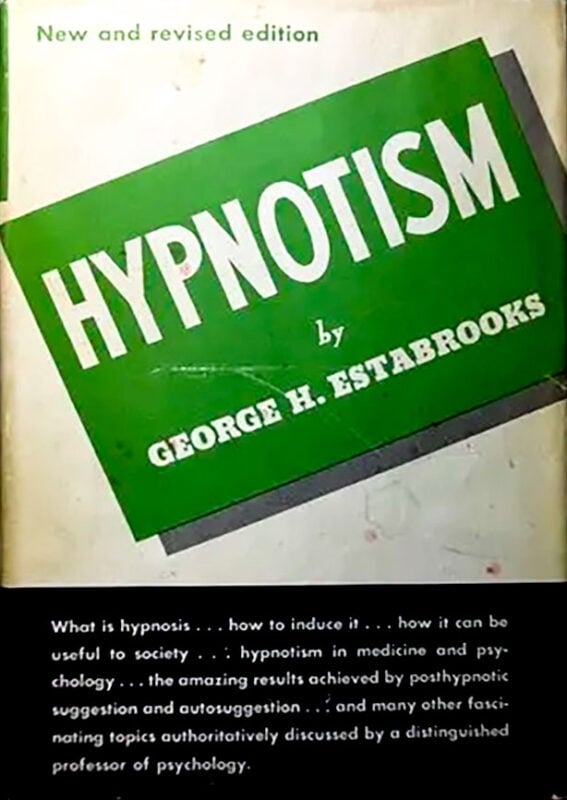
Hypnotism by George Hoben Estabrooks (Rhodes Scholar, 32nd degree Knight Templar Mason) examines the scientific structure, operational psychology, and human consequences of hypnotic control in precise behavioral terms. Estabrooks, a Harvard-trained psychologist and consultant to the U.S. military during the 1940s, positions hypnosis as a reproducible psychological condition built through patterned suggestion, sensory regulation, and layered attention. He presents hypnotism not as occult practice but as a measurable transfer of executive control from the conscious mind to the operator’s directed language. His method unfolds through observation, experiment, and field application, connecting laboratory technique to social influence and state power.
The Structure of Hypnotic Control
Estabrooks defines hypnosis as the deliberate suspension of the subject’s conscious authority. The operator initiates the process through monotone repetition, narrowed focus, and progressive relaxation. This sequence dismantles voluntary control while amplifying responsiveness to verbal suggestion. The hypnotist does not command by strength of personality but by rhythm, timing, and calibrated assertion. Estabrooks describes a precise sequence: eye closure, muscular fixation, motor paralysis, and induced lethargy, each step measured by resistance tests. These tests—locked eyelids, stiffened arms, immobility—chart the subject’s descent into controlled trance. The operator records micro-behaviors such as tremors, facial tone, and breath rhythm to gauge transition between conscious states.
In Estabrooks’ experiments, ninety percent of subjects reached partial hypnotic responsiveness, while only one in five achieved full somnambulism. This distinction between shallow and deep hypnosis establishes his operational hierarchy. The lighter stages permit muscular inhibition and partial amnesia; deeper states allow full sensory substitution and constructed hallucination. Estabrooks treats these gradations as physiological thresholds rather than mystical grades of susceptibility.
The Laboratory Method
He outlines the psychologist’s controlled method: a quiet environment, a reclining subject, and a verbal formula of descent—“deeper and deeper, sound asleep.” The hypnotist repeats this cadence for several minutes before testing muscular response. The procedure functions through predictability. Each repetition narrows the subject’s field of attention, compressing awareness into a single auditory channel. Estabrooks describes the hypnotic subject as “a body directed by borrowed consciousness.” The unconscious mind, once isolated, becomes the receptive medium of instruction. Commands directed to this state—hallucinate, move, forget, obey—activate without reflective judgment. The operator thus engages the neurological mechanism of habit without conscious interference.
The Stage Technique
Estabrooks contrasts the laboratory approach with the stage performer’s accelerated technique. Under bright lights and public pressure, the performer issues rapid, direct imperatives—“clasp your hands, lock them tight, you cannot separate them.” The sudden authority overloads cognitive balance, forcing surrender through confusion. The hypnotist maintains verbal momentum, preventing rational recovery. This creates an artificial crisis in which the subject’s easiest path is compliance. The phenomenon mirrors high-pressure propaganda and crowd psychology. Estabrooks identifies the stage as an experimental field for mass suggestibility, a precursor to the collective trance states exploited in wartime broadcasting and political rallies.
Somnambulism and Constructed Reality
At the depth of somnambulism, suggestion becomes perception. Estabrooks describes how a subject, upon hearing “a black cat sits on the table,” will see, touch, and describe the cat in sensory detail. Vision, hearing, and tactile sense reorganize under linguistic command. He reports cases in which subjects fed imaginary animals, played invisible instruments, or recoiled from imagined heat. These demonstrations prove, he argues, that hypnosis does not simulate belief—it reorders sensory hierarchy. In this state, suggestion dictates the subject’s reality structure. Estabrooks links this phenomenon to the operations of ideology: the hypnotist’s command parallels the propagandist’s slogan, both functioning through substitution of perception rather than persuasion.
Rapport and Exclusive Attention
A central phenomenon in Estabrooks’ framework is rapport—the selective tuning of the subject’s awareness exclusively to the operator’s voice. During trance, external voices lose authority even though the subject continues to hear them. The subject filters the environment, responding only to the operator’s signals. Estabrooks demonstrates that rapport can be transferred by verbal instruction. Control can shift from one operator to another or even from a recorded voice to a live individual. He verifies this by using phonograph recordings of hypnotic inductions that transition authority to an observer mid-session. The experiment proves that rapport operates as a cognitive circuit, not a personal bond.
Suggestion, Memory, and Amnesia
Estabrooks details post-hypnotic suggestion—the delayed execution of commands after awakening. A subject may be told, “Tomorrow at four o’clock you will see a black dog.” At the designated hour, the subject reports the vision without recalling its origin. This capacity to implant temporal triggers demonstrates hypnosis as a tool of behavioral programming. The mechanism relies on dissociation: the command is stored outside conscious recall but activated by environmental cue. Estabrooks interprets this as a temporary division of the self, an induced compartmentalization that science can exploit for therapy or for coercion. He describes clinical uses such as pain control and alcoholism treatment, but he also examines potential military applications.
Hypnosis and the Autonomic System
Estabrooks explores the physiological reach of hypnotic influence. Through controlled suggestion, the hypnotist can alter pulse rate, respiration, and glandular activity. He recounts experiments in which subjects produced gastric secretions in response to imagined food and experienced nausea at the mention of alcohol. He references the work of Liebeault and Pavlovian laboratories that documented involuntary muscular and vascular responses under trance. These findings establish hypnosis as an interface between conscious language and the autonomic nervous system, an operational bridge between mind and physiology.
The Disguised Technique
Beyond voluntary cooperation, Estabrooks describes procedures for inducing hypnosis without the subject’s awareness. The operator frames the process as a harmless psychological test—blood pressure measurement, relaxation exercise, or lie detection—while using standard hypnotic cues. Because the subject perceives the setting as scientific, resistance diminishes. The subject relaxes under authority, opening the same channels of suggestion as formal induction. Estabrooks proposed that intelligence agencies could use this “disguised technique” for interrogation or conditioning, provided ethical oversight. He outlines scenarios involving prisoners of war or criminal suspects where hypnotic suggestion might elicit information concealed by conscious resistance.
Group Hypnosis and Collective Suggestion
Estabrooks experiments with group sessions involving twelve or more participants. He instructs them simultaneously to relax, close their eyes, and follow rhythmic verbal prompts. Though group hypnosis cannot produce deep trance in all participants, it allows the operator to identify highly suggestible individuals for later individual work. Estabrooks notes that mass suggestion functions on similar principles: rhythm, authority, repetition, and emotional contagion. He draws structural parallels between group induction and the rhetorical methods of mass leaders who synchronize emotion through speech cadence and collective focus.
Technology and Hypnotic Mediation
Estabrooks extends hypnotic research into the domain of recorded media. He created a phonograph record capable of inducing trance through pre-recorded suggestion, demonstrating that the hypnotist’s physical presence is unnecessary once rapport is established. He collaborated with the Marietta Apparatus Company to distribute instructional records to laboratories. This mechanization of hypnotic practice anticipated the modern concept of audio therapy. Estabrooks imagines remote hypnotic reinforcement sessions for clinical treatment of alcoholism or speech disorders. He also speculates on future broadcasts of therapeutic suggestions, though he recognizes the logistical and ethical limits of such an experiment.
Ethical Responsibility and Psychological Power
The author frames hypnotism as a scientific tool demanding discipline equal to its power. He rejects theatrical sensationalism and insists on controlled methodology. The danger lies not in the technique itself but in its use without moral supervision. Hypnosis can heal trauma, relieve pain, and correct compulsive behavior, yet the same principles can construct obedience and erase autonomy. Estabrooks therefore situates hypnotism within a broader moral architecture: the science of influence requires the science of restraint. He urges professional oversight by psychologists rather than entertainers or self-proclaimed mystics. The American medical community’s reluctance to adopt hypnotism, he argues, results from this association with performance rather than from scientific limitation.
Hypnosis and Warfare
Estabrooks acknowledges his wartime work applying hypnotic principles to intelligence training. He explores how suggestion can enhance discipline, reduce fear, and compartmentalize memory in agents. His notion of “split personality induction” proposed the possibility of creating controlled amnesia for classified operations, where an operative could perform assigned tasks without conscious recall. Estabrooks treats this as theoretical but experimentally plausible. His commentary foreshadows later Cold War research into psychological conditioning and memory suppression.
The Human Threshold
Throughout the book, Estabrooks insists that hypnotic susceptibility depends on inherent personality structure. Sleep-talkers and natural somnambulists enter trance with ease; hysterics respond strongly; the feebleminded resist. Children between seven and twelve exhibit remarkable responsiveness due to flexible imagination and limited inhibitory control. He categorizes hypnotic readiness as a continuum of openness rather than a deficit of will. The process requires cooperation or at least absence of conflict between operator and subject. Hypnotic resistance arises from anxiety, distrust, or cognitive dissonance, not strength of character.
From Suggestion to Social Order
In its later sections, the book moves beyond clinical description into social psychology. Estabrooks analyzes how governments, advertisers, and religious institutions use hypnotic mechanisms—repetition, rhythm, authority—to direct collective emotion. He interprets wartime propaganda and radio broadcasting through hypnotic structure. The human nervous system, conditioned by routine and repetition, absorbs slogans as post-hypnotic commands. Estabrooks sees in modern mass communication the externalization of hypnotic technique, scaled from the individual trance to the civic audience. He names Hitler as a “master hypnotist of nations,” a phrase intended not as metaphor but as diagnostic classification.
The Continuum of Consciousness
Estabrooks dismantles the binary between waking and hypnotic states. He situates consciousness on a continuum from full alertness through reverie to deep trance. Everyday absorption—reading, driving, daydreaming—shares structural features with hypnosis: narrowed focus, reduced peripheral awareness, and heightened internal imagery. The hypnotist merely formalizes this natural mechanism and directs it with purpose. Through this continuum model, Estabrooks integrates hypnotism into mainstream psychology rather than isolating it as anomaly. The unconscious mind, in his view, remains continuously accessible and programmable under proper conditions.
The Technical Legacy
The final chapters catalogue applications for medicine, education, criminology, and experimental psychology. Estabrooks anticipates therapeutic protocols for pain control, psychosomatic treatment, and habit correction. He advocates university research into hypnotic communication, learning acceleration, and emotional regulation. His manual outlines the ethical standards for hypnotic practice: informed consent, professional training, and record-keeping. He urges that every operator master awakening procedures to ensure subject safety and mental integration after trance.
Closing Reflection
Hypnotism by George Hoben Estabrooks stands as a field manual for the disciplined application of suggestion. It defines hypnosis as an active process of attention management, a systematic redirection of consciousness under verbal control. Through case studies, experiments, and detailed transcripts, Estabrooks constructs a practical science of influence that extends from the clinical couch to the mechanisms of state communication. His language remains empirical, his method replicable, his warnings explicit. Hypnosis, in his account, reveals the architecture of human compliance and the precision with which words can govern the body, the senses, and the will.