A History of Central Banking and the Enslavement of Mankind
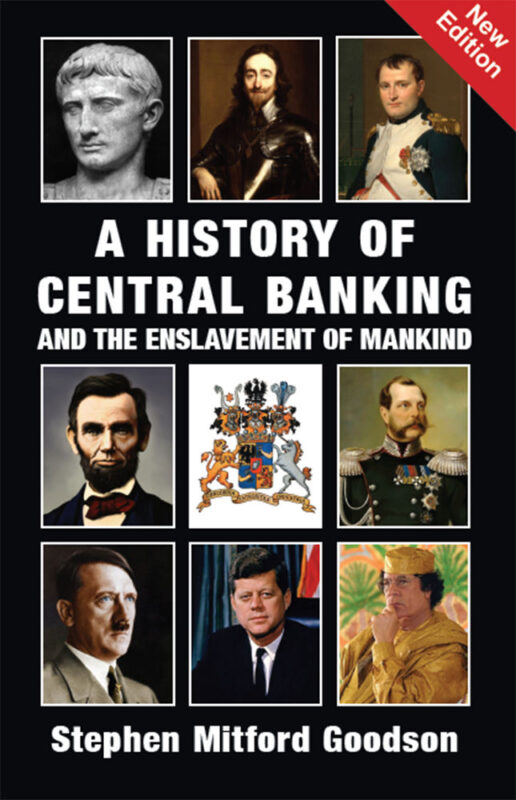
A History of Central Banking and the Enslavement of Mankind by Stephen Mitford Goodson traces the concentration of monetary power from ancient Rome to the present financial order. Goodson, a former director of the South African Reserve Bank, presents a chronological investigation of how debt-based finance replaced sovereign credit and how this transformation shaped empires, revolutions, and wars. The book argues that the control of money creation by private interests has been the central engine of political subjugation, economic inequality, and recurring global conflict.
The Roman Precedent of Usury and Collapse
Goodson begins in 753 BC with the foundation of Rome and the introduction of copper ingots as a state-issued means of exchange. This early monetary system, rooted in law rather than metal value, produced centuries of stability and civic order. The conversion to silver coinage in 267 BC, minted by patrician elites, altered the relationship between state, people, and credit. Interest-bearing debt became an instrument of domination. Peasants lost land to moneylenders, agricultural output declined, and the Republic fell into oligarchic control. Julius Caesar’s brief reform of 49–44 BC reintroduced public money, reduced interest, and abolished debt slavery. His assassination ended these reforms and restored financial oligarchy. By 27 BC, with the adoption of the gold standard, scarcity of coinage induced deflation and imperial decay. The accumulation of gold by the Church and elites halted circulation, impoverishing citizens. By 476 AD, a monetary collapse had hollowed the Empire. The Roman experience, Goodson insists, revealed a permanent law of history: when private interests monopolize money, civilizations disintegrate.
The English Transformation of Sovereignty into Debt
The narrative moves to England’s monetary evolution under the Anglo-Saxons. King Offa of Mercia in the eighth century minted sterling silver coins and prohibited usury. Later monarchs from Alfred to Edward the Confessor reinforced the moral and legal ban on interest. Goodson describes the Norman Conquest of 1066 as the entry point of organized moneylending into England. Jewish financiers from Rouen, rewarded by William I, charged annual rates of 33 percent on noble lands and 300 percent on collateralized tools. Within two generations, a quarter of English land was mortgaged to moneylenders. The Magna Carta of 1215 attempted to cancel these debts. In 1290, Edward I expelled the Jewish financiers and outlawed usury, replacing private credit with tally sticks—wooden instruments of state-issued, interest-free money. This system financed government for nearly five centuries, funding cathedrals, public works, and trade without inflation or taxation crises. Laborers worked about fourteen weeks per year, wages held purchasing power, and England experienced what Goodson calls “the golden Middle Ages.”
Cromwell, the Bankers, and the English Civil War
The stability ended in the seventeenth century. Expelled financiers from Spain and Portugal, now based in Amsterdam, sought to reenter England. Oliver Cromwell’s alliance with Jewish merchants during the English Civil War facilitated their return in 1656. Goodson cites correspondence between Cromwell and Jewish leaders negotiating financial aid in exchange for readmission. The execution of King Charles I in 1649, framed as a political act, is presented as the decisive break with sovereign finance. Under Charles II and James II, private minting rights and free export of bullion eroded royal control over money. In 1688, William of Orange’s invasion—financed by Amsterdam bankers—installed a government amenable to financial restructuring.
The Birth of the Bank of England
On 27 July 1694, Parliament approved a bill authorizing the creation of the Bank of England. Its capital of £1.2 million, subscribed by private investors, granted the right to issue notes far beyond its gold reserves. The Bank lent money to the Crown at eight percent interest, inaugurating the national debt. Taxes on land, trade, and consumption funded the interest payments. Goodson identifies this as the institutionalization of debt slavery. Within two years, the Bank had issued £1.75 million in notes backed by only two percent gold. The War of the Spanish Succession pushed the national debt to £30 million by 1720. Subsequent wars—against the American colonies, Napoleonic France, and others—expanded it exponentially. By 1815, Britain owed £885 million. William Cobbett described the result as “starvation in the midst of abundance.” The debt structure entrenched permanent taxation, speculative finance, and elite control of policy.
Napoleon’s State Banking Revolution
Goodson turns to Napoléon Bonaparte as the archetype of sovereign financial reform. After seizing power in 1799, Napoléon founded the Banque de France in January 1800 as a state-supervised institution issuing credit for productive enterprise. He prohibited government borrowing for current expenditure and defined agriculture as the foundation of the economy. Industry served domestic needs; trade existed to distribute surplus production. The Bank, capitalized at thirty million francs, issued stable currency and supported infrastructure. Napoléon’s principle—that money serves the nation, not speculators—threatened British and Rothschild banking power. Following his defeat at Waterloo, the system was dismantled and France returned to debt finance.
The Nineteenth-Century Expansion of Debt Power
The pattern spread globally. In the United States, the struggle between state banking and central banking defined the republic’s first century. Presidents Jefferson, Jackson, and later Lincoln fought to maintain sovereign money. Jackson closed the Second Bank of the United States in 1836, declaring that “the bold effort the present bank had made to control the government... are but premonitions of the fate that awaits the American people should they be deluded into a perpetuation of this institution.” Lincoln issued Greenbacks during the Civil War—interest-free government notes that financed victory. After his assassination, private banking regained control. In Russia, the state bank established by Alexander II supported industrialization until the Bolshevik Revolution, which Goodson characterizes as another banker-backed seizure of monetary power. By the late nineteenth century, British capital dominated global trade, and wars functioned as debt engines feeding the City of London.
The Federal Reserve and the Twentieth-Century Debt Empire
The establishment of the U.S. Federal Reserve in 1913 formalized private control of money creation in America. Goodson traces the drafting of the Federal Reserve Act to Jekyll Island meetings of bankers including Paul Warburg and representatives of J.P. Morgan and Rockefeller interests. The Federal Reserve’s structure—twelve regional banks owned by private institutions—enabled the creation of money through lending rather than public issuance. The First World War followed months later, financed by bonds underwritten by the same banks. The war debt transformed the United States from creditor to debtor to its own banking system. The interwar years introduced the Bank for International Settlements in Basel, which Goodson calls the “central bank of central banks.” He interprets the Great Depression as a deliberate contraction of credit to consolidate power.
State Banking in the Interwar Period
Between 1932 and 1945, several nations experimented with state-controlled credit systems. Germany’s Reichsbank under Hjalmar Schacht issued debt-free money tied to labor and production, achieving full employment by 1936. Italy’s Istituto per la Ricostruzione Industriale and Japan’s Yokohama Specie Bank financed internal development under similar principles. These systems withdrew from international debt markets, which Goodson argues provoked military confrontation. The destruction of Germany, Italy, and Japan in World War II restored global dominance to the private banking order. After 1945, the Bretton Woods institutions—the International Monetary Fund and World Bank—extended this model globally, conditioning loans on structural debt repayment.
Modern Examples of Public Banking
Goodson identifies several surviving examples of sovereign banking. The Bank of North Dakota, founded in 1919, remains state-owned and profitable, financing local development without federal dependence. The Guernsey model of interest-free credit, established in 1816 to build public infrastructure, demonstrates the viability of money issued directly by government. Libya’s central bank under Muammar Gaddafi issued dinars free of debt, funded housing and education, and proposed a pan-African gold-backed currency. Goodson attributes NATO’s 2011 intervention to the financial threat posed by Libya’s independent monetary system.
The Banking Crisis and the Great Depression of the 21st Century
The 2007–2008 global financial crisis represents the culmination of fractional-reserve instability. Derivatives and mortgage-backed securities multiplied credit far beyond underlying assets. When defaults cascaded, central banks bailed out private institutions with taxpayer funds, deepening public debt. Goodson describes this as the deliberate perpetuation of the same system inaugurated in 1694. The concentration of wealth accelerated, productive economies stagnated, and real wages declined. He warns that this trajectory mirrors the terminal phase of Rome: currency debasement, elite hoarding, and mass impoverishment.
The Thesis of Monetary Sovereignty
Across its eight chapters, the book asserts that monetary sovereignty determines political freedom. Control over money creation defines the power to tax, wage war, and allocate resources. When a state issues its own money debt-free, it commands its destiny. When it borrows from private banks, it forfeits sovereignty. Goodson presents this principle as the recurring pivot of history: Rome’s fall, England’s debt revolution, France’s defeat, and the modern global order follow the same law of monetary control. The solution he offers is explicit: dismantle fractional-reserve banking, nationalize currency issuance, and restore credit as a public utility.
The Contemporary Implication
Goodson’s work positions central banking as the structural core of modern political economy. He views monetary reform not as a policy debate but as a civilizational imperative. The book invites inquiry into the origin of public debt, the moral logic of interest, and the legitimacy of unelected financial institutions. What happens when nations reclaim the right to issue their own currency? What structures of production, equity, and community emerge when money ceases to be a commodity? Goodson closes by asserting that the future of sovereignty depends on answering these questions through action, not theory. The history of central banking, he concludes, is the history of mankind’s struggle to free labor, land, and law from the bondage of debt.