The Great Conspiracy of the House of Morgan Exposed and How to Defeat It
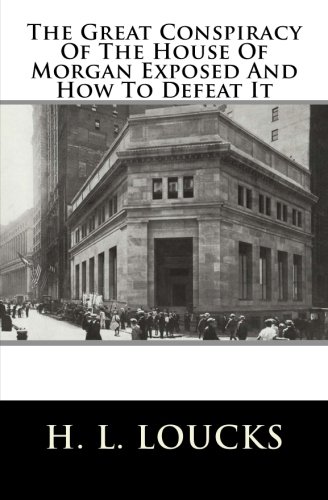
The Great Conspiracy of the House of Morgan Exposed and How to Defeat It by Henry Langford Loucks opens with the author’s conviction that a hidden financial machine—centered on the banking empire of J.P. Morgan & Co.—shapes American agriculture, commerce, and industry. Loucks traces a calculated campaign by Morgan interests to consolidate control over credit, currency, land and labor, an enterprise he identifies as dire for farmers and workers. His book presents a methodical anatomy of how the Morgan‑banking complex harnesses monetary policy, speculative ventures and political alliances to dominate production and profit, and then lays out strategies for how the American farmer and citizen might resist and reclaim independence.
The Morgan Empire and the Machinery of Control
Loucks begins by delineating the institutional architecture underpinning Morgan power. He describes how J. P. Morgan himself and his associates built dominance by buying controlling interests in banks, railroads, telegraphs and industrial corporations. He argues that these acquisitions enabled the Morgan group to determine who received credit and at what cost—and thus who prospered or perished. Loucks explains the mechanism: banks created money by extending credit; Morgan‑owned banks extended credit into agriculture and industry under terms favorable to the borrowers’ creditors rather than the borrowers themselves. He emphasizes how Morgan banking interests influenced the national currency question, dictating circulation and contraction of money so as to press farmers into debt while enabling speculative buyers to profit.
Agriculture, Credit and Monetary Policy
A core focus lies on how the U.S. farm sector gets caught in the mechanism. Loucks tracks the cycle: farmers borrow seed money early in the season; harvest comes; they sell at market—often after prices fall—and then must borrow again to repay. Meanwhile, Morgan‑controlled banks and brokerage houses extend credit only to those producers the bankers deem safe, and may call in loans when crop‑prices falter. Loucks points out that the national currency system—controlled by banking interests through the specie‑standard, currency contraction and centralised clearing—favours concentration of wealth. He asserts that farmers find themselves locked into a system where credit comes with heavy interest, collateral requirements favour the large holder, and the small farmer faces dispossession. He presents data and anecdotes on foreclosures, land transfers and the rise of tenant‑farming as direct outcomes of Morgan influence.
Political Alliances and the Financial Oligarchy
Loucks then shifts to the political dimension. He identifies how Morgan capital worked to influence Congress, the Presidency and banking legislation. For example, he notes the role Morgan bankers played in the passage and enforcement of the National Banking Act, the establishment of clearing‑houses and the intermittent contractions of currency in 1893 and 1907. He claims that financial crisis served as a weapon: when markets collapsed, small debt‑holders found themselves at the mercy of larger credit houses which Morgan controlled, enabling those houses to pick up assets on the cheap. Political power, in Loucks’s view, legitimised the banking oligarchy and made regulatory relief unlikely. He shows how farm organisations, labour movements and populist parties emerged in response—but he also insists that unless they challenge the money‑system itself, they remain vulnerable.
Methods of Resistance: Cooperative Credit and Land Ownership
Loucks does not simply catalogue the problem; he offers remedies that rest on structural change. He argues farmers must form cooperative credit associations, independent of the Morgan banking network, to supply seed‑money, harvesting credit and storage loans. He insists cooperative pools, land‑tenant boards and localised credit systems can shrink dependence on national banking machines. He also advocates that state legislatures enact laws to regulate land leasing, tenancy terms and interest rates so the “money‑trust” cannot gamble with farmer labour. He views land ownership as the bulwark of economic independence: if farmers hold their land free from oppressive mortgages, the Morgan system cannot fully harness them. He calls for education of producers about the credit‐cycle, for unionisation of farmers and for alliances between agriculture and labour.
Currency Reform and a Farmers’ Bank
Loucks next turns to the currency issue: he argues currency must expand with production and must be controlled democratically, not by private banks. He outlines how the Morgan group manipulated the specie‑standard—that is, gold and silver reserves—and the issuance of national bank currency so as to contract money when debt‑levels rose among farmers, forcing sales and bail‑outs. He proposes a “farmers’ bank” free from private banking interests, governed by elected producer‑representatives, issuing credit based on agricultural output rather than speculative collateral. He insists this bank would stabilise prices, reduce interest‐rates and provide long‐term loans adapted to crop‑cycles. In his vision the bank would diminish the capacity of the Morgan banking machine to leverage agricultural credit for profit.
Speculation, Trusts and the Industrial Consolidation
Loucks holds that the Morgan group did more than dominate agriculture: it extended its power into industrial trusts, railroads and raw materials. He describes mergers engineered by Morgan associates, pooling of stocks, cross‑directorships and interlocking boards that reduced competition and enabled price‐fixing and debt leverage across sectors. The prairie farmer, according to Loucks, may feel distant from the steel‑trust but feels the effect: higher freight‑rates for grain, higher equipment cost and fewer buyers for farm produce. Loucks argues that once industrial credit rests in the same network as agricultural credit, the entire national economy functions to enrich the financial oligarchy rather than support free producers.
Crisis, Foreclosure and the Cycle of Debt
In detailing the mechanics of foreclosure Loucks charts a cycle: price‑drops → bank calls → sale of assets → concentration of land → tenancy and wage‑labour. He points to the 1893 Panic and subsequent years when currency contraction forced farmers to borrow at high rates, and when banks foreclosed lands just as crop prices bottomed. Farmers who held independent land and credit, Loucks suggests, were better buffered. He highlights specific states—Dakota Territory, Minnesota and Nebraska—as examples where farm foreclosure soared, co‑ops and local banks fought back, and where legislative reforms made modest headway. Loucks presents detailed figures: mortgage growth, farm‐sales volumes, the rise of tenant acreage—and he interprets these numbers as indicators of systemic capture by the Morgan network.
Education, Organised Action and the Farmers’ Alliance
Loucks emphasises that farmers carry responsibility for collective action. He situates the Farmers’ Alliance and the People’s Party as historical examples of producers organising to defend credit rights, but he insists that unless such alliances challenge the money‐power directly they cannot win. He prescribes educational campaigns in rural communities, cooperative newspapers, local training on credit laws and land reform, and electoral campaigns aimed at credit regulation and public banks. Loucks presents steps: hold town‑hall meetings, craft state bills to charter farmers’ banks, elect sympathetic legislators, and form local cooperative boards tied across states. He shows how the political wing of agriculture failed to gain traction in the 1890s because it treated its symptom (high interest) rather than its root (private banking control).
Legacy and Relevance to Contemporary Readers
Although published in 1916, Loucks’s argument resonates for readers interested in the history of banking power and agricultural economy. He offers both a historical case study of how one financial network captured regional agriculture and a blueprint for alternative credit systems anchored in producers’ interests. He names individuals—J.P. Morgan, Thomas F. Ryan, Charles E. Mitchell—and institutions—Morgan banks, national clearing‑houses, agriculture credit associations—so the narrative remains anchored in real actors. He also calls on farmers to refuse the financial role of farm‑mortgage debtors and to build their own networks of credit and ownership. His vision treats the money‐system as a terrain of struggle rather than passive background.
Why This Book Matters
Readers seeking to understand the intersection of banking power, agriculture, and political economy will find in Loucks’s work a detailed exposé: he illuminates how private banking can extend beyond the mere provision of credit into the regulation of economic life. He urges those affected—farmers and labourers—to reshape credit and land institutions so as to wrest autonomy from financial monopolies. His prescriptions champion collective ownership of credit, democratic governance of banks and the alignment of capital with production rather than speculation. For historians, economists and producers alike the book offers concrete lessons: credit terms matter, who controls currency matters, land tenure matters, and organised action can reshape the game. The Great Conspiracy of the House of Morgan Exposed and How to Defeat It stands as a call to comprehend power and to act on it.